Frequently Asked Questions
Q: What does it mean when the verse says 'And the Lord spoke to Moshe, saying'?
A: This phrase appears frequently in the Torah to introduce divine commandments or instructions given to Moshe (Moses). According to Rashi, this wording emphasizes that Moshe received these words directly from Hashem (God) to transmit to Bnei Yisrael (the Children of Israel). It shows the authenticity and divine origin of the commandments.
Q: Why does the Torah repeat 'saying' after 'spoke'?
A: The double language of 'spoke... saying' (dibber... lemor) teaches us that Moshe was commanded to repeat these words to others - in this case, to Bnei Yisrael. The Talmud (Yoma 4b) explains this as a fundamental principle in Torah transmission: Moshe would hear from Hashem and then 'say' (transmit) the message to the people.
Q: How is this introduction different from other times the Torah says 'Hashem spoke to Moshe'?
A: While the basic formula is similar throughout the Torah, our sages note that sometimes it says 'Vayedaber' (spoke) and other times 'Vayomer' (said). The Midrash (Sifra) explains that 'Vayedaber' implies stronger, more forceful language, often used for commandments and prohibitions, while 'Vayomer' is softer, used for narratives and positive mitzvos.
Q: What can we learn from how Hashem communicated with Moshe?
A: The Rambam teaches in Moreh Nevuchim that this communication model shows us the importance of having a clear, designated prophet to transmit divine will. The consistent phrasing reminds us that Torah comes from Hashem through an unbroken chain of transmission, a fundamental Jewish belief about the authenticity of our tradition.
Q: Why is it important that the Torah specifies it was Moshe who received these words?
A: The Talmud (Sanhedrin 99a) emphasizes that Moshe was the supreme prophet, the only one who spoke to Hashem 'face to face.' By specifying Moshe each time, the Torah reinforces that these laws come through the authorized, reliable channel of prophecy, not through any other means or individual.

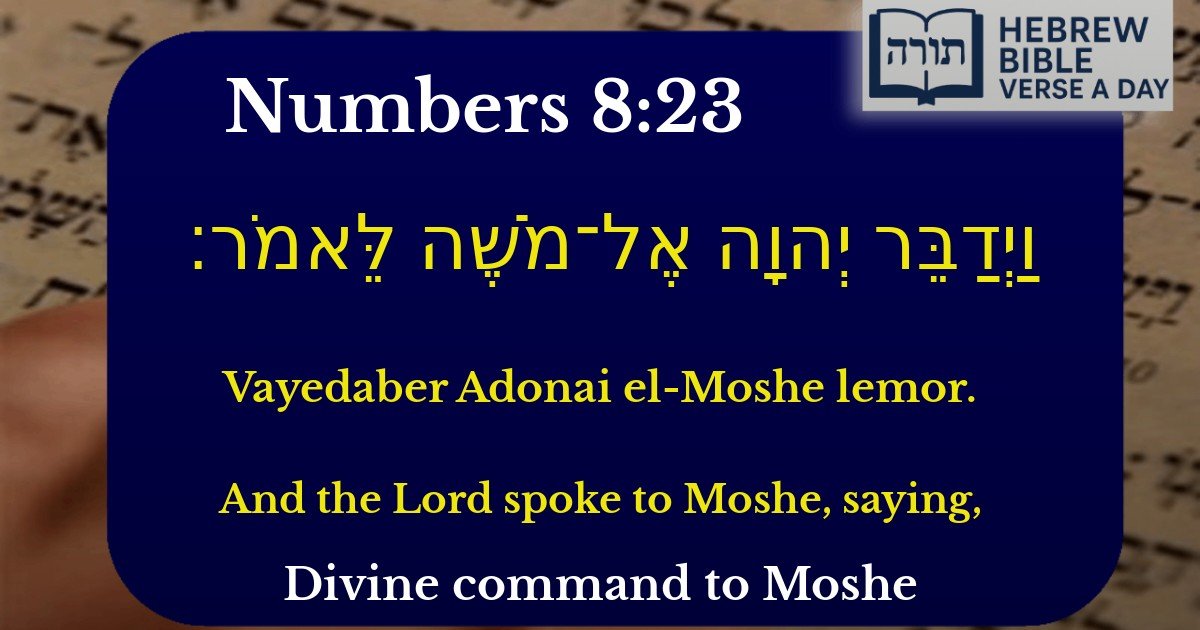

The Divine Communication to Moshe
The verse "וַיְדַבֵּר יְהוָה אֶל־מֹשֶׁה לֵּאמֹר" ("And the Lord spoke to Moshe, saying") appears frequently in the Torah, introducing divine commandments or revelations. Rashi (Shemot 6:2) explains that this phrasing indicates a direct and clear communication from Hashem to Moshe, emphasizing the prophetic clarity unique to Moshe Rabbeinu. Unlike other prophets who received messages through visions or allegories, Moshe heard Hashem's words "פה אל פה" ("mouth to mouth")—with absolute clarity (Bamidbar 12:8).
The Significance of "לֵּאמֹר"
The term "לֵּאמֹר" ("saying") is interpreted by the Midrash (Shemot Rabbah 28:6) as an instruction for Moshe to transmit the divine words exactly as received, without alteration. Rambam (Hilchos Yesodei HaTorah 7:6) elaborates that this underscores the principle of נבואת משה (Moshe's prophecy) being the foundation of Torah transmission, requiring precise repetition to Bnei Yisrael.
Structural Role in the Torah
Ibn Ezra (Shemot 25:1) notes that this phrase often precedes mitzvot, marking a shift from narrative to legal instruction. The Ramban (Bamidbar 1:1) adds that it signifies a new, independent divine utterance, distinguishing it from previous or subsequent communications.