
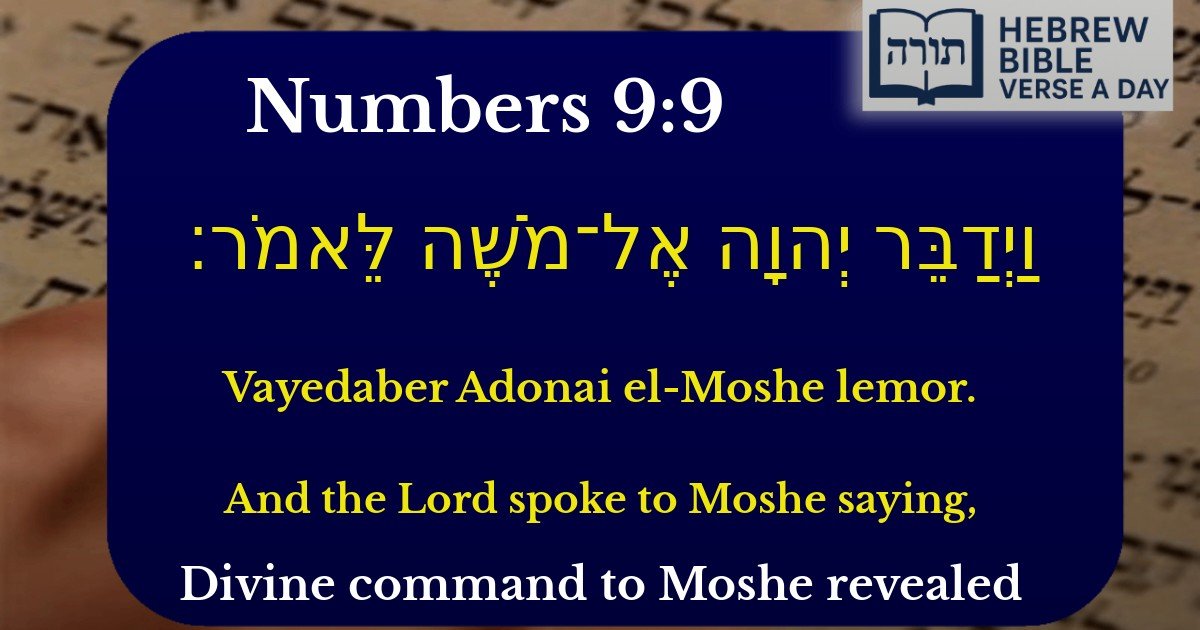

Numbers 9:9 - Divine command to Moshe revealed

Numbers 9:9 - במדבר 9:9

Hebrew Text

וַיְדַבֵּר יְהוָה אֶל־מֹשֶׁה לֵּאמֹר׃

English Translation

And the Lord spoke to Moshe saying,

Transliteration

Vayedaber Adonai el-Moshe lemor.

Hebrew Leining Text

וַיְדַבֵּ֥ר יְהֹוָ֖ה אֶל־מֹשֶׁ֥ה לֵּאמֹֽר׃

🎵 Listen to leining

Parasha Commentary

Introduction to Divine Communication

The phrase "וַיְדַבֵּר יְהוָה אֶל־מֹשֶׁה לֵּאמֹר" ("And the Lord spoke to Moshe saying") appears frequently in the Torah, marking the transmission of divine commandments and teachings. This formulation emphasizes the direct and authoritative nature of Hashem's communication with Moshe Rabbeinu, the greatest of all prophets.

Rashi's Explanation

Rashi (on Shemot 6:2) notes that the term "וַיְדַבֵּר" ("and He spoke") often indicates a harsh or forceful tone, as opposed to "וַיֹּאמֶר" ("and He said"), which is softer. However, in this context, it signifies the clarity and precision of divine instruction. The phrase "לֵּאמֹר" ("saying") suggests that Moshe was to relay these words to Bnei Yisrael, underscoring his role as the intermediary.

Rambam on Prophecy

In Moreh Nevuchim (2:45), the Rambam explains that Moshe's prophecy was unique—Hashem spoke to him "פֶּה אֶל פֶּה" ("mouth to mouth"), with unparalleled clarity (Bamidbar 12:8). This introductory phrase highlights the divine origin of the commandments and Moshe's singular role in transmitting them without alteration.

Talmudic Insight

The Talmud (Yevamot 49b) teaches that all other prophets received messages through visions or allegories, but Moshe heard Hashem's words "בְּאַסְפַּקְלַרְיָא הַמְּאִירָה" ("through a clear lens"). This verse thus serves as a reminder of the Torah's divine authorship and Moshe's unparalleled prophetic stature.

Midrashic Perspective

The Midrash (Shemot Rabbah 28:6) elaborates that every divine communication to Moshe was preceded by a call ("מֹשֶׁה מֹשֶׁה"), demonstrating Hashem's love and direct relationship with him. The phrase "וַיְדַבֵּר יְהוָה אֶל־מֹשֶׁה" reflects this intimate and ongoing dialogue.

Key Themes

  • Divine Authority: The verse affirms the Torah's origin in Hashem's will.
  • Moshe's Unique Role: No other prophet communicated with Hashem as directly.
  • Transmission to Israel: The inclusion of "לֵּאמֹר" emphasizes Moshe's duty to teach the nation.

📚 Talmud Citations

This verse is not quoted in the Talmud.

Frequently Asked Questions

Q: What does it mean when the Torah says 'And the Lord spoke to Moshe saying'?
A: This phrase is a common introduction in the Torah indicating that Hashem is giving a direct commandment or instruction to Moshe (Moses) to transmit to the Jewish people. Rashi explains that this wording emphasizes the divine origin of the commandments and Moshe's role as the faithful transmitter of Hashem's word.
Q: Why does the Torah repeat 'And the Lord spoke to Moshe saying' so many times?
A: The repetition teaches us that each commandment was given separately and with its own importance. The Rambam (Maimonides) explains in his introduction to Mishneh Torah that this phrasing shows that every mitzvah (commandment) was communicated clearly and directly from Hashem to Moshe at Sinai.
Q: What can we learn from the phrase 'And the Lord spoke to Moshe saying'?
A: We learn about the special relationship between Hashem and Moshe, and by extension, between Hashem and the Jewish people. The Midrash (Sifrei) notes that this phrasing shows Moshe's humility - even though he could speak directly with Hashem, he remained the most humble of men (Numbers 12:3).
Q: How is this phrase relevant to us today?
A: This reminds us that the Torah we study and observe today comes directly from Hashem through Moshe. The Talmud (Sanhedrin 99a) teaches that anyone who says the Torah is not from Heaven (i.e., not divine) has no share in the World to Come. This phrase reinforces our belief in Torah MiSinai (Torah from Sinai).
Q: Why does it say 'saying' at the end of the phrase?
A: Rashi explains that the word 'saying' (לֵּאמֹר) means that Moshe was commanded to repeat these words to the Jewish people. The Talmud (Yoma 4b) derives from this that a messenger must faithfully deliver the exact message he was given, teaching us about proper communication and transmission of Torah.