
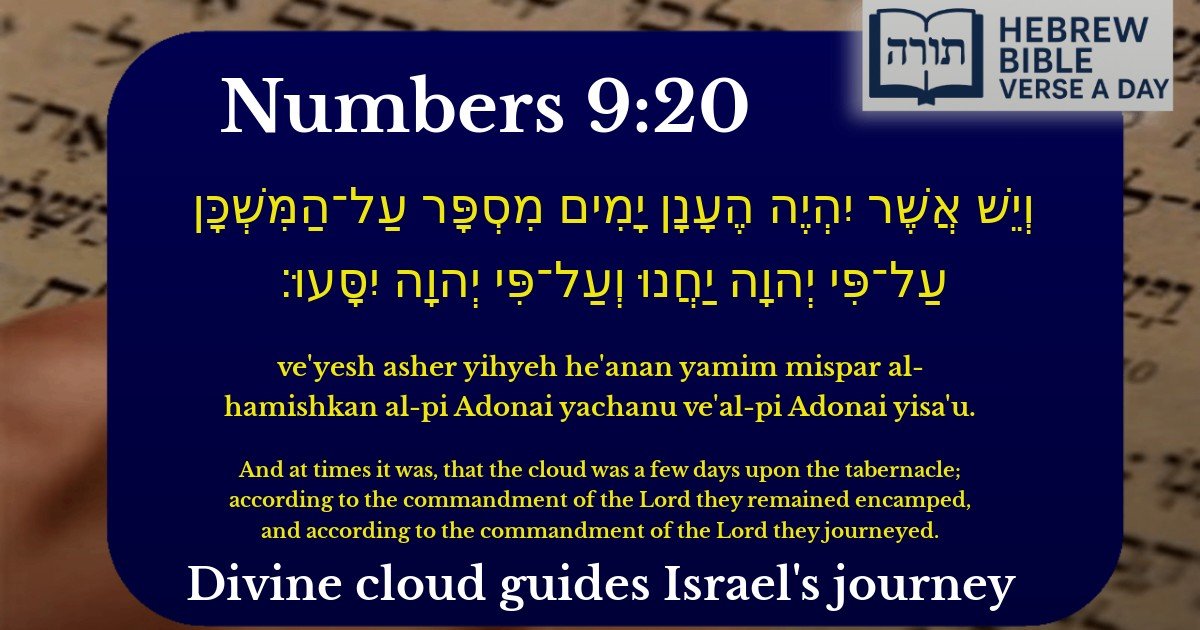

Numbers 9:20 - Divine cloud guides Israel's journey

Numbers 9:20 - במדבר 9:20

Hebrew Text

וְיֵשׁ אֲשֶׁר יִהְיֶה הֶעָנָן יָמִים מִסְפָּר עַל־הַמִּשְׁכָּן עַל־פִּי יְהוָה יַחֲנוּ וְעַל־פִּי יְהוָה יִסָּעוּ׃

English Translation

And at times it was, that the cloud was a few days upon the tabernacle; according to the commandment of the Lord they remained encamped, and according to the commandment of the Lord they journeyed.

Transliteration

Ve'yesh asher yihyeh he'anan yamim mispar al-hamishkan al-pi Adonai yachanu ve'al-pi Adonai yisa'u.

Hebrew Leining Text

וְיֵ֞שׁ אֲשֶׁ֨ר יִהְיֶ֧ה הֶֽעָנָ֛ן יָמִ֥ים מִסְפָּ֖ר עַל־הַמִּשְׁכָּ֑ן עַל־פִּ֤י יְהֹוָה֙ יַחֲנ֔וּ וְעַל־פִּ֥י יְהֹוָ֖ה יִסָּֽעוּ׃

🎵 Listen to leining

Parasha Commentary

Overview of the Verse

The verse (Bamidbar 9:20) describes the divine guidance of the Israelites in the wilderness through the Anan HaKavod (Cloud of Glory), which rested upon the Mishkan (Tabernacle). The duration of the cloud's presence determined whether Bnei Yisrael would encamp or journey, following Hashem's command.

Rashi's Commentary

Rashi explains that the phrase "וְיֵשׁ אֲשֶׁר יִהְיֶה הֶעָנָן יָמִים מִסְפָּר" ("And at times it was, that the cloud was a few days") teaches that the cloud did not follow a fixed schedule—sometimes it lingered for only two days, while other times it remained for extended periods. This emphasizes complete submission to divine will, as the Israelites had no predictability in their travels.

Rambam's Perspective

In Moreh Nevuchim (3:50), Rambam discusses the miraculous nature of the cloud, highlighting it as a visible sign of Hashem's presence guiding the nation. The cloud's movements were not natural but entirely directed by divine providence, reinforcing the idea that the Mishkan was the focal point of spiritual leadership.

Midrashic Insights

  • Midrash Tanchuma (Bamidbar 12): The cloud's varying durations symbolize the need for patience and trust in Hashem's timing. Just as the Israelites waited without knowing when they would move, we too must accept divine decrees without question.
  • Bamidbar Rabbah (1:2): The phrase "עַל־פִּי יְהוָה" ("according to the commandment of the Lord") underscores that every movement was a direct response to divine instruction, not human initiative.

Halachic Implications

The Sforno notes that this verse establishes a model for Jewish life: just as the Israelites followed the cloud unquestioningly, we must align our actions with Torah and halachah, accepting that divine wisdom supersedes human understanding.

📚 Talmud Citations

This verse is not quoted in the Talmud.

Frequently Asked Questions

Q: What does Numbers 9:20 mean about the cloud over the Tabernacle?
A: Numbers 9:20 describes how the Divine Cloud (ענן הכבוד) would rest over the Mishkan (Tabernacle) for varying lengths of time. According to Rashi, this teaches that the Israelites only journeyed or camped based on Hashem's direct command through the movement of this cloud, showing complete submission to Divine will.
Q: Why was the cloud important for the Israelites in the desert?
A: The cloud served as a visible sign of Hashem's presence (Shechinah) and guidance. The Rambam explains (Moreh Nevuchim 3:50) that this supernatural phenomenon gave the nation clear direction, removing any doubt about when to travel or stay. It was both a protective covering (as per Midrash Tanchuma) and a navigation system.
Q: What lesson can we learn from the cloud's movement in Numbers 9:20?
A: The Talmud (Yoma 38a) derives from this verse that all our movements should be for the sake of Heaven. Just as the Israelites followed Divine timing - sometimes waiting 'days' (ימים מספר) without complaint - we must learn to align our schedules with spiritual priorities rather than personal convenience.
Q: How does the concept of 'על־פי ה' (by Hashem's command) apply today?
A: While we no longer have the visible cloud, the Sforno explains that we must seek Divine guidance through Torah study and consulting righteous scholars. The principle remains: major life decisions about where to live, work, or travel should align with Torah values and halachic considerations, not just practical concerns.
Q: Why does the verse mention both camping and traveling?
A: The Midrash (Bamidbar Rabbah 1:2) teaches that both states - rest (חנייה) and movement (נסיעה) - are equally holy when done according to Hashem's will. Sometimes spiritual growth comes from stability in one place (like prolonged Torah study), and sometimes from transitions (like moving to a Jewish community).