
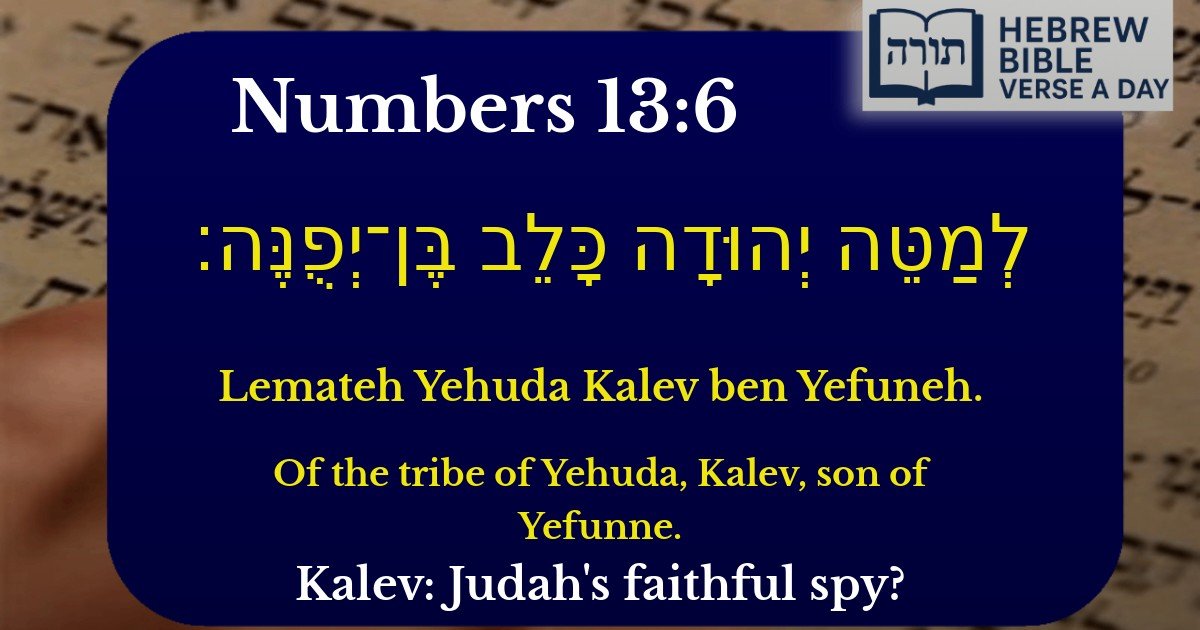

Numbers 13:6 - Kalev: Judah's faithful spy?

Numbers 13:6 - במדבר 13:6

Hebrew Text

לְמַטֵּה יְהוּדָה כָּלֵב בֶּן־יְפֻנֶּה׃

English Translation

Of the tribe of Yehuda, Kalev, son of Yefunne.

Transliteration

Lemateh Yehuda Kalev ben Yefuneh.

Hebrew Leining Text

לְמַטֵּ֣ה יְהוּדָ֔ה כָּלֵ֖ב בֶּן־יְפֻנֶּֽה׃

🎵 Listen to leining

Parasha Commentary

Kalev ben Yefunne from the Tribe of Yehuda

The verse (Bamidbar 13:6) lists Kalev ben Yefunne as the representative of the tribe of Yehuda among the twelve spies sent to scout Eretz Yisrael. This seemingly simple identification carries deep significance in Orthodox Jewish tradition.

Kalev's Unique Character

  • Exceptional Faith: Rashi (Bamidbar 13:6) notes that Kalev was singled out for special mention because he would later stand against the other spies' negative report (Bamidbar 14:24). His name "Kalev" (כָּלֵב) is interpreted as "wholehearted" (כָּל לֵב), indicating his complete devotion to Hashem.
  • Connection to Yehuda: The Midrash (Bamidbar Rabbah 16:1) highlights that Kalev's association with Yehuda foreshadowed his kingly qualities, as Yehuda was the royal tribe. This explains his leadership in opposing the spies' rebellion.

The Significance of "Ben Yefunne"

Ramban (Bamidbar 13:6) explains that the unusual patronymic "ben Yefunne" (rather than the more common "ben Kenaz") teaches that Kalev was biologically the son of Kenaz but was called "son of Yefunne" because Yefunne was his mother. This emphasizes the importance of his maternal lineage in shaping his righteous character.

Kalev's Reward

The Talmud (Sotah 34b) teaches that because Kalev separated himself from the spies' evil counsel, he merited inheriting Chevron (Yehoshua 14:13-14). This fulfilled the divine promise (Bamidbar 14:24) that he would enter the Land and his descendants would possess it.

📚 Talmud Citations

This verse is not quoted in the Talmud.

Frequently Asked Questions

Q: Who was Kalev (Caleb) in the Torah?
A: Kalev (Caleb) was one of the twelve spies sent by Moshe (Moses) to scout the Land of Israel. He was from the tribe of Yehuda (Judah) and was known for his great faith in Hashem. Unlike the other spies (except Yehoshua/Joshua), he brought back a positive report and trusted that G-d would help Bnei Yisrael conquer the land (Numbers 13-14).
Q: Why is Kalev called 'ben Yefunne' (son of Yefunne)?
A: Rashi explains that 'Yefunne' comes from the root 'panah' (to turn), indicating that Kalev 'turned away' from the evil counsel of the other spies. The Midrash also suggests that 'Yefunne' hints at his clear vision and understanding, as he remained faithful to Hashem's promise despite the others' doubts (Rashi on Numbers 13:6; Midrash Tanchuma).
Q: What special merit did Kalev have?
A: Kalev was rewarded for his faithfulness. While the other spies died in the plague, Kalev and Yehoshua were spared and later entered the Land of Israel. The Talmud (Sotah 34b) also teaches that Kalev went to pray at the graves of the Avot (Patriarchs) in Chevron to strengthen himself against the spies' negative influence.
Q: Why is the tribe of Yehuda (Judah) mentioned with Kalev?
A: The tribe of Yehuda was known for leadership and strength. By mentioning Kalev's lineage, the Torah highlights that he embodied these traits spiritually—standing firm in his faith when others faltered. Rambam teaches that true courage is staying morally strong even when facing opposition (Mishneh Torah, Hilchot De'ot 1:5-6).