

Join Our Newsletter To Be Informed When New Videos Are Posted
Hebrew Text
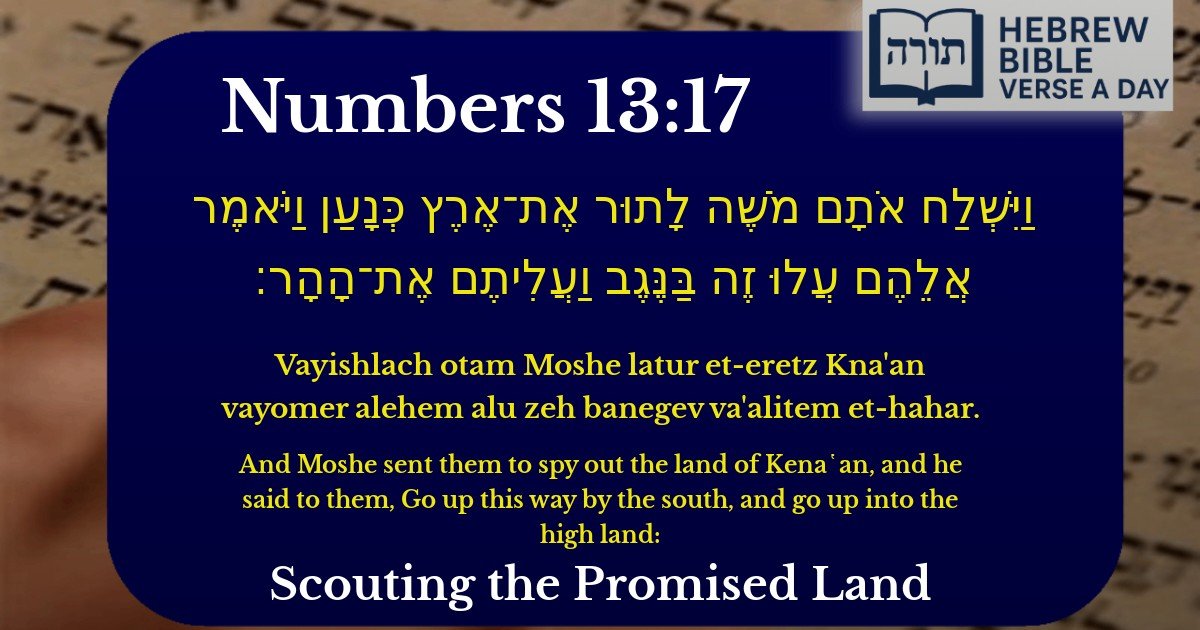
וַיִּשְׁלַח אֹתָם מֹשֶׁה לָתוּר אֶת־אֶרֶץ כְּנָעַן וַיֹּאמֶר אֲלֵהֶם עֲלוּ זֶה בַּנֶּגֶב וַעֲלִיתֶם אֶת־הָהָר׃
English Translation
And Moshe sent them to spy out the land of Kena῾an, and he said to them, Go up this way by the south, and go up into the high land:
Transliteration
Vayishlach otam Moshe latur et-eretz Kna'an vayomer alehem alu zeh banegev va'alitem et-hahar.
Hebrew Leining Text
וַיִּשְׁלַ֤ח אֹתָם֙ מֹשֶׁ֔ה לָת֖וּר אֶת־אֶ֣רֶץ כְּנָ֑עַן וַיֹּ֣אמֶר אֲלֵהֶ֗ם עֲל֥וּ זֶה֙ בַּנֶּ֔גֶב וַעֲלִיתֶ֖ם אֶת־הָהָֽר׃
🎵 Listen to leining
Parasha Commentary
📚 Talmud Citations
This verse is not quoted in the Talmud.
Context of the Verse
The verse (Bamidbar 13:17) describes Moshe's instructions to the twelve spies before their mission to scout the Land of Canaan. This event is pivotal in the narrative of Bnei Yisrael's journey toward Eretz Yisrael, ultimately leading to the tragic episode of the spies' negative report and the subsequent forty-year delay in entering the land.
Rashi's Explanation
Rashi (Bamidbar 13:17) notes that Moshe gave the spies specific directions—"Go up this way by the south"—because the southern region of Canaan was the most vulnerable and easiest to conquer. He wanted them to see that even the most fortified part of the land could be overcome with Hashem's help. Rashi also highlights that the phrase "וַעֲלִיתֶם אֶת־הָהָר" ("go up into the high land") refers to the mountainous region of Chevron, where the giants and the graves of the Avot (Patriarchs) were located, as a subtle reminder of the merit of the Avot.
Rambam's Perspective
Rambam (in his commentary on the Mishnah, Sanhedrin 1:2) discusses the broader implications of the spies' mission. He explains that Moshe’s directive was meant to assess the land’s agricultural and military conditions, as a practical step before conquest. However, the spies’ failure lay in their lack of faith, as they doubted Hashem’s promise despite witnessing His miracles.
Midrashic Insights
Talmudic Interpretation
The Talmud (Sotah 34b) discusses the spies’ route, noting that Chevron was singled out because it was both a place of great spiritual significance (the burial place of the Avot) and a stronghold of the feared giants. The Talmud emphasizes that the spies should have drawn strength from the presence of the Avot’s graves, recognizing that their merit would ensure success.
Lessons from the Verse
This verse teaches the importance of faith and perspective in fulfilling divine missions. Moshe’s instructions were designed to inspire confidence in Hashem’s promise, but the spies’ inability to internalize this led to disaster. Orthodox Jewish tradition underscores that true success in any endeavor—especially those tied to Eretz Yisrael—requires both practical preparation and unwavering trust in Hashem.