

Join Our Newsletter To Be Informed When New Videos Are Posted
Hebrew Text
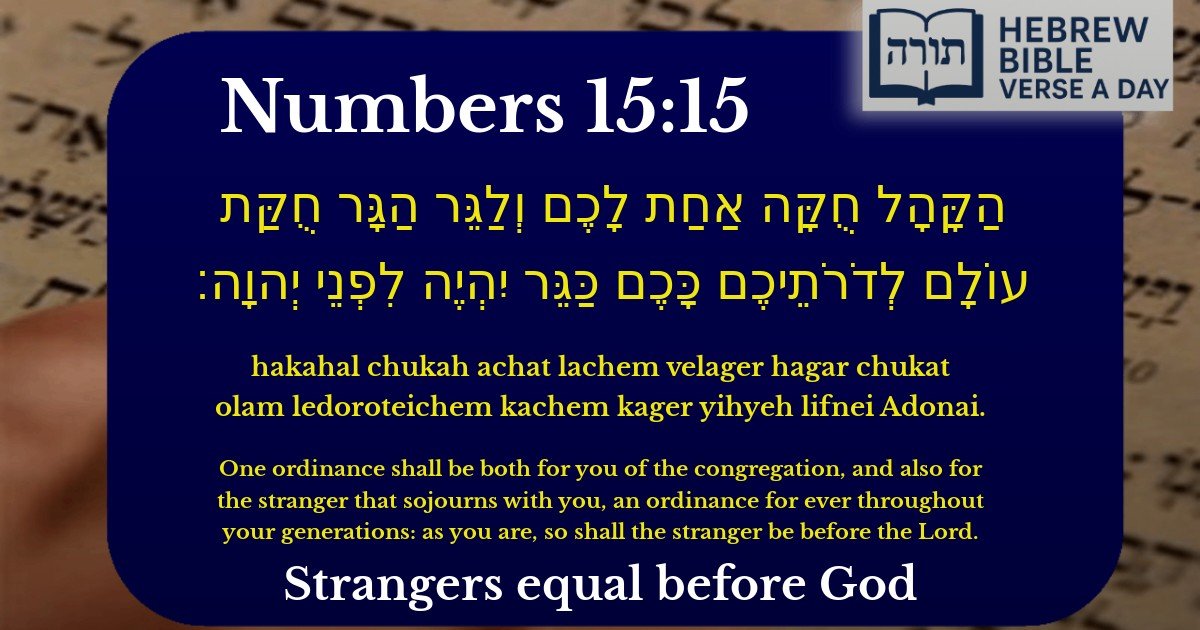
הַקָּהָל חֻקָּה אַחַת לָכֶם וְלַגֵּר הַגָּר חֻקַּת עוֹלָם לְדֹרֹתֵיכֶם כָּכֶם כַּגֵּר יִהְיֶה לִפְנֵי יְהוָה׃
English Translation
One ordinance shall be both for you of the congregation, and also for the stranger that sojourns with you, an ordinance for ever throughout your generations: as you are, so shall the stranger be before the Lord.
Transliteration
Hakahal chukah achat lachem velager hagar chukat olam ledoroteichem kachem kager yihyeh lifnei Adonai.
Hebrew Leining Text
הַקָּהָ֕ל חֻקָּ֥ה אַחַ֛ת לָכֶ֖ם וְלַגֵּ֣ר הַגָּ֑ר חֻקַּ֤ת עוֹלָם֙ לְדֹרֹ֣תֵיכֶ֔ם כָּכֶ֛ם כַּגֵּ֥ר יִהְיֶ֖ה לִפְנֵ֥י יְהֹוָֽה׃
🎵 Listen to leining
Parasha Commentary
📚 Talmud Citations
This verse is not quoted in the Talmud.
Context in the Torah
The verse (Bamidbar 15:15) appears in the context of the laws concerning communal offerings (קרבנות ציבור) and the inclusion of the גר (stranger/convert) in these mitzvot. It emphasizes the equal standing of the convert and the native-born Israelite before Hashem in matters of Divine service.
Rashi's Explanation
Rashi explains that this verse teaches us that the same laws apply to both native-born Jews and converts regarding all matters of Torah and mitzvot. The phrase "ככם כגר" ("as you are, so shall the stranger be") means that just as native-born Israelites are obligated in all mitzvot, so too are converts.
Rambam's Perspective
In Hilchot Issurei Biah (14:4), the Rambam writes that a convert is like a newborn child, with no familial ties to his past, and is considered equal in all respects to a born Jew. This verse serves as the biblical source for this principle.
Talmudic Interpretation
The Talmud (Bava Metzia 59b) derives from this verse that we must not remind a convert of their non-Jewish past, as they are now fully part of the Jewish people. The equal status before Hashem means we must treat converts with the same respect as native-born Jews.
Midrashic Insight
The Sifrei (Bamidbar 15:14) comments that this verse comes to include converts in all positive commandments, just as native-born Israelites are included. The Midrash emphasizes that the convert's status is not secondary in any way.
Halachic Implications
Philosophical Meaning
The phrase "לפני ה'" teaches that in the most essential spiritual relationship - standing before Hashem - there is absolutely no difference between a convert and a born Jew. This reflects the Torah's view that Jewish identity is fundamentally spiritual rather than ethnic.