Frequently Asked Questions
Q: What does 'the first of your dough' refer to in Numbers 15:21?
A: The phrase 'the first of your dough' refers to the mitzvah of 'Challah,' where a portion of dough is separated and given to the Kohen (priest) when baking bread. This is a reminder that our sustenance comes from Hashem, and we acknowledge His blessings by giving a portion back. (Rashi on Numbers 15:21, Rambam Hilchot Bikkurim 5:1)
Q: Why is separating Challah important in Judaism?
A: Separating Challah is important because it fulfills a Torah commandment (Numbers 15:21) and serves as a reminder of the Beit HaMikdash (Temple), where portions of dough were given to the Kohanim. Today, even without the Temple, we separate a small piece of dough and burn it to commemorate this mitzvah. (Shulchan Aruch, Yoreh De'ah 322:5)
Q: How much dough requires separating Challah?
A: According to Halacha (Jewish law), Challah must be separated when kneading dough made from at least 1.666 kg (about 3.67 lbs) of flour. The amount separated is traditionally the size of an olive (k'zayit), though today a small piece is often taken as a symbolic fulfillment. (Rambam Hilchot Bikkurim 6:15, Mishnah Challah 2:7)
Q: What do we do with the separated Challah today?
A: Since we no longer have the Beit HaMikdash or Kohanim in purity, the separated Challah is burned (or wrapped and discarded respectfully) instead of being given to a Kohen. A bracha (blessing) is recited before separating it when the dough meets the required amount. (Shulchan Aruch, Yoreh De'ah 322:4-5)
Q: What lesson can we learn from the mitzvah of Challah?
A: The mitzvah of Challah teaches us gratitude to Hashem for our sustenance and reminds us to prioritize holiness in everyday life—even in something as basic as baking bread. By dedicating the first portion, we acknowledge that all blessings come from Him. (Midrash Tanchuma, Korach 8)

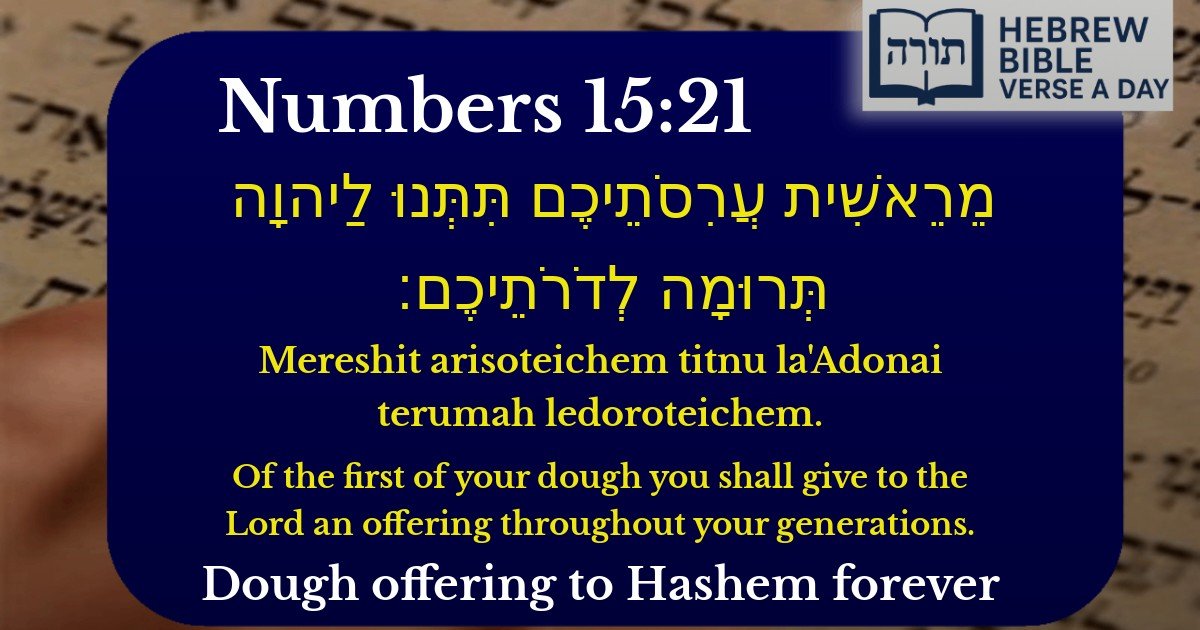

The Mitzvah of Challah
The verse (Bamidbar 15:21) commands the separation of challah from dough as a gift to Hashem. This mitzvah applies specifically when kneading dough from the five species of grain (wheat, barley, spelt, rye, and oats) in Eretz Yisrael (Rambam, Hilchot Bikkurim 5:1).
Rashi's Explanation
Rashi explains that "מֵרֵאשִׁית עֲרִסֹתֵיכֶם" refers to the first portion of the dough that must be separated before any use. The term "עֲרִסֹתֵיכֶם" (your dough) teaches that this obligation applies only to dough owned by Jews (Rashi on Bamidbar 15:21).
Halachic Details from the Talmud
Spiritual Significance
The Midrash (Bamidbar Rabbah 15:12) teaches that separating challah brings blessing to one's home. The act acknowledges that all sustenance comes from Hashem, and by giving the first portion to Him, we merit continued provision.
Contemporary Application
Today, Jewish women traditionally perform this mitzvah when baking bread, reciting the blessing: "ברוך אתה ה'... להפריש חלה" when the dough contains at least 2.6 lbs of flour (Mishnah Berurah 242:15). Many have the custom to use this time for personal prayer.