Frequently Asked Questions
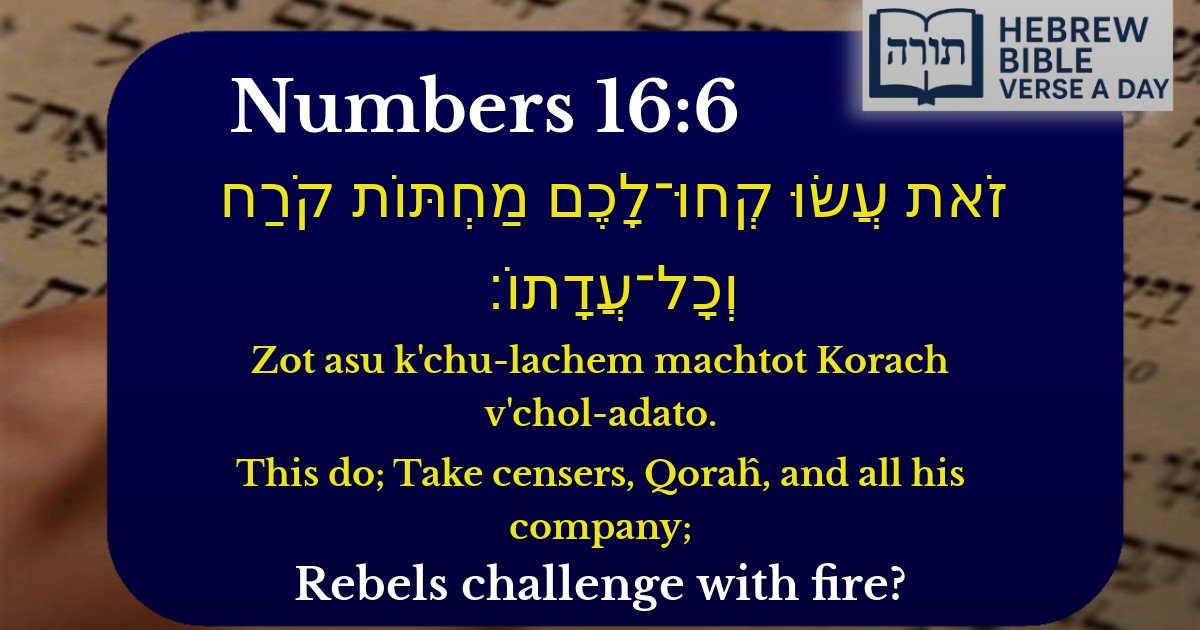
Q: What does Numbers 16:6 mean when it says 'Take censers, Korach, and all his company'?
A: In Numbers 16:6, Moshe instructs Korach and his followers to take fire pans (censers) as part of a test to determine whom Hashem chooses for the priesthood. Rashi explains that this was a way to settle the dispute—since Korach challenged Aharon's position as Kohen Gadol (High Priest), Moshe proposed that they all bring incense offerings, and Hashem would show whose service He accepts (Rashi on Numbers 16:6).
Q: Why did Moshe tell Korach and his group to take censers?
A: Moshe instructed them to take censers to demonstrate that only those chosen by Hashem—specifically Aharon and his descendants—were permitted to perform the sacred service in the Mishkan (Tabernacle). The Ramban explains that incense offerings were a particularly holy and dangerous service (as seen later when unauthorized offerings led to punishment), proving that Korach's rebellion was against divine appointment (Ramban on Numbers 16:6).
Q: What lesson can we learn from Numbers 16:6 about leadership disputes?
A: This verse teaches that leadership roles, especially in spiritual matters, are determined by Hashem, not personal ambition. The Talmud (Yoma 22b) discusses how humility and acceptance of divine will are essential, as Korach's rebellion led to tragedy. Moshe’s response shows that disputes should be resolved through divine guidance, not power struggles.
Q: How does the story of Korach and the censers apply today?
A: The episode reminds us to respect divinely ordained roles, such as rabbinic authority and communal structure. The Midrash (Bamidbar Rabbah 18:3) compares Korach’s rebellion to baseless conflict (machloket shelo l’shem shamayim), warning against undermining legitimate leadership. Today, we apply this by valuing unity and trusting in Torah-based hierarchy.


Context of the Verse
The verse (Bamidbar 16:6) is part of the narrative of Korach's rebellion against Moshe and Aharon. Korach and his followers challenged the leadership and priesthood, claiming that the entire congregation was holy and questioning why Moshe and Aharon elevated themselves above the people. Here, Moshe instructs Korach and his assembly to take censers (fire pans) for an incense offering, which would serve as a test to determine whom Hashem has chosen.
Rashi's Explanation
Rashi (Bamidbar 16:6) explains that Moshe proposed this test because incense offerings were a sacred duty reserved for the Kohanim. By having Korach and his followers bring incense, Moshe was demonstrating that unauthorized individuals who encroach upon the priestly service would face severe consequences. Rashi emphasizes that this was a fair test, as the outcome would be determined by divine intervention.
Rambam's Perspective
Rambam (Hilchos Klei HaMikdash 5:11) discusses the sanctity of the incense service and its exclusive assignment to the Kohanim. He notes that any unauthorized individual who attempts to perform this service violates a severe prohibition. Moshe's instruction here underscores the gravity of Korach's rebellion, as he was effectively testing whether their claims of equal holiness would hold up under divine scrutiny.
Midrashic Insights
Halachic Implications
The Gemara (Yoma 19b) derives from this incident that only Kohanim may perform the incense service in the Mikdash. The tragic outcome of Korach's rebellion serves as a eternal reminder of the dangers of challenging divinely ordained roles and the severe consequences of unauthorized service in the Mishkan or Beis HaMikdash.
Moral Lesson
The Or HaChaim (Bamidbar 16:6) teaches that this episode warns against the sin of machlokes (dispute) and the importance of accepting divinely appointed leadership. Moshe's measured response—offering a fair test rather than immediate punishment—demonstrates the proper way to handle conflict while upholding Torah principles.