
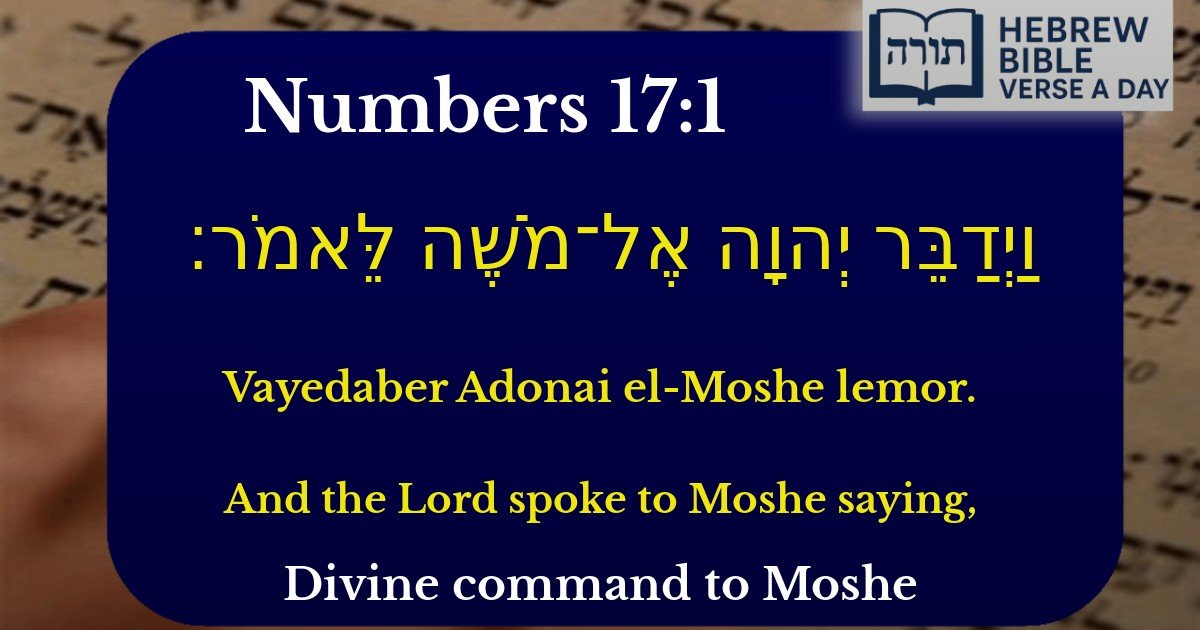

Numbers 17:1 - Divine command to Moshe

Numbers 17:1 - במדבר 17:1

Hebrew Text

וַיְדַבֵּר יְהוָה אֶל־מֹשֶׁה לֵּאמֹר׃

English Translation

And the Lord spoke to Moshe saying,

Transliteration

Vayedaber Adonai el-Moshe lemor.

Hebrew Leining Text

וַיְדַבֵּ֥ר יְהֹוָ֖ה אֶל־מֹשֶׁ֥ה לֵּאמֹֽר׃

🎵 Listen to leining

Parasha Commentary

The Divine Communication to Moshe

The phrase "וַיְדַבֵּר יְהוָה אֶל־מֹשֶׁה לֵּאמֹר" ("And the Lord spoke to Moshe saying") appears frequently in the Torah, introducing divine commandments or revelations. Rashi (on Shemot 6:2) notes that this phrasing emphasizes the direct and clear communication between Hashem and Moshe, distinguishing Moshe's prophecy from that of other prophets, who often received messages through visions or allegories.

The Significance of "לֵּאמֹר" (Saying)

The word "לֵּאמֹר" is interpreted by the Midrash (Shemot Rabbah 28:6) as an instruction for Moshe to relay the divine message to Bnei Yisrael. Rambam (Hilchos Yesodei HaTorah 7:6) explains that Moshe's role as the intermediary was unique—he was commanded to transmit the word of Hashem precisely as he received it, without alteration.

Moshe's Unique Prophetic Status

  • The Talmud (Yevamos 49b) teaches that Moshe's prophecy was unparalleled, as he spoke with Hashem "face to face" (Devarim 34:10), unlike other prophets who received messages in dreams or riddles.
  • Rambam (Moreh Nevuchim 2:35) elaborates that Moshe's clarity of prophecy was a prerequisite for receiving the Torah, ensuring its transmission without error.

The Structure of Divine Commandments

Ibn Ezra (on Shemot 25:1) observes that this introductory phrase often precedes mitzvos, underscoring their divine origin. The Ohr HaChaim (Shemot 25:1) adds that the repetition of this phrasing throughout the Torah serves as a constant reminder of the authority behind the commandments.

📚 Talmud Citations

This verse is quoted in the Talmud.

📖 Yoma 4a
The verse is referenced in a discussion about the communication between God and Moses, particularly in the context of the commandments given in the Torah.
📖 Megillah 31b
This verse is cited in the context of discussing the divine origin of the Torah and the manner in which God communicated with Moses.

Frequently Asked Questions

Q: What does 'And the Lord spoke to Moshe saying' mean in Numbers 17:1?
A: This phrase is a common introduction in the Torah indicating that Hashem is giving a direct commandment or instruction to Moshe (Moses). Rashi explains that this wording emphasizes the divine origin of the mitzvot (commandments) and Moshe's role as the faithful transmitter of Hashem's word to the Jewish people.
Q: Why does the Torah frequently repeat 'And the Lord spoke to Moshe saying'?
A: The Ramban (Nachmanides) teaches that this repetition shows each commandment is equally important and comes directly from Hashem. The Talmud (Sanhedrin 56a) notes that every instance marks a new, distinct communication, not just a continuation of the previous subject.
Q: What can we learn from how Hashem spoke to Moshe?
A: The Midrash (Shemot Rabbah 28:6) teaches that Hashem always spoke to Moshe clearly and directly (באמירה ברורה), showing the special level of Moshe's prophecy. This teaches us about the importance of clear communication when transmitting Torah values to others.
Q: Does 'saying' at the end of the verse have special meaning?
A: Yes, Rashi explains that the word 'saying' (לאמר) means Moshe was commanded to repeat these words exactly to the Jewish people or to specific individuals when applicable. This shows the precision required in transmitting Torah teachings.
Q: How does this verse connect to the events in Numbers 17?
A: This introduction leads to the commandment about Aaron's staff blossoming (Bamidbar 17:16-26). The Sforno explains that by introducing it with 'And Hashem spoke to Moshe,' we understand this miracle was a direct divine response to the rebellion of Korach, confirming Aaron's selection as Kohen Gadol (High Priest).