
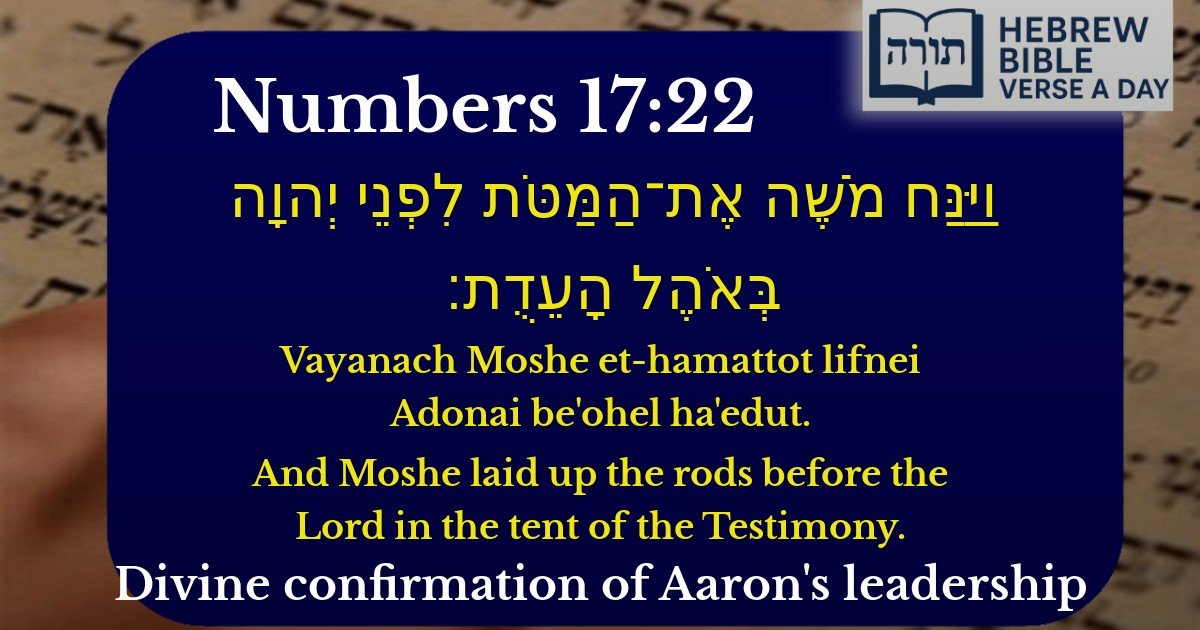

Numbers 17:22 - Divine confirmation of Aaron's leadership

Numbers 17:22 - במדבר 17:22

Hebrew Text

וַיַּנַּח מֹשֶׁה אֶת־הַמַּטֹּת לִפְנֵי יְהוָה בְּאֹהֶל הָעֵדֻת׃

English Translation

And Moshe laid up the rods before the Lord in the tent of the Testimony.

Transliteration

Vayanach Moshe et-hamattot lifnei Adonai be'ohel ha'edut.

Hebrew Leining Text

וַיַּנַּ֥ח מֹשֶׁ֛ה אֶת־הַמַּטֹּ֖ת לִפְנֵ֣י יְהֹוָ֑ה בְּאֹ֖הֶל הָעֵדֻֽת׃

🎵 Listen to leining

Parasha Commentary

Context of the Verse

The verse (Bamidbar 17:22) describes Moshe placing the staffs of the tribal leaders, including Aharon's staff, before Hashem in the Ohel Moed (Tent of Meeting) as part of the test to confirm Aharon's divinely chosen status as Kohen Gadol. This follows Korach's rebellion and the subsequent miraculous blossoming of Aharon's staff.

Rashi's Explanation

Rashi (Bamidbar 17:22) explains that Moshe placed the staffs "before the Ark", as the Aron HaEdut (Ark of Testimony) was located in the Ohel Moed. He emphasizes that this placement was specifically to demonstrate that the selection of Aharon's staff was a divine act, not Moshe's personal decision.

Symbolism of the Staffs

  • Midrash Tanchuma (Korach 10) teaches that the staffs represented each tribe's unique role in Klal Yisrael, with Aharon's almond-blossoming staff symbolizing the swiftness (almonds grow quickly) of divine justice in affirming the priesthood.
  • Ramban (Bamidbar 17:20) adds that the placement before the Ark - containing the Luchos and later Aharon's staff - served as an eternal testimony to the authenticity of the Kehuna.

The Location: Ohel HaEdut

The Malbim notes that the "Tent of Testimony" is referenced here (rather than Mishkan or Ohel Moed) to emphasize that this miracle would stand as permanent testimony against future challenges to the priestly lineage, just as the Luchos testified to the truth of Torah.

Halachic Significance

Rambam (Hilchos Klei HaMikdash 4:13) derives from this episode that the blossoming staff remained near the Ark as a continuous reminder of Aharon's selection, establishing the eternal nature of the priestly covenant.

📚 Talmud Citations

This verse is quoted in the Talmud.

📖 Sanhedrin 17b
The verse is referenced in a discussion about the qualifications for leadership and the significance of the rods in the Tent of Testimony.
📖 Horayot 12a
Mentioned in the context of discussing the procedures and symbols used in the Tent of Testimony, highlighting the role of Moses.

Frequently Asked Questions

Q: What does it mean that Moshe laid the rods before Hashem in the tent of the Testimony?
A: This verse refers to the test Hashem commanded to resolve the dispute between the tribes regarding leadership (Korach's rebellion). Moshe placed the staffs of each tribal leader in the Mishkan (Tabernacle) overnight to see which would miraculously blossom, showing Aharon's divinely chosen status as Kohen Gadol (High Priest). Rashi explains this demonstrated that leadership comes from Hashem's selection, not human argument.
Q: Why was Aharon's staff the only one that blossomed?
A: The miracle of Aharon's staff budding with almonds (as described in the next verses) proved his unique role as Kohen Gadol was divinely ordained. The Midrash (Bamidbar Rabbah 18:23) teaches that almonds symbolize haste - showing Hashem's swift confirmation of Aharon's priesthood to end the dispute.
Q: What is the significance of placing the staffs in the 'tent of Testimony'?
A: The Ohel Moed (Tent of Meeting) was where Hashem's presence dwelled and where Moshe received prophecy. Placing the staffs there showed this was a sacred test under Hashem's direct supervision. The Rambam (Hilchos Klei HaMikdash 1:1) explains this location emphasized that the priesthood connects to Divine service in the holiest space.
Q: How does this story about the staffs apply to us today?
A: This teaches that true leadership in Jewish life must align with Torah principles and divine will, not personal ambition. The Talmud (Yoma 53a) derives from this incident that we shouldn't pursue positions of authority, but accept roles of responsibility when properly called to serve the community's spiritual needs.