Frequently Asked Questions
Q: What does 'keeping the charge of the sanctuary and the altar' mean in Numbers 18:5?
A: This verse refers to the sacred duties assigned to the Kohanim (priests) and Levi'im (Levites) in maintaining the Mishkan (Tabernacle) and later the Beit HaMikdash (Temple). Rashi explains that 'the charge of the sanctuary' includes guarding the holy vessels and maintaining purity, while 'the charge of the altar' refers to proper sacrificial service. These responsibilities were given specifically to prevent divine displeasure.
Q: Why does the verse mention preventing 'wrath upon the children of Israel'?
A: The Ramban teaches that when the Kohanim and Levi'im properly fulfill their sacred duties, it creates a protective spiritual merit for all of Israel. The Talmud (Yoma 26a) notes that negligence in these holy matters could bring consequences, while proper observance maintains divine favor. This reflects the principle that the nation's spiritual leaders bear responsibility for the people's wellbeing.
Q: How does this verse apply today without the Temple?
A: While we lack the physical Temple, the Midrash (Tanchuma Tzav 14) teaches that our synagogues and Torah study maintain aspects of the Temple's sanctity. The Rambam (Hilchot Beit HaBechira 1:1) explains that prayer substitutes for sacrifices. Thus, the principle remains: treating holy spaces and spiritual practices with proper reverence prevents spiritual decline and maintains our connection to Hashem.
Q: What is the significance of the Kohanim and Levi'im having these special responsibilities?
A: The Sforno explains that these tribes were chosen for their unique spiritual qualities. The Kohanim, descended from Aharon, were selected for their devotion to serving Hashem, while the Levi'im demonstrated loyalty during the Golden Calf incident (Exodus 32:26). Their designated roles create a spiritual infrastructure that benefits all Israel, as emphasized in this verse's conclusion about preventing divine wrath.
Q: What practical lesson can we learn from Numbers 18:5?
A: The verse teaches that proper maintenance of holiness requires designated guardianship. Just as the Kohanim guarded the Temple's sanctity, today we must safeguard our synagogues, Torah scrolls, and mitzvah observance. The Kli Yakar adds that this applies personally too - we must 'guard' our own spiritual growth through consistent Torah study and mitzvah performance to maintain divine favor in our lives.


Understanding the Verse in Context
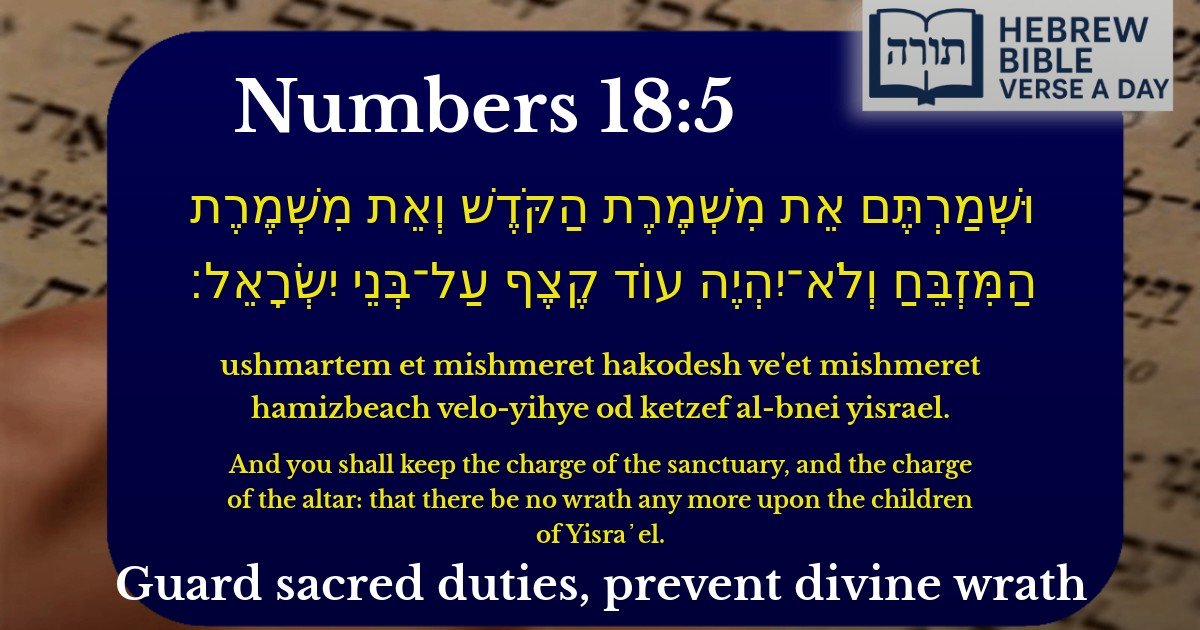
The verse (Bamidbar 18:5) is part of Hashem's instruction to Aharon and the Kohanim regarding their sacred duties in the Mishkan (Tabernacle). The phrase "וּשְׁמַרְתֶּם אֵת מִשְׁמֶרֶת הַקֹּדֶשׁ" ("And you shall keep the charge of the sanctuary") emphasizes the responsibility of the Kohanim to safeguard the sanctity of the Mishkan and its service. Rashi explains that this refers to preventing unauthorized individuals from approaching the sacred areas, as the Kohanim were designated as the sole guardians of the Mishkan's holiness.
The Dual Responsibility: Sanctuary and Altar
The verse mentions two specific charges: "מִשְׁמֶרֶת הַקֹּדֶשׁ" (the charge of the sanctuary) and "מִשְׁמֶרֶת הַמִּזְבֵּחַ" (the charge of the altar). The Ramban elaborates that these represent distinct aspects of the Kohanim's duties:
Preventing Divine Wrath
The verse concludes with the purpose of these safeguards: "וְלֹא־יִהְיֶה עוֹד קֶצֶף עַל־בְּנֵי יִשְׂרָאֵל" ("that there be no wrath any more upon the children of Yisra᾽el"). The Sforno explains that proper adherence to these roles ensures that the Shechinah (Divine Presence) rests peacefully among Bnei Yisrael, averting any divine displeasure. The Talmud (Yoma 26a) connects this to the tragic incident of Nadav and Avihu, whose unauthorized service brought about divine wrath, underscoring the necessity of strict adherence to halachic protocols.
Practical Lessons for All Generations
The Midrash Tanchuma (Korach 12) derives from this verse that the Kohanim serve as protectors of the nation's spiritual well-being. The Kli Yakar adds that this principle extends beyond the Mishkan to all mitzvot—meticulous observance safeguards the Jewish people from harm. Thus, the verse teaches that maintaining kedushah (holiness) in divine service is not merely a ritual duty but a national imperative for divine favor.