

Join Our Newsletter To Be Informed When New Videos Are Posted
Hebrew Text
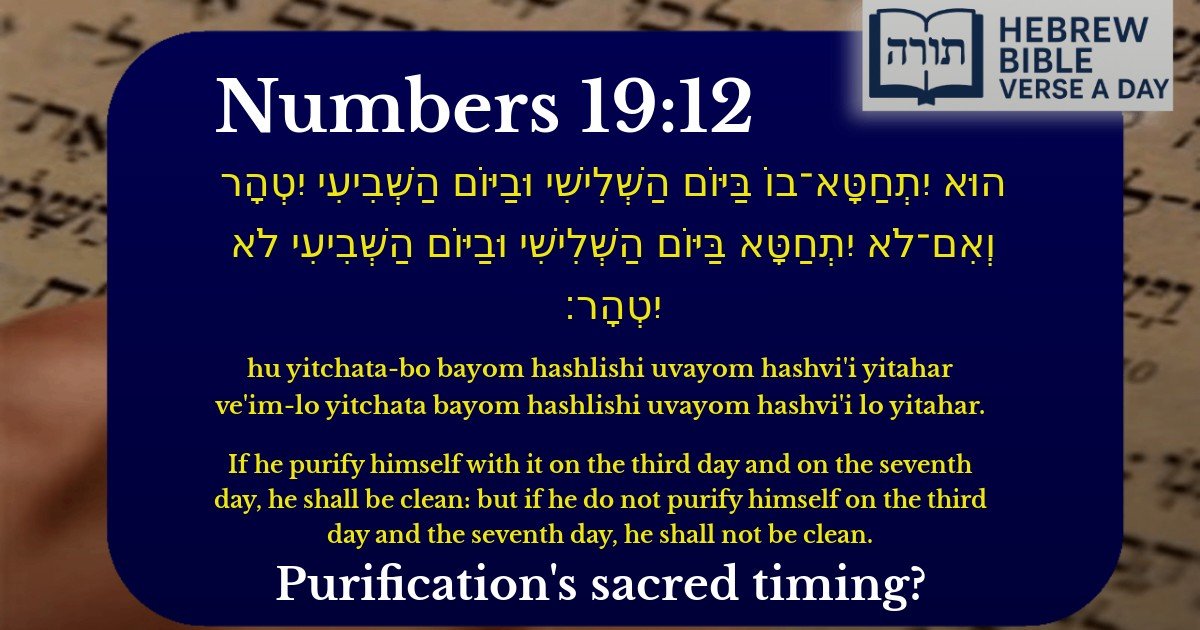
הוּא יִתְחַטָּא־בוֹ בַּיּוֹם הַשְּׁלִישִׁי וּבַיּוֹם הַשְּׁבִיעִי יִטְהָר וְאִם־לֹא יִתְחַטָּא בַּיּוֹם הַשְּׁלִישִׁי וּבַיּוֹם הַשְּׁבִיעִי לֹא יִטְהָר׃
English Translation
If he purify himself with it on the third day and on the seventh day, he shall be clean: but if he do not purify himself on the third day and the seventh day, he shall not be clean.
Transliteration
Hu yitchata-bo bayom hashlishi uvayom hashvi'i yitahar ve'im-lo yitchata bayom hashlishi uvayom hashvi'i lo yitahar.
Hebrew Leining Text
ה֣וּא יִתְחַטָּא־ב֞וֹ בַּיּ֧וֹם הַשְּׁלִישִׁ֛י וּבַיּ֥וֹם הַשְּׁבִיעִ֖י יִטְהָ֑ר וְאִם־לֹ֨א יִתְחַטָּ֜א בַּיּ֧וֹם הַשְּׁלִישִׁ֛י וּבַיּ֥וֹם הַשְּׁבִיעִ֖י לֹ֥א יִטְהָֽר׃
🎵 Listen to leining
Parasha Commentary
📚 Talmud Citations
This verse is quoted in the Talmud.
📖 Yoma 83b
The verse is referenced in the discussion about the purification process and the significance of the third and seventh days in the context of ritual purity.
📖 Niddah 71a
The verse is cited in a discussion about the laws of purification, particularly concerning the timing and requirements for becoming clean.
Context of the Verse
This verse (Bamidbar 19:12) is part of the Torah's discussion regarding the purification process for one who has become impure through contact with a corpse (טומאת מת). The purification involves being sprinkled with water mixed with the ashes of the red heifer (פרה אדומה) on the third and seventh days, followed by immersion in a mikveh.
Rashi's Explanation
Rashi explains that the phrase "he shall be clean" (יִטְהָר) refers to the completion of the purification process. The third day begins the purification, while the seventh day finalizes it. Rashi emphasizes that both sprinklings are essential—if either is omitted, the person remains impure (טמא). This highlights the Torah's precise requirements for achieving taharah (purity).
Rambam's Perspective
In Hilchos Parah Adumah (11:2), the Rambam codifies this law, stating that sprinkling on both the third and seventh days is a Torah obligation (דאורייתא). He further clarifies that if one fails to perform either sprinkling, they must restart the entire process to achieve purity.
Symbolism of the Third and Seventh Days
Halachic Implications
The Talmud (Chullin 122a) derives from this verse that the sprinkling must be performed during daylight hours (ביום), not at night. Additionally, the Sifrei notes that the repetition of "he shall not be clean" underscores the severity of neglecting these steps—impurity remains until both actions are fulfilled.