Frequently Asked Questions
Q: What does Numbers 19:14 mean?
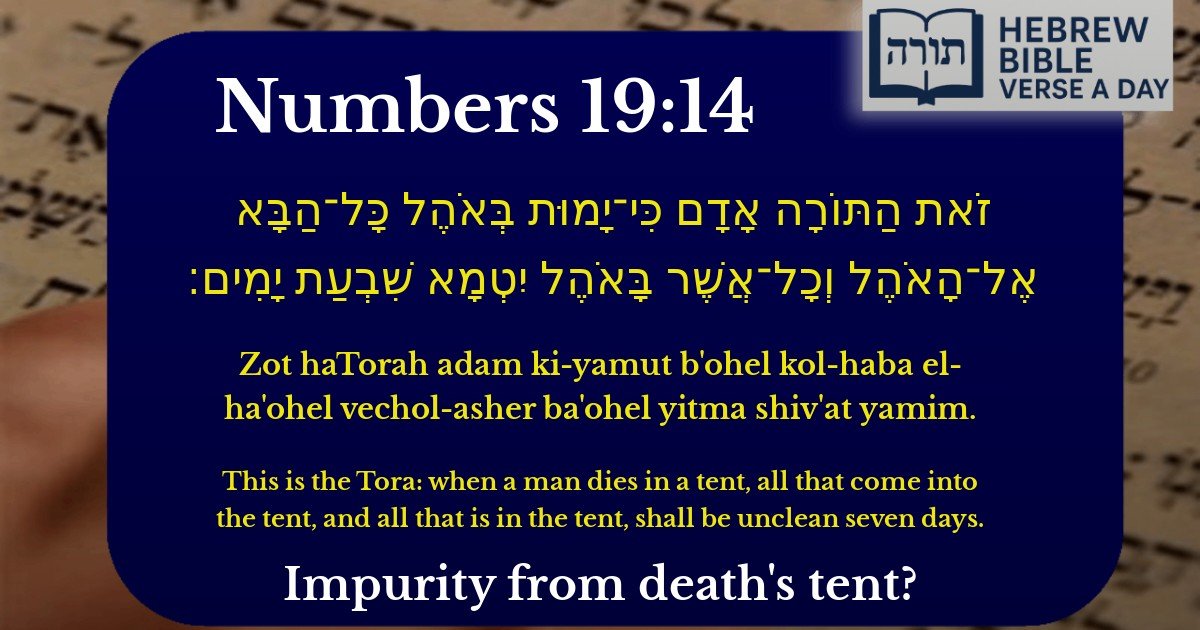
A: Numbers 19:14 discusses the laws of ritual impurity (tum'ah) that occurs when a person comes into contact with a dead body in a tent. According to Orthodox Jewish interpretation, anyone or anything inside the tent becomes ritually impure for seven days. This is part of the Torah's detailed laws about purity and impurity, which were especially relevant for the Mishkan (Tabernacle) and later the Beit HaMikdash (Temple). Rashi explains that this teaches the severity of contact with death, which creates a strong form of tum'ah.
Q: Why is this verse important in Judaism?
A: This verse is important because it establishes key laws of tum'at met (impurity from a dead body), which affect a person's ability to enter the Temple or partake in holy things. The Rambam (Hilchot Tum'at Met) elaborates on these laws, showing their significance in maintaining spiritual purity. Even today, Kohanim (priests) must avoid such impurity, and these laws remain relevant for future Temple service.
Q: How does this law apply today without the Temple?
A: While the Temple is not standing, these laws still have relevance. Kohanim (descendants of Aaron) are still forbidden from coming into contact with dead bodies (except for immediate family) to maintain their ritual purity. Additionally, Orthodox Jews study these laws to prepare for the future rebuilding of the Temple. The Talmud (Sotah 15a) discusses how these concepts remind us of the sanctity of life and the spiritual impact of death.
Q: What can we learn from this verse about Jewish views on purity?
A: This verse teaches that Judaism places great emphasis on spiritual purity, especially in relation to holiness and sacred spaces. The Midrash (Bamidbar Rabbah 19) connects this idea to the concept that Torah study protects a person, just as the tent represents a dwelling of holiness. The seven-day impurity period also mirrors the seven days of mourning (shiva), showing a link between physical and spiritual states.
Q: Does this mean everything in the tent becomes impure, even objects?
A: Yes, according to traditional Jewish law (based on this verse and explained in Mishnah Ohalot), all people and even open vessels or food in the tent contract impurity. However, sealed containers (tzamid patil) can remain pure. Rashi notes that this strict law emphasizes how deeply tum'at met affects a space, reinforcing the need for caution regarding purity in holy matters.


Overview of the Verse
The verse (Bamidbar 19:14) discusses the laws of tum'as meis (impurity from a corpse) and its effect on those who enter a tent where a person has died. According to Halacha, anyone or anything under the same roof as a corpse becomes ritually impure for seven days, requiring purification through the parah adumah (red heifer) process.
Rashi's Explanation
Rashi (Bamidbar 19:14) explains that the phrase "זֹאת הַתּוֹרָה" ("This is the Tora") introduces a fundamental principle regarding impurity from a corpse. He emphasizes that the impurity applies even if one merely enters a tent containing a dead body, without direct contact. The term "אֹהֶל" (tent) is understood broadly to include any enclosed space, as derived from Talmudic interpretation (Nazir 53a).
Halachic Implications
Midrashic Insight
The Midrash (Bamidbar Rabbah 19:11) connects this verse to the idea that Torah study protects against spiritual death. Just as physical death in a tent causes impurity, neglecting Torah leads to spiritual decay. The Sages derive from here that one must immerse in Torah to maintain spiritual purity.
Rambam's Codification
In Hilchos Tum'as Meis (3:1), the Rambam rules that this law applies to any enclosed space, not just tents, reinforcing the Talmudic expansion of the term "אֹהֶל". He also clarifies that partial entry (even just the head) into the space transmits impurity.