Frequently Asked Questions
Q: What is the significance of the well mentioned in Numbers 21:16?
A: The well mentioned in Numbers 21:16 is a miraculous well that provided water for the Israelites in the desert. According to the Midrash (Taanit 9a), this well was created during the six days of Creation and accompanied the Israelites throughout their 40-year journey in the wilderness as a reward for Miriam's righteousness. It symbolizes divine providence and care for the Jewish people.
Q: Why did Hashem tell Moshe to gather the people before giving them water?
A: Rashi explains that gathering the people before giving them water was meant to teach them unity and collective responsibility. By assembling together, they demonstrated that the miracle of the well was for the entire nation, not just individuals. This highlights the importance of communal prayer and shared blessings in Jewish tradition.
Q: How does the well in Numbers 21:16 relate to Jewish teachings today?
A: The well represents Hashem's constant support, even in difficult times (like the desert). The Talmud (Avodah Zarah 5a) teaches that Torah study is compared to water—just as water is essential for life, Torah sustains the Jewish soul. The well reminds us to seek spiritual nourishment through Torah and mitzvot, trusting in divine providence.
Q: What is the connection between Miriam and the well in this verse?
A: The Midrash (Shir HaShirim Rabbah 4:14) states that the well existed in Miriam's merit. When she passed away (Numbers 20:1), the well temporarily disappeared until Moshe prayed for its return. This teaches that righteous individuals can bring blessings to the entire community, and their legacy continues to inspire future generations.
Q: Why is the well called 'Be'er' in this verse?
A: The name 'Be'er' (בְּאֵר) simply means 'well' in Hebrew, emphasizing its literal function. However, the Sages (see Bamidbar Rabbah 19:25) note that it was also called 'the well of the Law,' symbolizing how Torah wisdom flows like water to those who thirst for spiritual growth. The dual meaning reflects physical and divine sustenance.

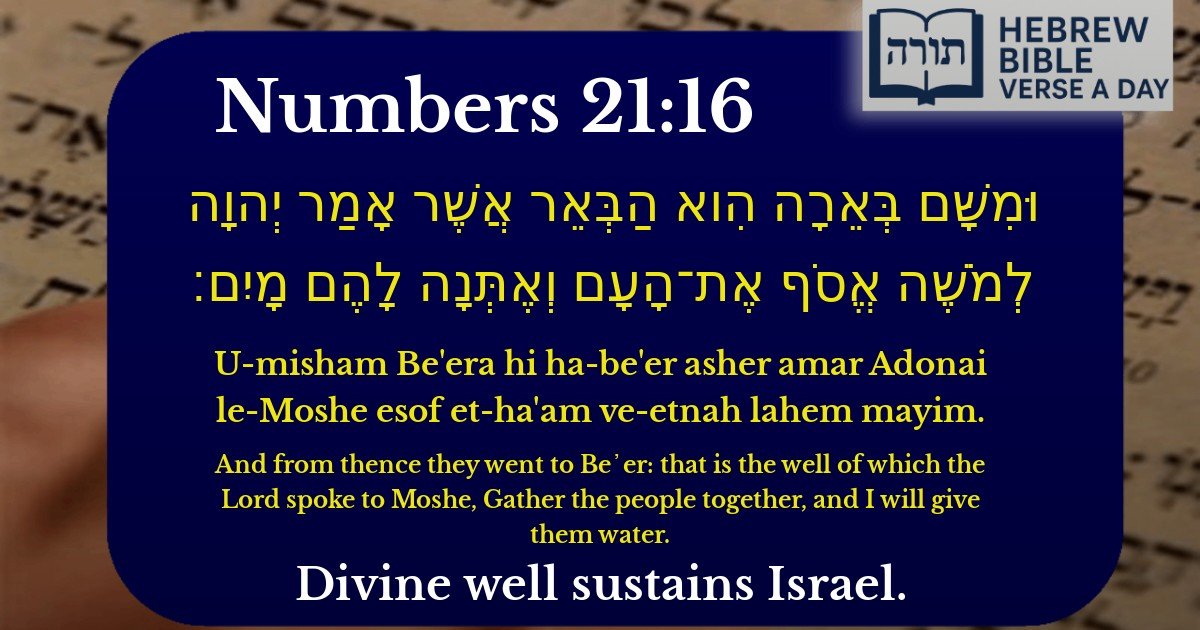

The Well of Be'er in the Wilderness
The verse (Bamidbar 21:16) describes the miraculous well that accompanied Bnei Yisrael in the wilderness, providing them with water. This well is referred to as "Be'er" (the well) and is identified as the same well mentioned earlier in Shemot 17:6, where Hashem instructed Moshe to strike the rock to bring forth water.
Rashi's Commentary
Rashi explains that this well was a constant miracle, traveling with Bnei Yisrael throughout their journeys in the wilderness. He cites the Midrash (Taanit 9a) which states that the well was given in the merit of Miriam, Moshe's sister, and is thus sometimes called "Miriam's Well." When Miriam passed away (Bamidbar 20:1), the well temporarily ceased until Moshe and Aharon prayed for its return.
The Significance of the Well
The Rambam (Moreh Nevuchim 3:32) discusses how this miracle demonstrated Hashem's constant providence over Bnei Yisrael, ensuring their survival in the harsh desert. The well symbolized both physical sustenance and spiritual nourishment, as Torah is often compared to water (see Talmud, Bava Kama 82a).
Midrashic Interpretations
Spiritual Lessons
The Sforno teaches that the mention of this well here emphasizes that even after Miriam's passing, Hashem continued to provide for His people, showing that divine kindness is not dependent on any single individual's merit. The Netziv adds that the phrase "Gather the people" indicates the importance of unity when receiving Hashem's blessings.