Frequently Asked Questions
Q: What does Numbers 21:28 mean?
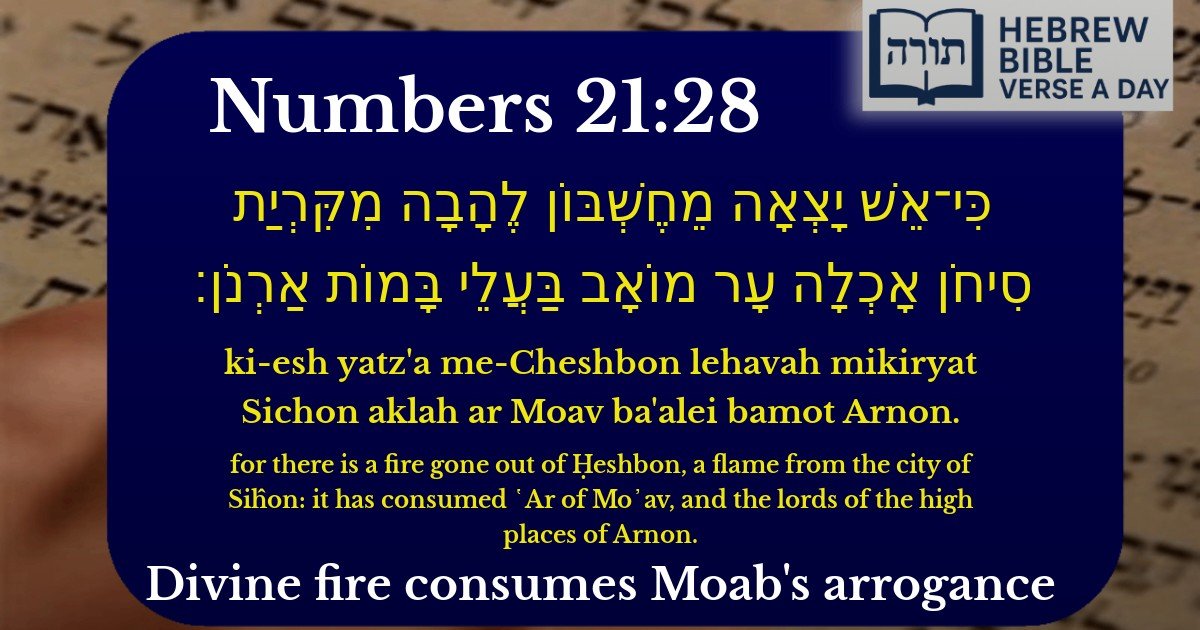
A: Numbers 21:28 describes a metaphorical 'fire' or war that originated from Heshbon, the city of King Sihon, and spread to destroy the Moabite city of Ar and its leaders ('lords of the high places'). According to Rashi, this verse is part of a song celebrating Israel's victory over Sihon, the Amorite king, who had previously conquered parts of Moab. The 'fire' symbolizes the unstoppable force of Israel's advance with Hashem's help.
Q: Why is this verse important in Jewish tradition?
A: This verse is important because it highlights Hashem's role in granting Israel victory over their enemies as they journeyed toward the Promised Land. The Talmud (Bava Batra 78b) references this verse to discuss the power of words (like the 'fire' in the verse) and how they can influence events. It also serves as a reminder of the historical conflicts between Israel and neighboring nations like Moab.
Q: What can we learn from Numbers 21:28 today?
A: We learn that just as Hashem helped Israel overcome obstacles in the past, we can trust in His guidance during challenges today. The Midrash (Bamidbar Rabbah 19:25) connects this verse to the idea that spiritual 'fire'—such as Torah study and mitzvot—can purify and elevate us. Additionally, it teaches that conflicts often have deeper historical roots, as seen in the tensions between Israel and Moab.
Q: Who were the 'lords of the high places of Arnon' mentioned in this verse?
A: The 'lords of the high places of Arnon' refer to the Moabite leaders who controlled the pagan altars (bamot) near the Arnon River. Rashi explains that these were places of idol worship, and their destruction symbolized the downfall of Moab's spiritual and political power. The Arnon River was a significant border between Moab and the Amorites (later conquered by Israel).
Q: How does this verse connect to the broader narrative in Numbers?
A: This verse is part of a larger account (Numbers 21:21-35) where Israel defeats Sihon and Og, two powerful kings blocking their path to Canaan. The Ramban notes that these victories demonstrated Hashem's promise to give Israel the land and fulfilled the prophecy in this poetic verse. It also sets the stage for future interactions with Moab (e.g., the story of Balak and Balaam in later chapters).


Context in Tanach
This verse (Numbers 21:28) appears in the "Song of Heshbon," a poetic passage describing Israel's victory over Sihon, king of the Amorites. The verse metaphorically portrays the military conquest as a consuming fire originating from Heshbon, Sihon's capital, which then spread to Moabite territories.
Rashi's Commentary
Rashi explains that this verse refers to Sihon's prior conquests before Israel's encounter with him. Sihon had taken Heshbon from Moab (as referenced in Numbers 21:26), and from there his military power expanded like fire, consuming Ar of Moab and the "lords of the high places of Arnon." Rashi notes that these "high places" (bamot) were Moabite idolatrous altars, indicating that Sihon's conquest included their religious centers.
Midrashic Interpretation
The Midrash (Bamidbar Rabbah 19:25) connects this verse to broader themes of divine justice. It interprets the "fire from Heshbon" as representing the eventual downfall of Moab, who had hired Balaam to curse Israel (Numbers 22-24). The Midrash sees this as measure-for-measure justice - just as Moab sought to destroy Israel, their own cities were consumed.
Ibn Ezra's Analysis
Ibn Ezra provides a geographic explanation, noting that Heshbon was strategically located between Arnon (Moab's northern border) and the Israelite camp. He suggests the verse poetically describes how Sihon's military campaign radiated outward from his capital, first conquering Moabite territory before confronting Israel.
Halachic Connection
The Talmud (Bava Kama 38b) references this verse when discussing liability for damages caused by fire, using the metaphorical language of the verse to derive principles about how responsibility extends for damages that spread from their source.
Metaphorical Meaning