

Join Our Newsletter To Be Informed When New Videos Are Posted
Hebrew Text
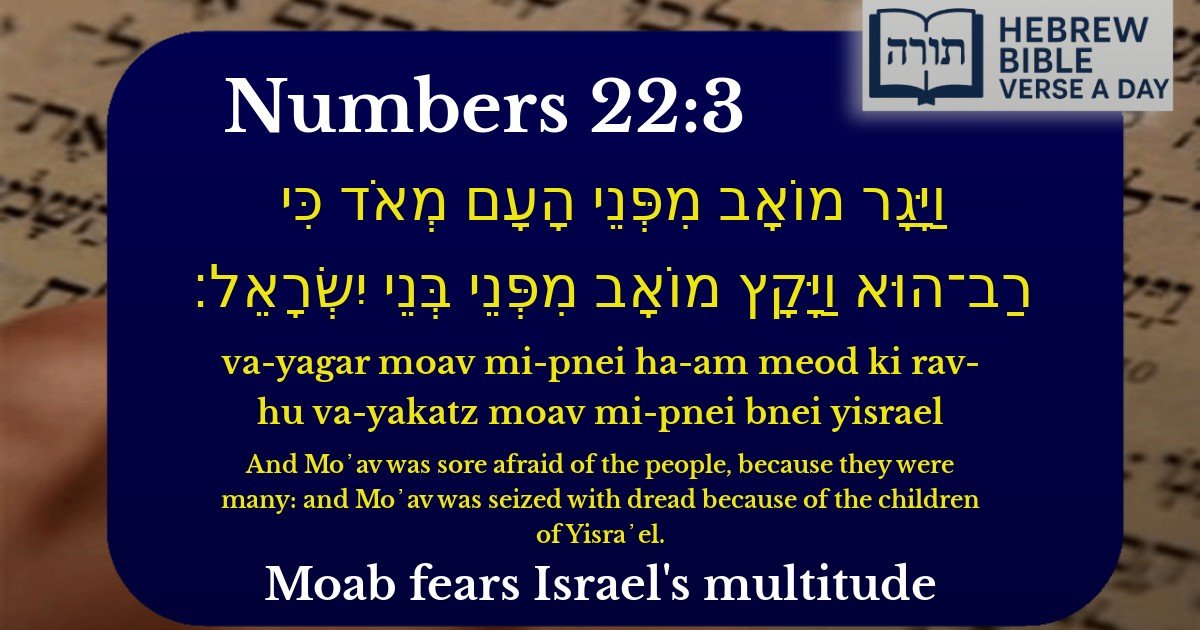
וַיָּגָר מוֹאָב מִפְּנֵי הָעָם מְאֹד כִּי רַב־הוּא וַיָּקָץ מוֹאָב מִפְּנֵי בְּנֵי יִשְׂרָאֵל׃
English Translation
And Mo᾽av was sore afraid of the people, because they were many: and Mo᾽av was seized with dread because of the children of Yisra᾽el.
Transliteration
Va-yagar moav mi-pnei ha-am meod ki rav-hu va-yakatz moav mi-pnei bnei yisrael
Hebrew Leining Text
וַיָּ֨גׇר מוֹאָ֜ב מִפְּנֵ֥י הָעָ֛ם מְאֹ֖ד כִּ֣י רַב־ה֑וּא וַיָּ֣קׇץ מוֹאָ֔ב מִפְּנֵ֖י בְּנֵ֥י יִשְׂרָאֵֽל׃
🎵 Listen to leining
Parasha Commentary
📚 Talmud Citations
This verse is not quoted in the Talmud.
Context of the Verse
The verse appears in Bamidbar (Numbers) 22:3, describing the reaction of Moav (Moab) upon seeing Bnei Yisrael encamped near their borders. This occurs after Bnei Yisrael's military victories over Sichon and Og, which instilled fear in the surrounding nations, including Moav.
Rashi's Explanation
Rashi (Rabbi Shlomo Yitzchaki) comments that Moav's fear was twofold:
Ibn Ezra's Insight
Ibn Ezra notes that the fear of Moav was not merely due to Bnei Yisrael's numbers but also because of their recent military successes. Having witnessed the defeat of Sichon and Og—powerful kings—Moav understood that Bnei Yisrael were divinely protected and unstoppable.
Midrashic Interpretation
The Midrash Tanchuma (Balak 1) elaborates that Moav's dread stemmed from a misunderstanding. They assumed Bnei Yisrael would consume all their resources like locusts, as the verse uses the term "וַיָּקָץ", which can also imply being "consumed" or "devoured." This reflects their irrational fear, despite Bnei Yisrael having no intention of harming Moav (as they were commanded not to wage war against them—see Devarim 2:9).
Rambam's Perspective
Rambam (Maimonides) in Moreh Nevuchim (Guide for the Perplexed) discusses how nations often fear what they do not understand. Moav, seeing Bnei Yisrael's unity and divine protection, misinterpreted their presence as a threat, leading to panic and the eventual hiring of Bilam to curse them.
Halachic Implications
The Chizkuni (Rabbi Hezekiah ben Manoach) connects this fear to the broader theme of hashgacha pratit (divine providence). Moav's reaction underscores how Hashem instills fear in the enemies of Bnei Yisrael to protect His people, fulfilling the promise made to Avraham that those who curse Yisrael will be cursed (Bereishit 12:3).