Frequently Asked Questions
Q: What does 'Behold, I am bidden to bless' mean in Numbers 23:20?
A: This verse is spoken by the prophet Balaam, who was hired by King Balak to curse the Jewish people. Balaam explains that he cannot curse them because G-d has commanded him only to bless Israel (Rashi on Numbers 23:20).
Q: Why couldn't Balaam reverse the blessing in Numbers 23:20?
A: Once G-d decrees a blessing, it cannot be reversed. The Talmud (Berachot 7a) teaches that blessings from Heaven are irrevocable, which is why Balaam couldn't change G-d's will to bless the Jewish people.
Q: What lesson can we learn from Numbers 23:20 today?
A: This verse teaches that no human can override G-d's will. When G-d chooses to bless the Jewish people, no enemy or curse can prevail against them (Rambam, Hilchot Teshuvah 3:8). This gives us faith in divine protection.
Q: Who was Balaam in the Torah?
A: Balaam was a non-Jewish prophet hired by Balak to curse Israel. Though he had prophetic abilities, his intentions were evil. The Talmud (Sanhedrin 105b) describes him as wicked, contrasting his blessings with his negative character.
Q: How does Numbers 23:20 show G-d's relationship with Israel?
A: This verse demonstrates G-d's eternal covenant with the Jewish people. As the Midrash (Bamidbar Rabbah 20:23) explains, G-d's blessings for Israel are unconditional and cannot be nullified, showing His everlasting commitment.

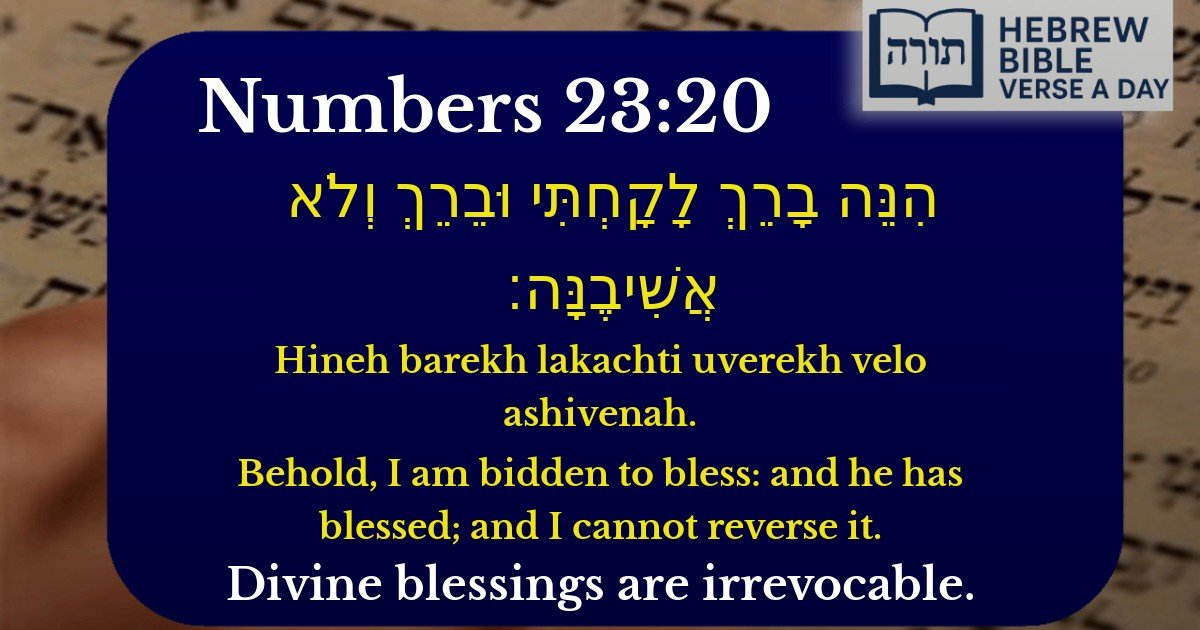

Context of the Verse
The verse (Numbers 23:20) is part of the narrative where Balak, king of Moab, hires the prophet Balaam to curse the Israelites. Despite Balak's insistence, Balaam repeatedly blesses Israel instead, as directed by Hashem. This verse emphasizes Balaam's acknowledgment that he cannot act against the divine will.
Rashi's Commentary
Rashi explains that Balaam declares, "הִנֵּה בָרֵךְ לָקָחְתִּי" ("Behold, I am bidden to bless")—meaning he has received a divine command to bless Israel, not curse them. The phrase "וּבֵרֵךְ וְלֹא אֲשִׁיבֶנָּה" ("and he has blessed; and I cannot reverse it") underscores that once Hashem has decreed a blessing, no human or prophetic power can nullify it (Rashi on Numbers 23:20).
Rambam's Perspective
Rambam (Maimonides) discusses prophecy in Moreh Nevuchim (Guide for the Perplexed), noting that true prophets like Balaam—despite his flawed character—could not contradict Hashem's will. This verse demonstrates the irrevocable nature of divine blessings, aligning with Rambam's view of prophecy as bound by divine truth.
Talmudic and Midrashic Insights
Ibn Ezra's Explanation
Ibn Ezra highlights the grammatical nuance: "לָקָחְתִּי" ("I have taken") implies Balaam's acceptance of Hashem's command, while "וּבֵרֵךְ" ("and he has blessed") refers to Hashem as the true source of the blessing. The phrase "וְלֹא אֲשִׁיבֶנָּה" ("I cannot reverse it") reinforces that divine decrees are unchangeable (Ibn Ezra on Numbers 23:20).
Philosophical Implication
This verse underscores a foundational Jewish belief: Hashem's will is absolute, and human intentions—even those of a prophet—cannot override it. The blessings for Israel are eternal, as later affirmed in Deuteronomy 28 and throughout Jewish tradition.