Frequently Asked Questions
Q: What does Numbers 24:18 mean when it says 'Edom shall be his possession'?
A: This verse, spoken by the prophet Balaam, refers to the future victory of Israel over Edom (descendants of Esau) and Seir (another name for Edomite territory). According to Rashi, this prophecy foretells that Israel will ultimately conquer their enemies, fulfilling G-d's promise to the Jewish people.
Q: Why is Edom mentioned specifically in Numbers 24:18?
A: Edom represents the descendants of Esau, Jacob's brother, and symbolizes a historical enemy of Israel. The Midrash explains that the conflict between Jacob and Esau (Genesis 25-33) continues through their descendants. This verse reassures Israel of their ultimate triumph over hostile nations.
Q: What does 'Israel shall do valiantly' mean in this verse?
A: The phrase 'Israel shall do valiantly' (וְיִשְׂרָאֵל עֹשֶׂה חָיִל) means that Israel will achieve greatness and success. Ramban explains that this refers to both military victories and spiritual strength, showing that Israel's true power comes from following G-d's commandments.
Q: How does this prophecy apply to Jewish history?
A: Traditional Jewish sources, including the Talmud and Midrash, see this verse as referring to future redemptions. The Sages connect it to the victories of King David over Edom (2 Samuel 8:14) and the ultimate triumph of Mashiach in the end of days, when Israel's enemies will be subdued.
Q: Is this verse still relevant today?
A: Yes, Orthodox Judaism views this prophecy as ongoing. The struggle between Israel and its enemies continues, and this verse reminds us of G-d's promise that righteousness will prevail. Many commentaries see Edom as representing oppressive forces throughout history, assuring us that divine justice will ultimately triumph.


Context of the Verse
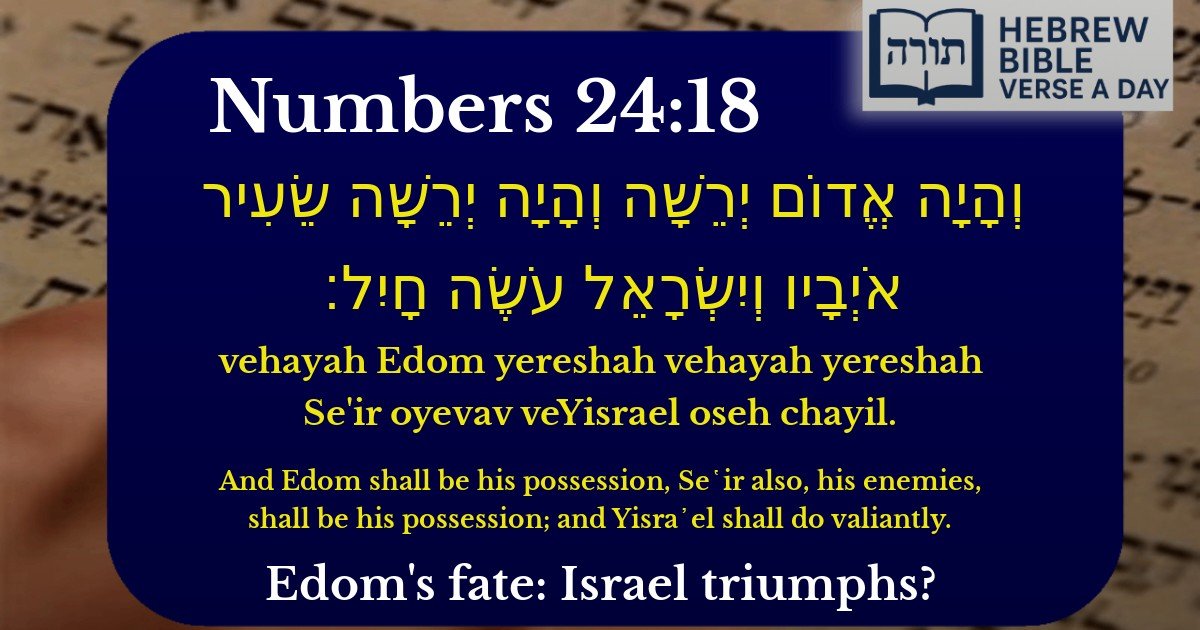
This verse appears in Bamidbar (Numbers) 24:18, part of the prophecy of Balaam concerning the future of Israel and its neighboring nations. Balaam, though initially intending to curse Israel, is compelled by Hashem to bless them instead. This particular verse speaks of Israel's eventual triumph over its enemies, specifically Edom (descendants of Esau) and Se'ir (associated with Edom).
Interpretation of "Edom shall be his possession"
Rashi explains that "Edom" here refers to the descendants of Esau, Israel's perennial adversaries. The phrase "shall be his possession" (yereshah) indicates that Israel will ultimately inherit or dominate Edom. Ramban (Nachmanides) elaborates that this prophecy was partially fulfilled during the reigns of Kings David and Shlomo (Solomon), who subjugated Edom (see II Shmuel 8:14, I Melachim 11:15-16). However, the ultimate fulfillment is linked to the Messianic era, as per the vision in Ovadiah 1:21.
Meaning of "Se'ir, his enemies"
Se'ir is the mountainous region associated with Edom (see Bereishit 36:8). The Midrash Tanchuma (Bamidbar 3) connects Se'ir to Esau's dwelling place, symbolizing the spiritual and physical enmity between Esau's descendants and Israel. The Malbim emphasizes that this conquest is not merely territorial but represents the triumph of Yaakov's righteous lineage over Esau's antagonistic legacy.
"Israel shall do valiantly"
The phrase "Israel shall do valiantly" (Yisrael osah chayil) is interpreted by Rashi as Israel growing strong and prosperous. The Ibn Ezra adds that this refers to Israel's military and spiritual strength, aligning with the promise that those who bless Israel will be blessed (cf. Bereishit 12:3). The Sforno suggests that this valor will be divinely assisted, as Israel's victories are ultimately orchestrated by Hashem.
Eschatological Significance
The Zohar (Bamidbar 200a) links this verse to the final redemption, where Edom (often symbolizing oppressive empires in Jewish thought) will be subdued by Mashiach. The Rambam (Hilchot Melachim 11:1) cites such prophecies as evidence of the future Messianic era, where Israel's sovereignty will be fully realized.
Key Themes