Frequently Asked Questions
Q: What does Numbers 24:19 mean?
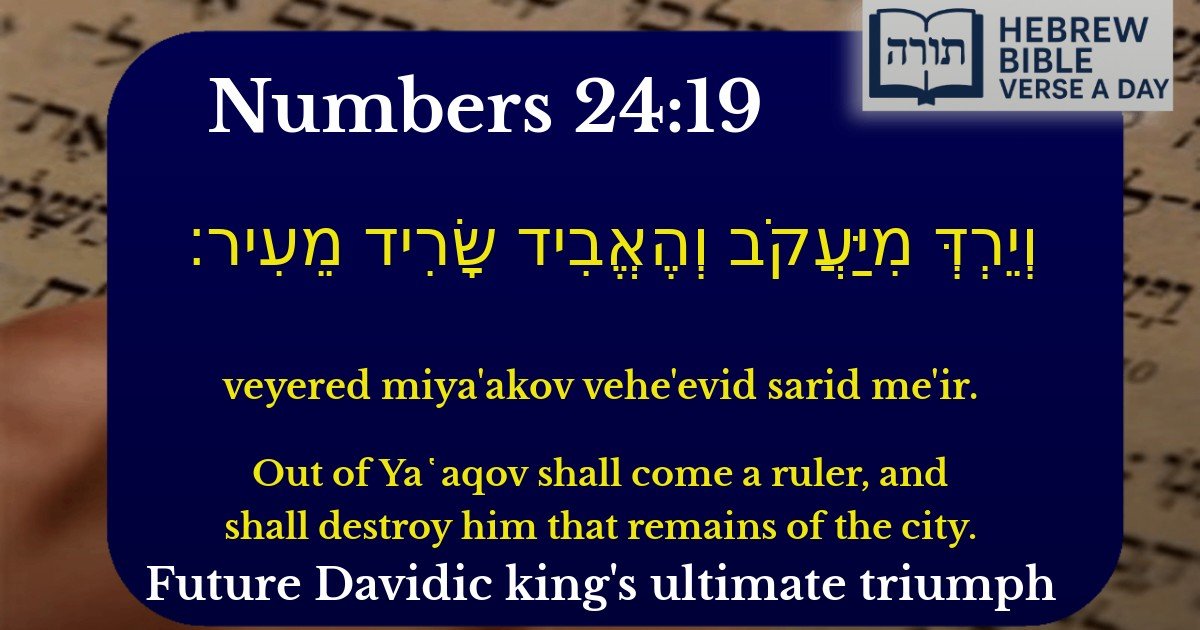
A: Numbers 24:19 is part of the prophecy of Balaam, where he foretells the future greatness of Israel. The verse speaks of a ruler emerging from Yaakov (Jacob) who will defeat Israel's enemies. According to Rashi, this refers to King David and the future Mashiach (Messiah), who will ultimately destroy the remnants of evil.
Q: Why is Numbers 24:19 important in Judaism?
A: This verse is important because it is a prophecy about the Jewish people's ultimate triumph over their enemies and the coming of a righteous ruler from the line of Jacob. The Rambam (Maimonides) cites this verse in discussing the principles of Mashiach, emphasizing that a future Jewish king will arise to restore Israel's sovereignty and bring peace.
Q: Who is the 'ruler' mentioned in Numbers 24:19?
A: Traditional Jewish sources, including Rashi and the Talmud (Sanhedrin 106b), explain that the 'ruler' refers first to King David, who defeated Israel's enemies, and ultimately to Mashiach, who will complete the final redemption. The verse highlights the enduring strength and leadership of the Jewish people.
Q: How does Numbers 24:19 apply to Jews today?
A: This verse serves as a reminder of Hashem's promise that the Jewish people will ultimately overcome adversity. It inspires hope in the eventual coming of Mashiach, as taught in Jewish tradition. The Midrash connects this prophecy to the belief that righteousness will prevail, reinforcing faith in divine justice.
Q: What does 'destroy him that remains of the city' mean in Numbers 24:19?
A: Rashi explains that this phrase refers to the complete downfall of Israel's enemies, ensuring that no remnant of their power remains. The Talmud (Bava Batra 123a) links this to the future era when evil will be eradicated, and only goodness will endure under Mashiach's rule.


Context in the Torah
The verse appears in Bamidbar (Numbers) 24:19, as part of the prophecy of Bil'am (Balaam), who was compelled by Hashem to bless Bnei Yisrael rather than curse them. This particular verse speaks of the future greatness of the Jewish people and their ultimate triumph over their enemies.
Rashi's Commentary
Rashi explains that the phrase "וְיֵרְדְּ מִיַּעֲקֹב" ("Out of Ya῾aqov shall come a ruler") refers to Mashiach, the future anointed king from the lineage of Yaakov (Jacob). He will rise to power and subdue the enemies of Israel. Rashi further clarifies that "וְהֶאֱבִיד שָׂרִיד מֵעִיר" ("and shall destroy him that remains of the city") alludes to the complete eradication of the remnants of Edom (often symbolizing Rome and later oppressive nations in Jewish thought).
Rambam's Perspective
In Hilchot Melachim (Laws of Kings 11:1), the Rambam cites this verse as a reference to the Messianic era, when a king from the House of David will arise to restore the Davidic dynasty. He emphasizes that this ruler will not only lead Israel to victory but also establish justice and Torah observance worldwide.
Midrashic Interpretation
The Midrash Tanchuma (Balak 12) connects this verse to the ultimate redemption, teaching that the "ruler from Yaakov" will be a descendant of David, who will bring about the final defeat of Israel's oppressors. The "remnant of the city" is interpreted as the last vestiges of evil that will be utterly destroyed in the Messianic age.
Ibn Ezra's Explanation
Ibn Ezra notes that the term "וְיֵרְדְּ" ("shall come down") implies a ruler who will exercise dominion, descending upon enemies with authority. He interprets "the city" as a metaphor for any stronghold of opposition to Israel, which will be completely vanquished.
Symbolism in Jewish Thought