Frequently Asked Questions
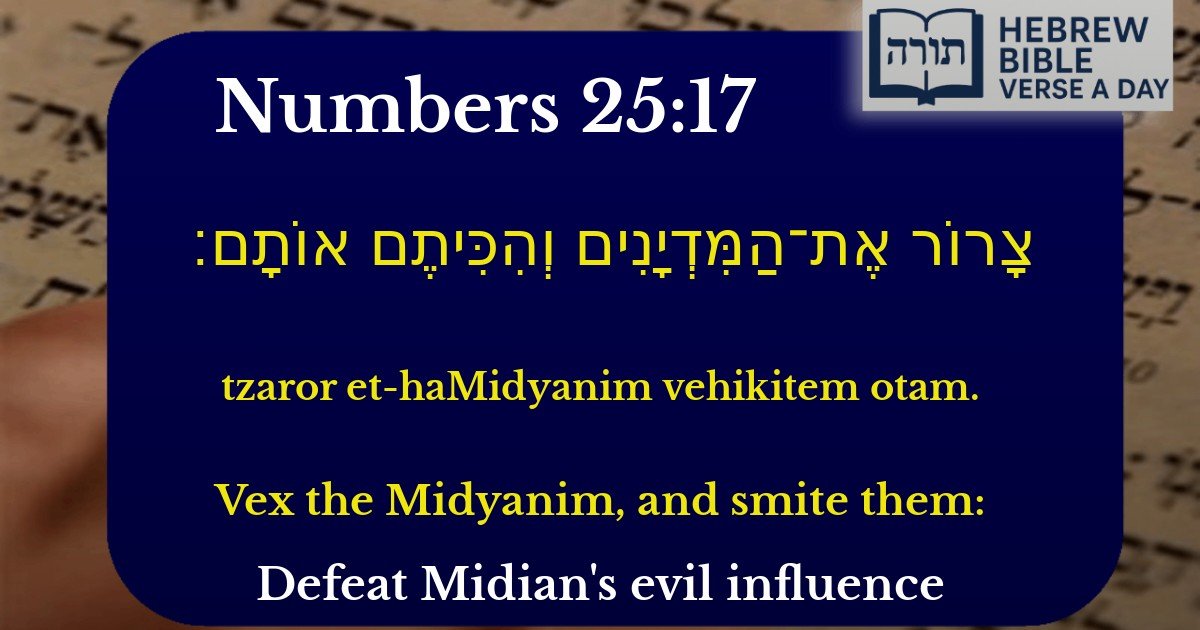
Q: What does the verse 'Vex the Midyanim, and smite them' mean?
A: This verse (Numbers 25:17) commands the Jewish people to wage war against the Midyanim (Midianites) as a response to their role in leading Israel into sin through the incident with Baal Peor (Numbers 25:1-9). Rashi explains that this was a divine command to hold the Midyanim accountable for their harmful influence.
Q: Why did Hashem command the Jewish people to fight the Midyanim?
A: The Midyanim, particularly through the advice of Bilaam, enticed the Israelites to sin with immorality and idolatry (Avodah Zarah), causing a plague (Talmud Sanhedrin 106a). This command was a measure of justice to prevent further spiritual harm to the Jewish people.
Q: How does this verse apply to us today?
A: While we are not commanded to wage physical war today, the verse teaches us to distance ourselves from negative influences that can lead us away from Torah values. The Rambam (Hilchos De'os 6:1) emphasizes the importance of avoiding bad company, as external influences can shape our behavior.
Q: Why were the Midyanim punished more severely than the Moabites in this incident?
A: The Midrash (Bamidbar Rabbah 21:4) explains that while the Moabites acted out of fear of Israel, the Midyanim acted out of pure hatred. Their malicious intent made them more culpable, hence the specific command to 'vex' them.
Q: What is the significance of the word 'צָרוֹר' (vex) in this verse?
A: Rashi notes that the word 'צָרוֹר' implies a lasting enmity, indicating that the conflict with Midyan was not just a one-time battle but an ongoing opposition to their harmful ways. This teaches that we must remain vigilant against negative influences that oppose Torah values.


Context of the Verse
The verse "צָרוֹר אֶת־הַמִּדְיָנִים וְהִכִּיתֶם אוֹתָם" (Bamidbar 25:17-18) appears in the Torah following the incident of Bnei Yisrael's sin with the daughters of Moav and Midyan, which led to the plague and the zealous act of Pinchas. Hashem commands Moshe to wage war against Midyan as a response to their role in leading Bnei Yisrael astray.
Rashi's Explanation
Rashi (Bamidbar 25:17) explains that the term "צָרוֹר" (vex) implies an ongoing hostility, not limited to a single battle. He cites the Midrash (Tanchuma, Balak 21) that this command was to be carried out even after Moshe's death, as seen later in Sefer Shoftim (6:1-3) when Midyan oppressed Israel again. Rashi emphasizes that Midyan's treachery warranted a lasting enmity.
Rambam's Perspective
Rambam (Hilchot Melachim 5:4) discusses the laws of war and identifies this as a milchemet mitzvah (obligatory war). Unlike discretionary wars, which require approval from the Sanhedrin, wars like the one against Midyan are mandated by the Torah due to their direct threat to the spiritual and physical well-being of Bnei Yisrael.
Midrashic Insights
Halachic Implications
The Gemara (Sanhedrin 72a) derives from this verse the principle of "הבא להורגך השכם להורגו"—if someone seeks to kill you, act first to eliminate the threat. Midyan's spiritual corruption of Bnei Yisrael was deemed equivalent to a physical threat, justifying the harsh response.
Moral and Ethical Lessons
Commentators like the Sforno (Bamidbar 25:17) highlight that the command was not driven by vengeance but by the need to eradicate evil influence. The severity of the punishment reflects the gravity of leading others to idolatry and immorality, which undermines the covenant between Hashem and Israel.