

Join Our Newsletter To Be Informed When New Videos Are Posted
Hebrew Text
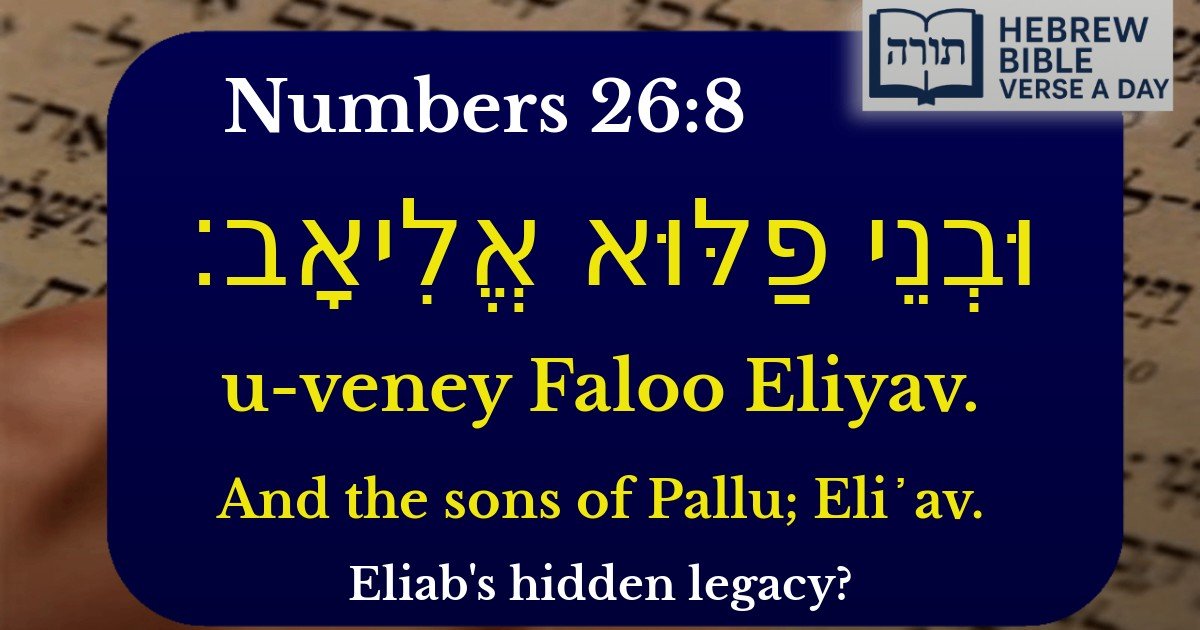
וּבְנֵי פַלּוּא אֱלִיאָב׃
English Translation
And the sons of Pallu; Eli᾽av.
Transliteration
U-veney Faloo Eliyav.
Hebrew Leining Text
וּבְנֵ֥י פַלּ֖וּא אֱלִיאָֽב׃
🎵 Listen to leining
Parasha Commentary
📚 Talmud Citations
This verse is not quoted in the Talmud.
Context in the Torah
The verse "וּבְנֵי פַלּוּא אֱלִיאָב" (And the sons of Pallu; Eli᾽av) appears in Bamidbar (Numbers) 26:8), within the census of the Israelites taken in the plains of Moav before entering Eretz Yisrael. This verse lists the descendants of Reuven through his son Pallu.
Rashi's Commentary
Rashi (Rabbi Shlomo Yitzchaki) notes that this verse is part of the genealogical record of the tribe of Reuven. He explains that Pallu was one of Reuven's sons (as mentioned earlier in Bereishit 46:9), and here, the Torah specifies his descendants. Rashi does not elaborate further on Eli'av in this context, as the primary focus is on the tribal lineage.
Midrashic Insights
The Midrash (Bamidbar Rabbah) connects this verse to broader themes of tribal identity and continuity. It emphasizes that even though Reuven lost his firstborn rights due to his earlier misdeeds (Bereishit 35:22, 49:3-4), his descendants were still counted prominently in the census, demonstrating Hashem's mercy and the enduring significance of each tribe.
Rambam's Perspective
Rambam (Maimonides) does not comment directly on this verse, but his principles of Torah study highlight the importance of understanding genealogies as part of the Torah's historical and legal framework. The listing of families reinforces the divine promise to Avraham, Yitzchak, and Yaakov that their descendants would be numerous and identifiable.
Significance in Jewish Tradition