Frequently Asked Questions
Q: What is the meaning of Numbers 26:20?
A: Numbers 26:20 lists the descendants of Yehuda (Judah) by their families: the Shelanites from Shela, the Perezites from Peretz, and the Zarhites from Zerach. This verse is part of the census taken in the wilderness, showing the organization of the tribes of Israel according to their families.
Q: Why is the genealogy of Yehuda important in this verse?
A: The genealogy of Yehuda is important because Yehuda was one of the twelve tribes of Israel and played a key role in Jewish history. The families listed here (Shelani, Parzi, Zarhi) were part of the tribal structure and inheritance system in Eretz Yisrael. The Ramban explains that these divisions were used for land distribution and tribal identity.
Q: What can we learn from the family divisions in Numbers 26:20?
A: We learn the importance of family lineage and tribal identity in Judaism. The Torah emphasizes the structure of families and tribes, showing how each group had its unique role and inheritance. Rashi notes that these divisions were preserved to maintain the sanctity and order of the Jewish people.
Q: How does this verse apply to Jewish identity today?
A: While we no longer have the tribal divisions as in biblical times, this verse reminds us of the value of family heritage and Jewish continuity. Many Jews today trace their lineage to certain traditions or communities, reflecting the enduring importance of family and identity in Jewish life, as discussed in the Talmud (Kiddushin 70a).
Q: Why are Peretz and Zerach mentioned separately in this verse?
A: Peretz and Zerach were both sons of Yehuda (Genesis 38:29-30), and their descendants formed distinct families within the tribe. The Midrash (Bereishit Rabbah 85:12) highlights their significance, as Peretz was an ancestor of King David, showing how family lines carry spiritual and historical importance in Judaism.

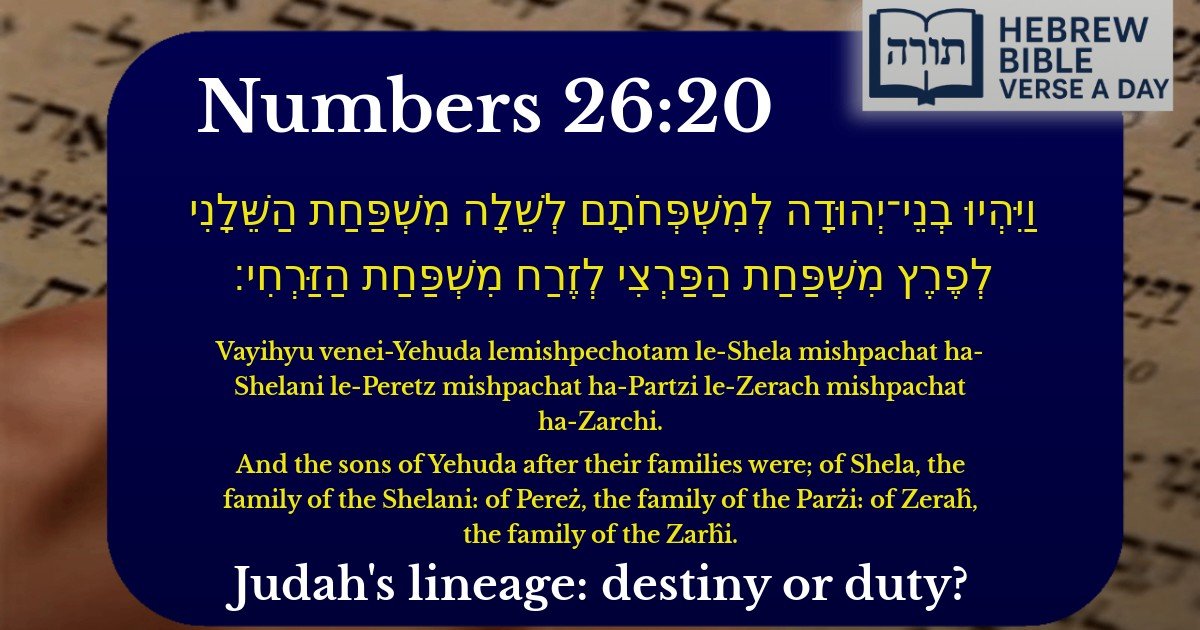

Overview of the Verse
The verse (Bamidbar 26:20) lists the descendants of Yehuda according to their families, specifically mentioning the families of Shela, Peretz, and Zerach. This enumeration appears in the context of the census taken in the wilderness before Bnei Yisrael entered Eretz Yisrael. The division into families highlights the importance of lineage and tribal identity in Jewish tradition.
Rashi's Commentary
Rashi explains that the phrase "לְמִשְׁפְּחֹתָם" (after their families) indicates that these families were recognized as distinct lineages within the tribe of Yehuda. He notes that the family names—Shelani, Parzi, and Zarchi—are derived from the names of their ancestors: Shela, Peretz, and Zerach, respectively. This follows the Torah's pattern of identifying families by their forebears.
Significance of the Three Families
Midrashic Insights
The Midrash (Bamidbar Rabbah 21:10) connects the names of these families to broader themes in Jewish thought. For example:
Halachic and Historical Implications
The Talmud (Bava Basra 109b) discusses the inheritance rights of these families, noting that tribal lineage determined land allocation in Eretz Yisrael. The Rambam (Hilchos Nachalos 1:6) further elaborates on how family divisions influenced territorial distribution. This verse thus serves as a foundation for understanding tribal inheritance laws.