Frequently Asked Questions
Q: What does Numbers 26:21 mean?
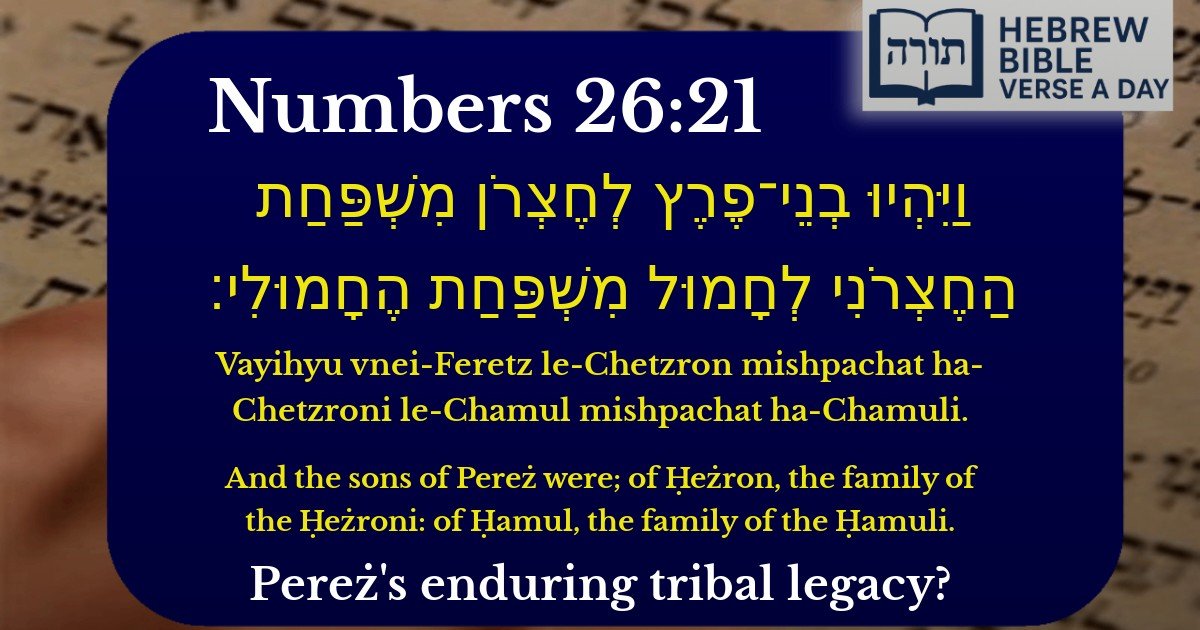
A: Numbers 26:21 lists the descendants of Peretz, who was the son of Yehuda (Judah). It mentions two families that came from Peretz: the Chetzroni family (from Chetzron) and the Chamuli family (from Chamul). This verse is part of the census taken in the wilderness to count the Israelite families before entering the Land of Israel.
Q: Why is the lineage of Peretz important in Judaism?
A: Peretz is significant because he was an ancestor of King David (Ruth 4:18-22), and ultimately, the future Mashiach (Messiah) will come from this lineage (Talmud, Sanhedrin 98a). The Torah carefully records genealogies to preserve the purity of the tribes, especially Yehuda’s line, from which Jewish royalty descends.
Q: What can we learn from the mention of families in Numbers 26:21?
A: This verse teaches the importance of family identity in Judaism. Each family had its unique role within the tribe of Yehuda. Rashi explains that these genealogies were recorded to show the fulfillment of Hashem’s promise to Avraham that his descendants would be as numerous as the stars (Bereishit 15:5).
Q: How does this verse apply to Jewish life today?
A: While we no longer trace tribal lineage as precisely today, the concept of family heritage remains important in Judaism. Many Jews still take pride in knowing their ancestry, and some traditions (like Kohanim and Leviim) are passed down through family lines. The verse reminds us of our connection to past generations.
Q: Why does the Torah list so many names and families?
A: The Rambam (Hilchot Melachim 12:3) explains that genealogies establish the authenticity of the Jewish people’s lineage, especially regarding kingship and priesthood. The Talmud (Pesachim 62b) also teaches that studying these lists honors our ancestors and connects us to our roots.


Verse Context
This verse appears in Bamidbar (Numbers) 26:21, within the census of the tribes of Israel conducted in the wilderness. It lists the descendants of Pereẓ, the son of Yehudah (Judah), focusing on his two sons, Ḥeẓron and Ḥamul, and their respective families.
Significance of Perek (Lineage) in Torah
Rashi (on Bamidbar 26:5) emphasizes that the Torah meticulously records lineage to highlight the importance of yichus (ancestry) in Jewish tradition. The families of Ḥeẓron and Ḥamul are noted because they became foundational clans within the tribe of Yehudah, playing key roles in Jewish history.
Ḥeẓron’s Family
Ḥeẓron is significant as he is the ancestor of King David (see Ruth 4:18-22). The Midrash (Bereishit Rabbah 85:4) connects Ḥeẓron’s name to ḥeẓer (enclosure), symbolizing his descendants' role in fortifying the Jewish people. Rambam (Hilchos Melachim 1:7) notes that the Davidic dynasty, and ultimately the Messiah, will descend from Ḥeẓron’s line.
Ḥamul’s Family
Ḥamul’s name means "spared" or "pitied", which the Talmud (Sotah 11b) links to the exile in Egypt. The Midrash (Tanchuma, Vayechi 12) suggests that Ḥamul was named because he was among those spared from hardship, foreshadowing the survival of his descendants.
Lessons from the Verse