

Join Our Newsletter To Be Informed When New Videos Are Posted
Hebrew Text
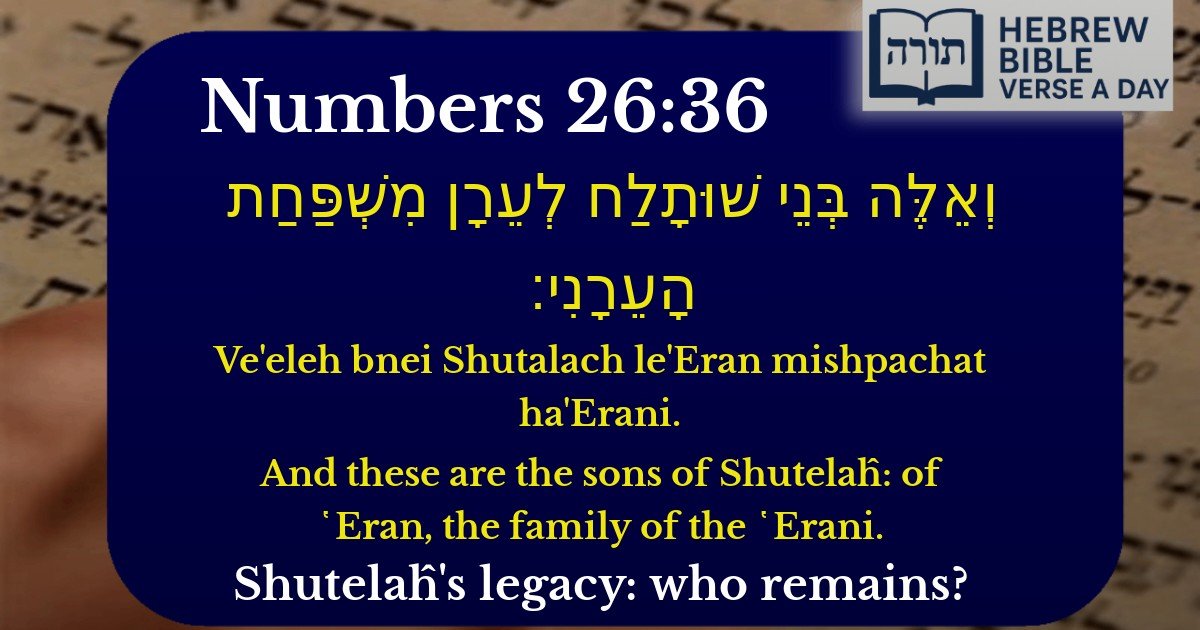
וְאֵלֶּה בְּנֵי שׁוּתָלַח לְעֵרָן מִשְׁפַּחַת הָעֵרָנִי׃
English Translation
And these are the sons of Shutelaĥ: of ῾Eran, the family of the ῾Erani.
Transliteration
Ve'eleh bnei Shutalach le'Eran mishpachat ha'Erani.
Hebrew Leining Text
וְאֵ֖לֶּה בְּנֵ֣י שׁוּתָ֑לַח לְעֵרָ֕ן מִשְׁפַּ֖חַת הָעֵרָנִֽי׃
🎵 Listen to leining
Parasha Commentary
📚 Talmud Citations
This verse is not quoted in the Talmud.
Context in Sefer Bamidbar
The verse (Bamidbar 26:36) appears in the census of Bnei Yisrael taken in the plains of Moav before entering Eretz Yisrael. It lists the descendants of Shutelach, a son of Ephraim, focusing on the family of Eran, the Erani.
Rashi's Commentary
Rashi (Bamidbar 26:36) notes that the phrasing "אֵלֶּה בְּנֵי שׁוּתָלַח" ("these are the sons of Shutelach") is unusual since only Eran is mentioned. He explains that the Torah sometimes uses "banim" (sons) to refer to a single descendant, as seen here with Eran being the primary continuation of Shutelach's line.
Ibn Ezra's Insight
Ibn Ezra adds that the repetition of "Eran" and "Erani" emphasizes the significance of this family within the tribe of Ephraim. The double mention may indicate that this branch was particularly numerous or distinguished in some way.
Midrashic Interpretation
The Midrash (Bamidbar Rabbah 21:22) connects this verse to the broader theme of shevet Ephraim's role in Jewish history. It suggests that the name "Eran" (from the root ע.ו.ר, meaning "awake" or "watchful") hints at this family's alertness in Torah study and mitzvah observance.
Halachic Significance
Chassidic Perspective
The Sefat Emet notes that the singular focus on Eran teaches that every Jewish family has a unique spiritual role. Even when a line seems to produce only one significant descendant, that individual can embody the entire family's spiritual potential.