Frequently Asked Questions
Q: Who was Serach, the daughter of Asher?
A: Serach bat Asher was the daughter of Asher, one of the twelve sons of Jacob. According to Midrashic tradition (e.g., Midrash Yalkut Shimoni), she was exceptionally righteous and is mentioned in the Torah because of her unique role in Jewish history. The Talmud (Sotah 13a) states that she was the one who gently informed Jacob that Joseph was still alive in Egypt, and due to her wisdom and righteousness, she merited to enter Gan Eden (Paradise) alive.
Q: Why is Serach mentioned by name in the Torah?
A: Serach is one of the few women mentioned by name in the genealogical lists of the Torah, which indicates her special significance. Rashi (on Genesis 46:17) notes that she was already alive when the family went down to Egypt, and the Midrash (Pirkei DeRabbi Eliezer) teaches that she was blessed with extraordinary longevity—some say she never died but entered Gan Eden alive due to her righteousness and her role in comforting Jacob.
Q: What lessons can we learn from Serach bat Asher?
A: From Serach bat Asher, we learn the importance of delivering difficult news with wisdom and sensitivity (as she did when telling Jacob that Joseph was alive). The Midrash also highlights her righteousness and Torah knowledge, showing that women played vital spiritual roles in Jewish history. Her mention in the Torah teaches that even seemingly minor figures can have profound impacts on Jewish tradition.
Q: Is Serach mentioned anywhere else in Jewish tradition?
A: Yes! Besides appearing in the Torah's genealogy, Serach is mentioned in Midrashim and Talmudic literature. The Talmud (Sotah 13a) says she was the one who identified Moses as the redeemer when he came to Egypt, confirming his mission. Later traditions (e.g., Zohar) connect her to the transmission of sacred knowledge, and some say she revealed secrets of the Exodus to future generations.

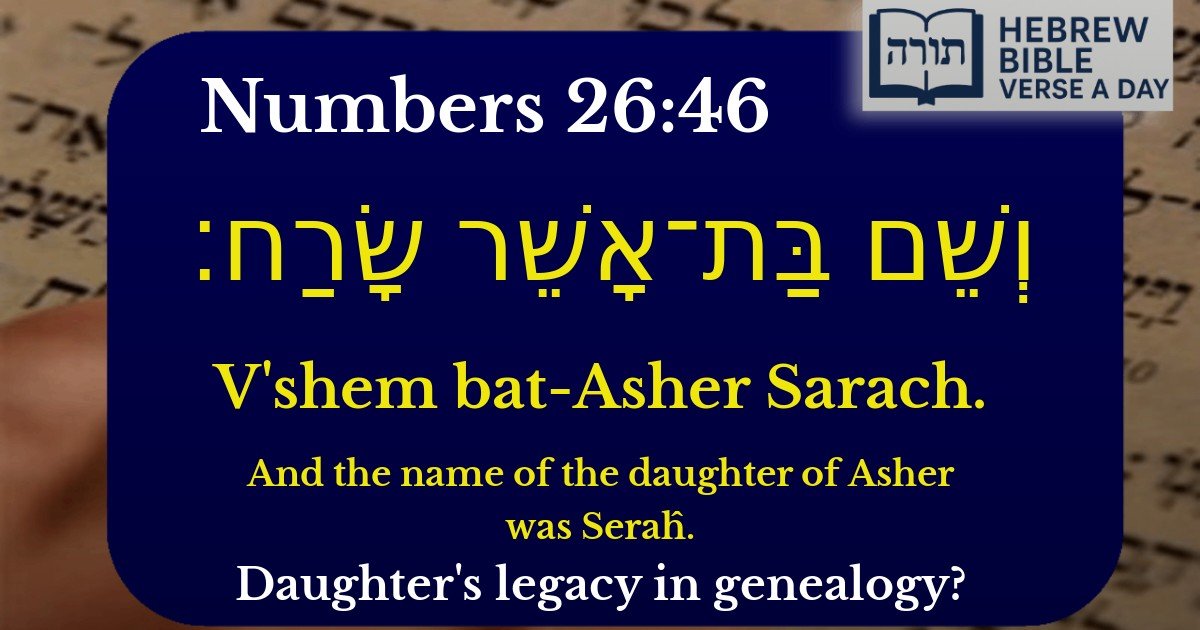

The Significance of Serach bat Asher
The verse (Bereishit 46:17) mentions Serach as the daughter of Asher, one of the sons of Yaakov. While the Torah lists her among the seventy souls who descended to Egypt, her name appears again in later narratives, indicating her unique role in Jewish tradition.
Midrashic Interpretations
Symbolic Meaning of Her Name
Rashi (on Bereishit 46:17) notes that "Serach" (שָׂרַח) may derive from the root שרר (to rule or remain), alluding to her enduring presence in Jewish history. Some commentators suggest her name reflects her role as a preserver of tradition, ensuring the continuity of the Exodus narrative.
Legacy in Later Sources
According to Pirkei de-Rabbi Eliezer (Ch. 48), Serach was among the righteous individuals who entered Gan Eden alive, akin to Chanoch and Eliyahu. This further emphasizes her unique spiritual stature in Jewish thought.