Frequently Asked Questions
Q: What does 'he died in his own sin' mean in Numbers 27:3?
A: Rashi explains that this phrase refers to the sin of the Spies (Numbers 14), where the generation that left Egypt doubted G-d's promise about entering the Land of Israel. The daughters of Tzelofchad are clarifying that their father was not part of Korach's rebellion, but rather died as part of that general wilderness generation.
Q: Why did the daughters of Tzelofchad mention that their father wasn't part of Korach's rebellion?
A: The Talmud (Bava Batra 117b) teaches that they wanted to emphasize their father's merits - while he died in the wilderness like others of his generation, he wasn't guilty of the more serious sin of rebelling against Moshe's leadership like Korach did. This strengthened their case for inheriting their father's portion in the Land.
Q: What lesson can we learn from the daughters of Tzelofchad's statement?
A: The Midrash (Tanchuma Pinchas 7) highlights how they spoke with wisdom and respect. Even when pointing out their father's passing, they did so in a way that honored him by distinguishing his actions from worse sins. This teaches us the importance of speaking carefully about family matters, especially when making requests of authority.
Q: Why does the verse mention that Tzelofchad 'had no sons'?
A: According to Rambam (Hilchos Nachalos 1:1), this detail is crucial because the Torah's default inheritance laws gave priority to sons. Since there were no sons, his daughters were making a novel claim to inherit - which G-d ultimately accepted, establishing this as a new halacha (Jewish law) for future generations.
Q: How does this verse show G-d's justice?
A: As the Sifrei (Pinchas 133) explains, this episode demonstrates that G-d punishes each person only for their own sins (not their family's), and rewards proper intentions. Though Tzelofchad died in the wilderness, his daughters' righteous appeal showed his merit - leading to both their inheritance and a lasting Torah law.


Context of the Verse
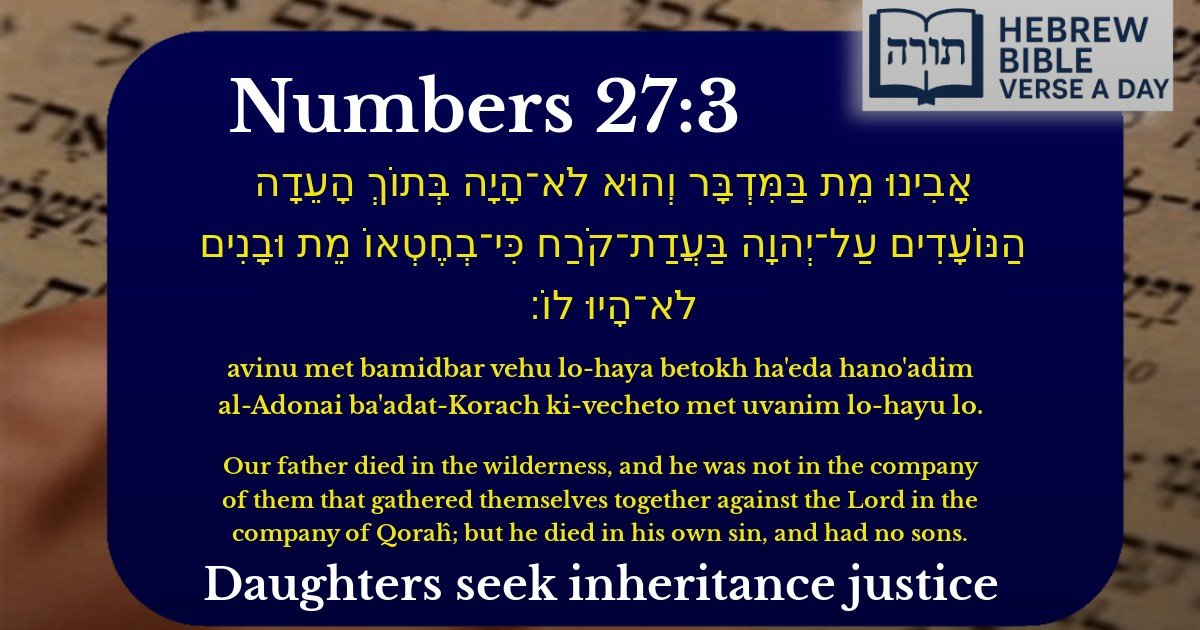
This verse appears in Bamidbar (Numbers) 27:3, spoken by the daughters of Tzelofchad, who approached Moshe to request a portion in Eretz Yisrael after their father's death. The verse clarifies that their father was not among Korach's rebellious followers but died due to his own sin in the wilderness.
Explanation of "He Died in His Own Sin"
Rashi explains that Tzelofchad's sin was gathering wood on Shabbat (Bamidbar 15:32-36), as mentioned earlier in the Torah. The daughters emphasize that their father was not part of Korach's mutiny, which was a public rebellion against Moshe and Hashem. Instead, his transgression was personal, and his punishment was individual.
Why the Daughters Mention Korach
The Talmud (Shabbat 96b) notes that the daughters strategically framed their request by distancing their father from Korach’s rebellion. They wanted to ensure that their claim to inheritance would not be dismissed due to any association with a notorious sin. This demonstrates their wisdom in presenting their case.
The Significance of "He Had No Sons"
According to the Midrash Rabbah (Bamidbar Rabbah 21:11), the daughters highlight that their father had no male heirs, making their request for inheritance both necessary and just. The Torah later establishes their case as the precedent for daughters inheriting when there are no sons (Bamidbar 27:8).
Halachic Implications
Rambam (Hilchot Nachalot 1:1-3) derives from this episode that daughters inherit when there are no sons. The daughters' appeal led to a new halachic ruling, showing how righteous women can influence Torah law through sincere and reasoned requests.
Moral Lessons