Frequently Asked Questions
Q: What does Numbers 30:4 mean about a woman making a vow?
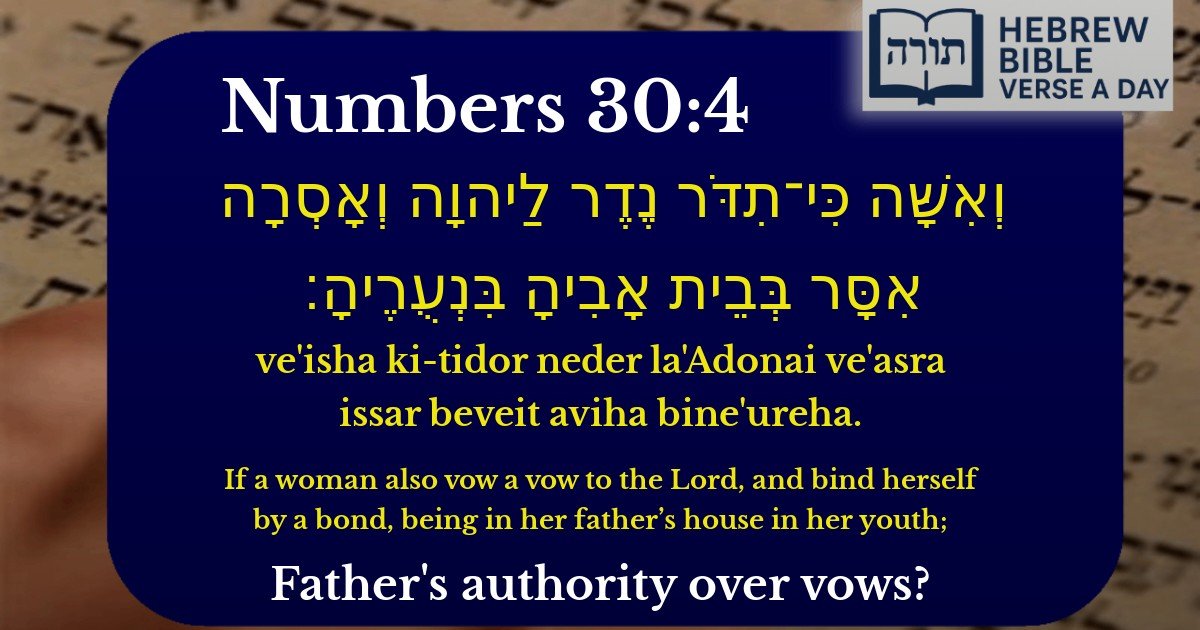
A: Numbers 30:4 discusses the laws of vows (nedarim) made by a young woman while still in her father's household. According to Jewish law, if an unmarried woman living at home makes a vow to Hashem, her father has the authority to affirm or nullify it on the same day he hears of it (as explained in the following verses). This shows the Torah's careful balance between personal spiritual commitments and family responsibility.
Q: Why does the Torah specify vows made by a woman 'in her father's house'?
A: The Torah specifies this condition because a woman's legal status regarding vows changes based on her life stage. Rashi explains that this refers to an unmarried girl under her father's authority. Once married, the authority transfers to her husband (as discussed later in the chapter). The Talmud (Nedarim 70b) elaborates on these different life stages and their halachic implications.
Q: What is the significance of vows in Judaism based on this verse?
A: Vows (nedarim) are taken very seriously in Judaism, as they create a binding obligation between a person and Hashem. The Rambam (Hilchot Nedarim 1:1) emphasizes that keeping one's word is a fundamental Torah value. This verse begins a section teaching that while all Jews may make vows, certain life circumstances (like being a daughter at home) introduce considerations about who can nullify them to prevent undue hardship.
Q: How does this verse apply to Jewish life today?
A: While the specific father-daughter dynamic may not apply as commonly today, the principles remain relevant: 1) The seriousness of keeping one's word to Hashem, 2) The importance of proper halachic guidance when making spiritual commitments, and 3) The Torah's sensitivity to family relationships in matters of personal growth. Contemporary poskim (halachic authorities) discuss how these laws apply in modern contexts.
Q: What does 'bind herself by a bond' mean in this verse?
A: The phrase 'bind herself by a bond' (v'asra issar) refers to creating a formal prohibition through a vow. As Rashi explains, this could mean either prohibiting something permitted (like abstaining from wine) or obligating oneself to do something (like bringing a sacrifice). The Sifrei notes this shows the power of speech - through words alone, a person can create new religious obligations.


Context and Source
The verse (Bamidbar 30:4) discusses the laws of vows (nedarim) made by a young woman still under her father's authority. This is part of a broader Torah section detailing the validity of vows under different circumstances, particularly concerning women whose vows may be subject to annulment by a father or husband.
Rashi's Explanation
Rashi (Bamidbar 30:4) explains that the phrase "בִּנְעֻרֶיהָ" (in her youth) refers to a girl who has not yet reached the age of twelve (na'arah) but has shown signs of maturity (bogeres). He clarifies that the verse applies specifically to a daughter still under her father's jurisdiction, emphasizing that her vows can be annulled by her father if he hears them and objects on the same day.
Rambam's Halachic Perspective
In Hilchos Nedarim (11:1), Rambam codifies this law, stating that a father may annul his daughter's vows only during her minority (before the age of twelve) or during the short transitional stage of na'arus (ages 12-12.5). Once she becomes fully independent (bogeres), her vows are binding like those of an adult woman.
Talmudic Discussion (Nedarim 70a)
The Talmud explores the nuances of this law, including:
Midrashic Insight (Sifrei Bamidbar 153)
The Midrash highlights the ethical dimension, teaching that this law safeguards young women from impulsive vows while still respecting their spiritual aspirations. It notes that the Torah's system balances parental guidance with individual responsibility as maturity develops.
Practical Implications
As ruled in Shulchan Aruch (Yoreh De'ah 234), these laws have practical applications: