Frequently Asked Questions
Q: What does Numbers 30:8 mean?
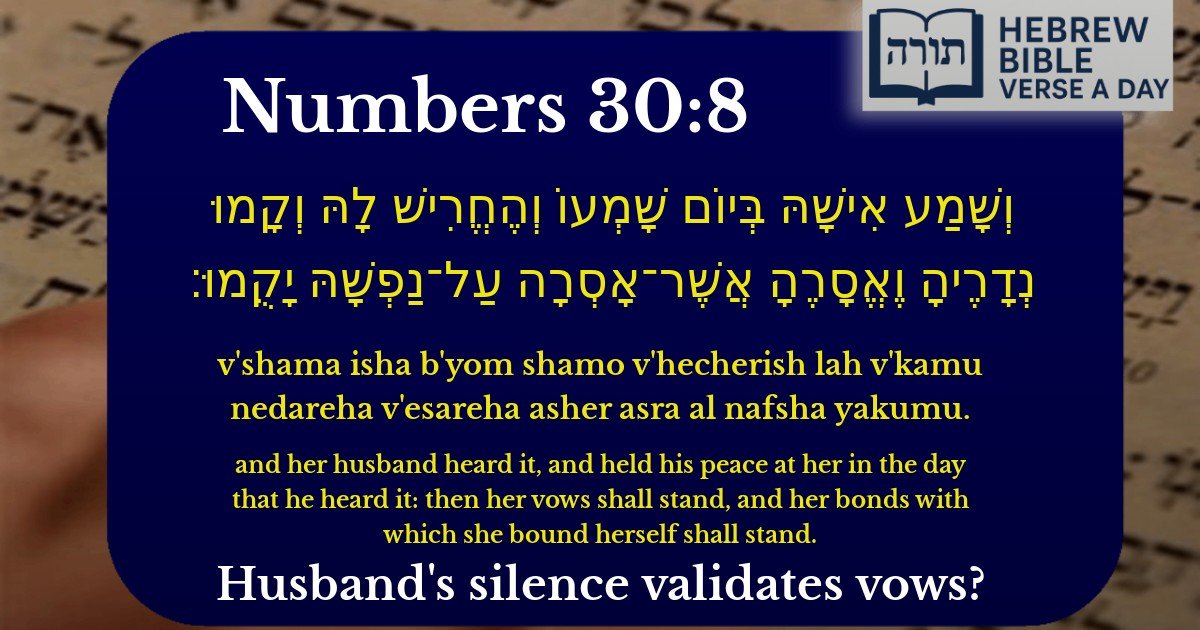
A: Numbers 30:8 discusses the laws of vows (nedarim) made by a married woman. If a woman makes a vow and her husband hears it but remains silent (does not object) on the same day, the vow remains valid and binding. This verse teaches that a husband has the authority to affirm or nullify his wife's vows under certain conditions, as outlined in the Torah.
Q: Why is this verse about vows important in Judaism?
A: This verse is important because it establishes the halachic (Jewish legal) framework for vows made by married women. The Torah gives a husband limited authority to uphold or annul his wife's vows, emphasizing the sanctity of speech and the seriousness of making commitments. The Talmud (Nedarim) elaborates on these laws, showing how seriously Judaism takes keeping one's word.
Q: What can we learn from Numbers 30:8 today?
A: We learn the importance of thoughtful communication and mutual respect in marriage. A husband must carefully consider his wife's commitments before deciding whether to affirm or nullify them. The verse also teaches the broader lesson of being mindful of vows and promises, as they carry spiritual weight in Jewish tradition.
Q: How does this law about vows apply in modern Orthodox Jewish practice?
A: While the specifics of vow annulment are rare today, the principle remains relevant. The concept of 'hatarat nedarim' (annulment of vows) before Rosh Hashanah stems from these laws. Additionally, it reminds married couples to communicate openly about commitments that affect their shared life, in accordance with Torah values.
Q: What does it mean that the husband 'held his peace' in this verse?
A: Rashi explains that 'held his peace' means the husband heard the vow and chose not to object on that same day. His silence is considered implicit approval, making the vow binding. The Talmud (Nedarim 72b) discusses that this silence must be intentional - if he genuinely didn't hear, the vow isn't automatically valid.


Context in Torah
This verse (Bamidbar 30:8) is part of the Torah's discussion of vows (nedarim) and the conditions under which a husband may annul his wife's vows. The passage outlines the circumstances where a husband's silence constitutes implicit approval of his wife's vows, causing them to remain binding.
Rashi's Explanation
Rashi explains that the phrase "בְּיוֹם שָׁמְעוֹ" ("on the day he hears it") teaches that the husband has only that specific day to nullify the vow. If he remains silent beyond that day, the vow becomes irrevocably established. Rashi emphasizes the temporal limitation based on the Sifrei (a halachic Midrash), which derives from this verse that the annulment period expires at nightfall.
Rambam's Halachic Perspective
In Hilchos Nedarim (11:6), Rambam codifies this law, stating that if a husband hears his wife's vow and does not protest on the same day, he loses the ability to annul it. This underscores the importance of timely response in halachic decision-making regarding vows.
Talmudic Analysis (Nedarim 72b-73a)
Midrashic Insight (Bamidbar Rabbah 10:9)
The Midrash connects this verse to the broader theme of speech and its consequences. It teaches that just as a husband's silence affirms a vow, our failure to protest wrongdoing can be tantamount to endorsement. The Midrash uses this to emphasize the power of timely moral action.
Practical Halachic Implications