Frequently Asked Questions
Q: What does Numbers 30:10 mean about vows made by widows and divorced women?
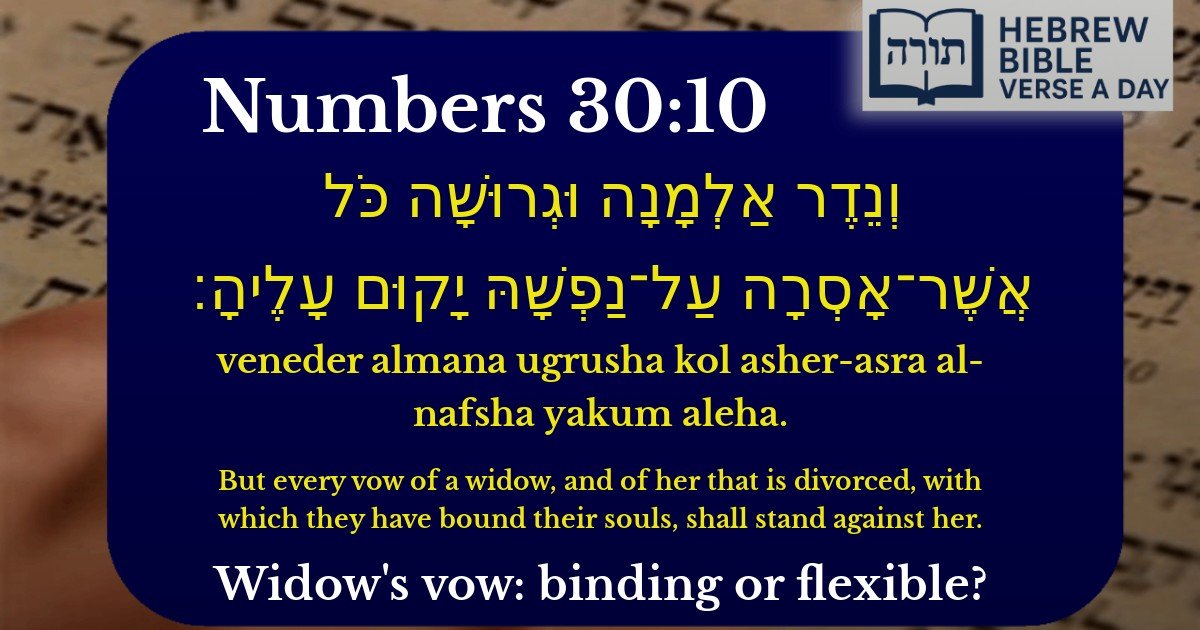
A: Numbers 30:10 teaches that vows made by widows or divorced women are binding and cannot be annulled by anyone else (unlike vows made by unmarried women, which could be annulled by their fathers, or married women, which could be annulled by their husbands). The verse emphasizes personal responsibility for one's commitments. Rashi explains that since these women are no longer under the authority of a father or husband, their vows 'shall stand against her'—meaning they are fully responsible for fulfilling them.
Q: Why is this verse about widows and divorced women important in Jewish law?
A: This verse is important in Jewish law (Halacha) because it establishes the principle that certain women have full autonomy over their vows. The Talmud (Nedarim 66b) discusses the legal implications, stating that widows and divorced women are treated as independent in matters of vows, unlike unmarried women who are under their father's authority or married women under their husband's authority. The Rambam (Hilchot Nedarim 12:1) codifies this law, showing its practical application.
Q: What can we learn from Numbers 30:10 about personal responsibility?
A: Numbers 30:10 teaches that when a person is fully independent (like a widow or divorced woman in this context), they bear complete responsibility for their words and commitments. The Midrash (Sifrei Bamidbar 153) highlights that vows are taken seriously because they 'bind the soul.' This reminds us to be careful with our promises and to recognize that our words have spiritual weight, especially when no one else can annul them for us.
Q: How does this verse apply to Jewish life today?
A: Today, this verse reinforces the Jewish value of integrity in speech. While the specific laws about vows may not apply as frequently in modern times, the principle remains: when we make commitments—whether in business, relationships, or mitzvot—we must take them seriously. The Chofetz Chaim (in his works on proper speech) often emphasized that keeping one's word is a foundation of trust and righteousness, aligning with the message of this verse.


Context in Torah
The verse (Bamidbar 30:10) discusses the laws of nedarim (vows) concerning widows and divorced women. Unlike a minor daughter or a married woman—whose vows may be annulled by a father or husband—a widow or divorced woman's vows are fully binding, as she has no male authority figure who can nullify them.
Rashi's Explanation
Rashi clarifies that the phrase "with which they have bound their souls" emphasizes that these women are fully responsible for their vows, just as a man is responsible for his own vows. Since they are no longer under the authority of a father or husband, their vows take full effect.
Rambam's Legal Perspective
In Hilchot Nedarim (12:1), the Rambam codifies this law, stating that a widow or divorced woman is "like a man in all regards concerning vows"—meaning her vows are irrevocable unless a Beit Din (Jewish court) finds grounds for annulment.
Midrashic Insight
The Midrash (Bamidbar Rabbah 20:10) connects this verse to the broader theme of personal responsibility. Since a widow or divorced woman is independent, her words carry full weight, teaching that one must be mindful of commitments made without reliance on others to nullify them.
Halachic Implications