Frequently Asked Questions
Q: What does Numbers 30:14 mean about vows and a husband's role?
A: Numbers 30:14 discusses the laws of vows (nedarim) made by a married woman. According to Orthodox Jewish interpretation, this verse teaches that a husband has the authority to uphold or nullify his wife's vows that involve self-affliction (such as fasting or abstaining from pleasures). This is derived from the Torah's system of family structure, where certain spiritual commitments may require mutual agreement to maintain harmony in the home. Rashi explains that this applies specifically to vows that affect marital relationships or personal well-being.
Q: Why is the concept of annulling vows important in Judaism?
A: In Judaism, vows (nedarim) are taken very seriously, as they create binding obligations. However, the Torah provides mechanisms—like a husband's or father's annulment—to prevent undue hardship or conflict. The Talmud (Nedarim) elaborates on this, emphasizing that vows should not lead to suffering or strife. The ability to annul certain vows ensures that spiritual commitments do not harm family unity or personal well-being, aligning with the Torah's values of shalom bayit (peace in the home) and compassion.
Q: How does Numbers 30:14 apply to Jewish life today?
A: Today, Orthodox Judaism still follows the principles of this verse. For example, before Yom Kippur, it is customary for a wife to annul any vows she may have unintentionally made by having her husband or a beit din (Jewish court) release her from them (Kol Nidrei). This practice, rooted in Numbers 30:14, ensures that vows do not create unintended spiritual burdens. The Rambam (Hilchot Nedarim) outlines detailed laws about vow annulment, showing its ongoing relevance in halachic life.
Q: What kinds of vows can a husband annul according to this verse?
A: Based on Numbers 30:14 and the Talmud (Nedarim 79a), a husband can only annul vows that involve 'afflicting the soul' (inui nefesh), such as fasting, abstaining from pleasures, or other forms of self-denial. Vows related to charity, Torah study, or positive mitzvot generally cannot be annulled. Rashi clarifies that the husband must annul the vow on the same day he hears it, as delaying invalidates his authority. The specifics are further detailed in halachic works like the Shulchan Aruch.


Context in the Torah
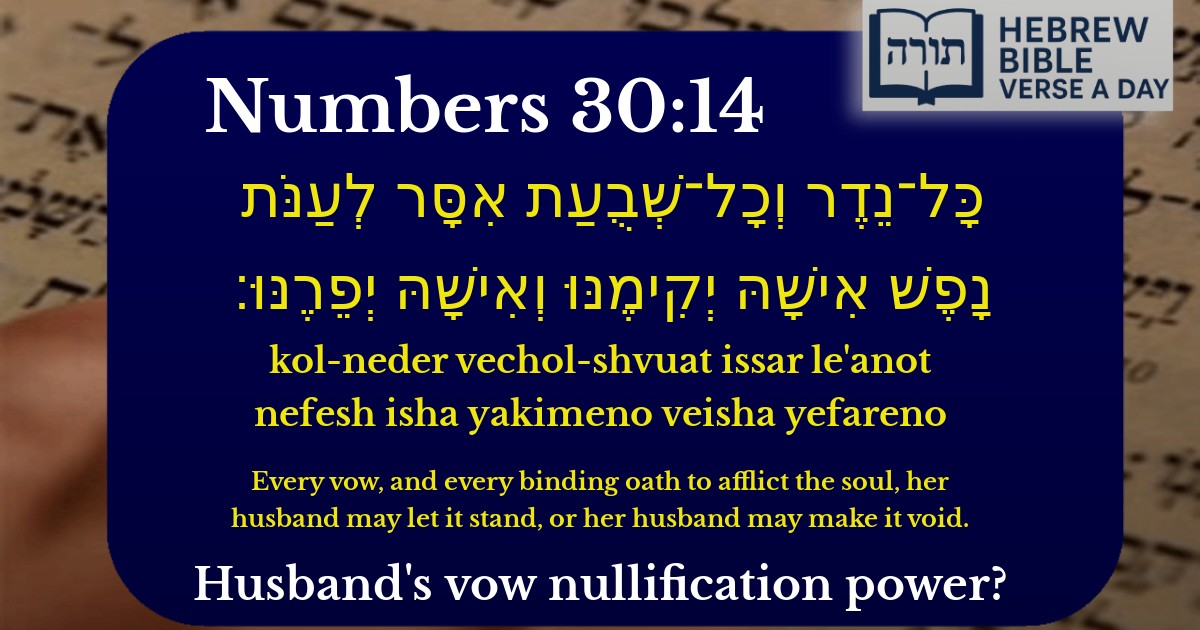
The verse (Bamidbar 30:14) discusses the laws of nedarim (vows) and shevuot (oaths) made by a married woman, particularly those involving self-affliction (inui nefesh). According to Torah law, a husband has the authority to affirm or nullify his wife's vows under certain conditions.
Rashi's Explanation
Rashi (Bamidbar 30:14) clarifies that the phrase "לְעַנֹּת נָפֶשׁ" ("to afflict the soul") refers specifically to vows involving fasting or other forms of self-denial, such as abstaining from pleasures. He explains that the husband's authority to nullify these vows stems from the Torah's concern for marital harmony (shalom bayit). If a wife takes upon herself excessive restrictions, it may negatively impact the relationship.
Rambam's Halachic Perspective
In Hilchot Nedarim (11:1), the Rambam elaborates that a husband may only nullify vows that affect the marital relationship or cause distress. This includes vows related to:
The Rambam emphasizes that the nullification must occur on the same day the husband hears of the vow (based on Bamidbar 30:15).
Talmudic Discussion (Nedarim 70b-71a)
The Gemara explores the scope of a husband's authority, stating that he may only annul vows that involve "עינוי נפש" (affliction of the soul) or those that affect their marital bond. Examples include:
Midrashic Insight (Sifrei Bamidbar 153)
The Midrash highlights that this law demonstrates the Torah's sensitivity to the dynamics of marriage. While a woman has the right to make vows, the Torah grants the husband a limited role in ensuring that these commitments do not harm their shared life. This reflects the principle that marriage is a partnership requiring mutual consideration.
Practical Halachic Considerations
Poskim (halachic decisors) note several key points: