Frequently Asked Questions
Q: What does Numbers 30:16 mean?
A: This verse discusses the laws of vows (nedarim) and states that if a husband nullifies his wife's vow after hearing it, he bears responsibility for her transgression if she breaks it. The Torah emphasizes the seriousness of verbal commitments and the husband's role in this specific case.
Q: Why is this verse about vows important?
A: Vows are extremely serious in Judaism, as our words have spiritual weight. This verse teaches that one must be careful with commitments and that certain relationships (like marriage) involve shared responsibility. The Talmud (Nedarim) elaborates on these laws extensively.
Q: What can we learn from Numbers 30:16 today?
A: We learn that words matter, promises must be kept, and relationships involve mutual accountability. Even today, before making vows or promises, we should consider them carefully, as the Rambam teaches in Hilchot Nedarim about the gravity of verbal commitments.
Q: Does this verse mean a husband controls his wife's vows?
A: No. Jewish law gives a husband (or father for an unmarried woman) limited ability to annul certain types of vows that affect their relationship, as explained in Talmud Nedarim. This is to maintain harmony, not control. Other personal vows cannot be annulled, showing respect for individual spiritual commitments.
Q: What does 'bear her iniquity' mean in this verse?
A: Rashi explains this means the husband bears the punishment if he nullifies the vow improperly or unnecessarily, since he prevented her from fulfilling a holy commitment. It teaches that spiritual leadership comes with responsibility before G-d.


Context of the Verse
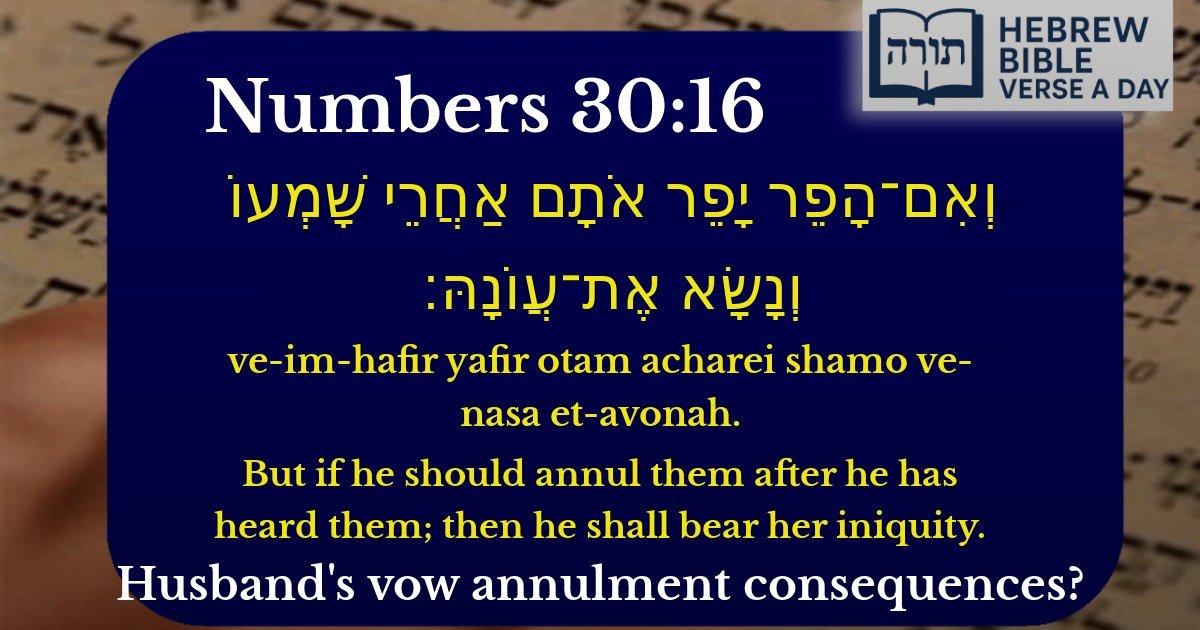
This verse (Numbers 30:16) appears in the Torah portion discussing the laws of vows (nedarim) and the authority of a husband or father to annul a woman's vows under certain conditions. The verse addresses the consequences if a husband annuls his wife's vows after initially confirming them.
Rashi's Explanation
Rashi explains that the phrase "וְאִם־הָפֵר יָפֵר" ("But if he should annul them") refers to a husband who initially heard his wife's vow and did not object, thereby implicitly accepting it, but later decides to annul it. In such a case, he bears the consequences of her iniquity ("וְנָשָׂא אֶת־עֲוֺנָהּ") because he acted improperly by reversing his stance after the fact.
Rambam's Perspective
Rambam (Hilchot Nedarim 12:15) elaborates that once a husband confirms a vow by silence or explicit agreement, he no longer has the right to annul it retroactively. If he attempts to do so, he violates the Torah's directive and assumes responsibility for the vow's transgression, as the annulment is invalid.
Midrashic Insight
The Midrash Tanchuma (Matot 7) emphasizes the moral lesson here: a person must be consistent in their words and commitments. The husband's failure to uphold his initial acceptance of the vow demonstrates a lack of integrity, for which he is held accountable.
Halachic Implications