
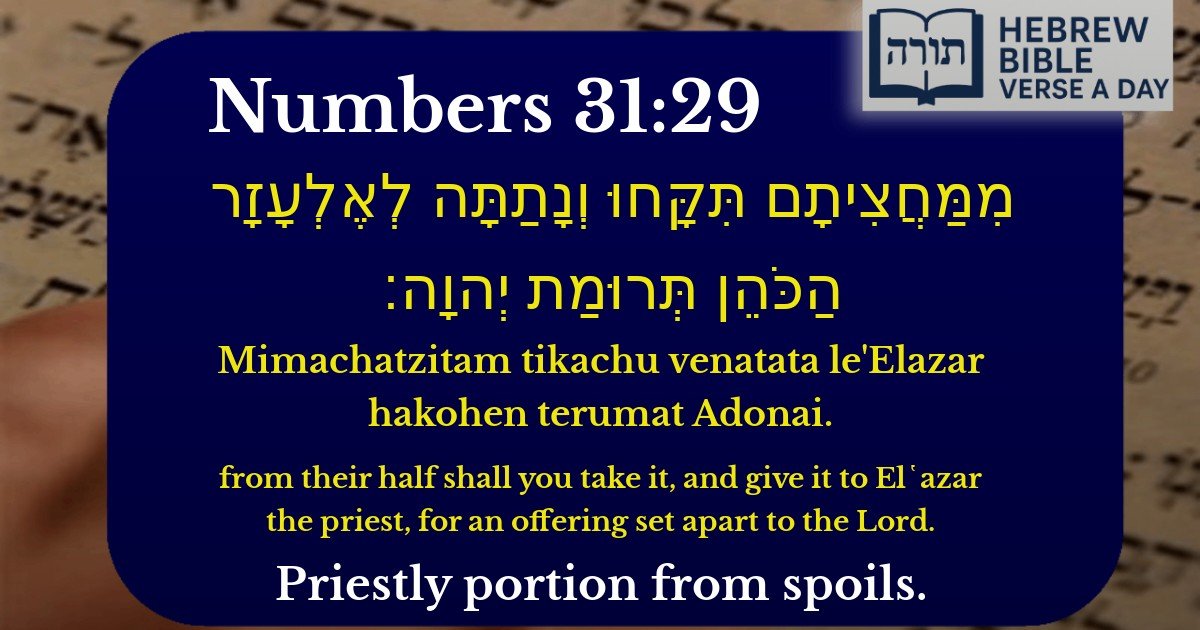

Numbers 31:29 - Priestly portion from spoils.

Numbers 31:29 - במדבר 31:29

Hebrew Text

מִמַּחֲצִיתָם תִּקָּחוּ וְנָתַתָּה לְאֶלְעָזָר הַכֹּהֵן תְּרוּמַת יְהוָה׃

English Translation

from their half shall you take it, and give it to El῾azar the priest, for an offering set apart to the Lord.

Transliteration

Mimachatzitam tikachu venatata le'Elazar hakohen terumat Adonai.

Hebrew Leining Text

מִמַּֽחֲצִיתָ֖ם תִּקָּ֑חוּ וְנָתַתָּ֛ה לְאֶלְעָזָ֥ר הַכֹּהֵ֖ן תְּרוּמַ֥ת יְהֹוָֽה׃

🎵 Listen to leining

Parasha Commentary

Context of the Verse

This verse (Bamidbar 31:41) appears in the context of the distribution of spoils from the war against Midian. The Torah instructs that half of the spoils taken by the soldiers should be given to the community, and from that half, a portion is to be given to Elazar the Kohen as a terumat Hashem (offering to the Lord).

Rashi's Explanation

Rashi (Bamidbar 31:41) clarifies that this portion given to Elazar the Kohen is terumah, akin to the terumat ma'aser (the tithe of the tithe) given to the Kohanim from agricultural produce. Just as terumah is sanctified and reserved for Kohanim, so too here, a portion of the spoils is designated for the Kohen as a sacred offering.

Rambam's Perspective

In Hilchot Melachim (8:1), Rambam discusses the laws of war spoils and explains that this portion given to the Kohen is a mitzvah derived from this verse. It emphasizes the Kohen's role in representing the Divine presence during military campaigns, ensuring that even in war, the sanctity of Hashem's portion is upheld.

Midrashic Insight

The Midrash (Bamidbar Rabbah 22:4) connects this verse to the broader theme of recognizing Hashem's hand in victory. By giving a portion to the Kohen, the soldiers acknowledge that their success in battle was not due to their own strength but through Divine assistance. This act of giving reinforces the principle of hakarat hatov (gratitude) to Hashem.

Halachic Implications

  • The portion given to the Kohen is one out of five hundred (1/500) from the half designated for the community, as derived from the subsequent verse (Bamidbar 31:52).
  • This teaches that even in extraordinary circumstances like war, the sanctity of the Kehunah (priesthood) and the obligation to support it remain in effect.
  • The Chatam Sofer notes that this mitzvah underscores the eternal bond between the Jewish people and the Kohanim, who serve as spiritual conduits.

📚 Talmud Citations

This verse is not quoted in the Talmud.

Frequently Asked Questions

Q: What does Numbers 31:29 mean when it says to take from 'their half' and give to Elazar the priest?
A: This verse refers to the division of spoils taken in battle against Midian. The Torah commands that half of the spoils go to the soldiers, and from that half, a portion (1 out of 500) was to be given to Elazar the Kohen as a 'terumat Hashem' (offering to G-d). Rashi explains this teaches that we must acknowledge G-d's role in our successes by giving a portion to those who serve in the Mishkan (Tabernacle).
Q: Why was the portion given specifically to Elazar the Kohen in Numbers 31:29?
A: Elazar was the Kohen Gadol (High Priest) at that time, and the verse teaches that offerings to G-d must be given through the proper channels of kedusha (holiness). The Rambam explains in Hilchot Terumot that this establishes the principle that holy gifts must be given to the Kohanim who serve in the Mishkan or Temple.
Q: What lesson can we learn today from Numbers 31:29 about sharing our possessions?
A: The Talmud (Chullin 131a) derives from this verse that when we benefit materially, we must set aside a portion for holy purposes. Today, this teaches us the importance of tzedakah (charity) and supporting Torah institutions. Just as the soldiers gave from their spoils, we should give a portion of our earnings to support Torah study and mitzvot.
Q: How does the concept of 'terumat Hashem' in Numbers 31:29 apply to maaser (tithing) today?
A: The Midrash (Bamidbar Rabbah 22:8) connects this verse to the broader concept of separating portions for holy purposes. While the exact terumah (heave offering) of the spoils was a one-time commandment, it establishes the principle that we separate maaser (a tenth) from our produce and earnings. The Shulchan Aruch (Yoreh De'ah 331) rules that this practice remains relevant even without the Temple.
Q: Why does the Torah specify giving the offering from the soldiers' half and not the other half?
A: Rashi explains that taking specifically from the soldiers' portion teaches that those who directly benefit from G-d's help (in this case, victory in battle) have a special obligation to show gratitude. The Talmud (Bava Kama 80b) derives from this that one who receives a miracle should increase their acts of charity and devotion.