

Join Our Newsletter To Be Informed When New Videos Are Posted
Hebrew Text
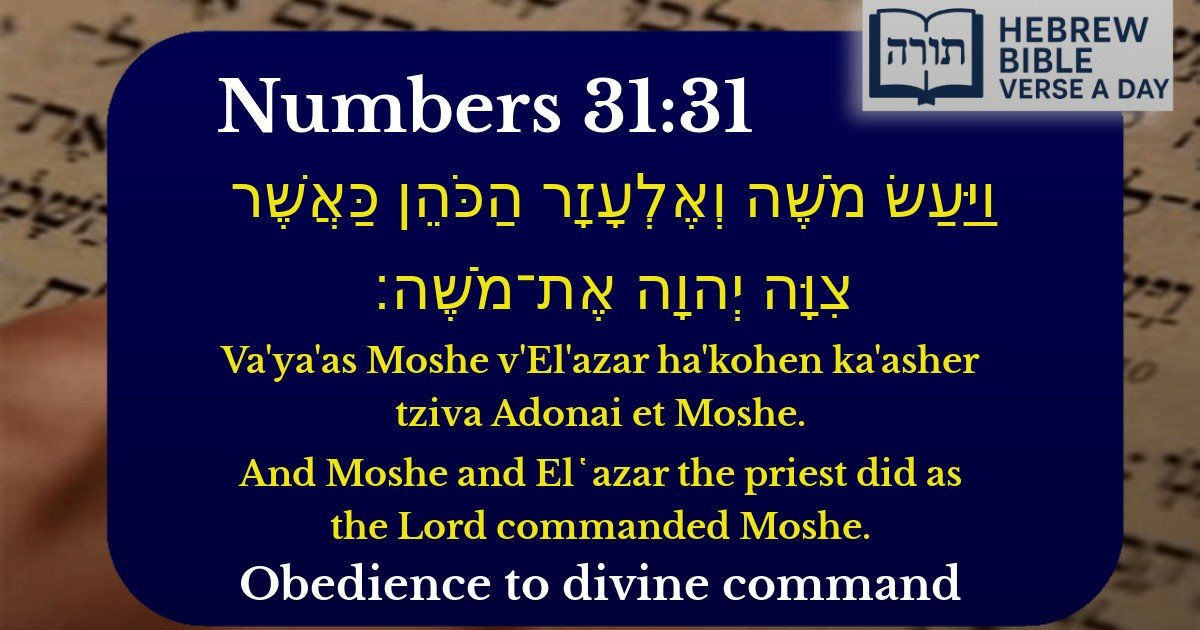
וַיַּעַשׂ מֹשֶׁה וְאֶלְעָזָר הַכֹּהֵן כַּאֲשֶׁר צִוָּה יְהוָה אֶת־מֹשֶׁה׃
English Translation
And Moshe and El῾azar the priest did as the Lord commanded Moshe.
Transliteration
Va'ya'as Moshe v'El'azar ha'kohen ka'asher tziva Adonai et Moshe.
Hebrew Leining Text
וַיַּ֣עַשׂ מֹשֶׁ֔ה וְאֶלְעָזָ֖ר הַכֹּהֵ֑ן כַּאֲשֶׁ֛ר צִוָּ֥ה יְהֹוָ֖ה אֶת־מֹשֶֽׁה׃
🎵 Listen to leining
Parasha Commentary
📚 Talmud Citations
This verse is not quoted in the Talmud.
Context of the Verse
This verse (Bamidbar 31:31) appears in the context of the aftermath of the war against Midian, where Moshe and Elazar the Kohen are instructed to divide the spoils of war between the warriors, the community, and a portion for Hashem. The verse emphasizes their precise fulfillment of the divine command.
Rashi's Explanation
Rashi (Bamidbar 31:31) highlights that this verse underscores the obedience of Moshe and Elazar to Hashem's command without deviation. He notes that even though Moshe was the primary leader, Elazar is mentioned alongside him because the division of spoils involved matters of ritual purity and sanctity, which fell under the Kohen's domain.
Rambam's Perspective
In Hilchot Melachim (Laws of Kings 8:1), Rambam discusses the laws of war spoils, deriving principles from this episode. He explains that the division was not arbitrary but followed a precise halachic framework, demonstrating that even in wartime, the Torah's laws must be meticulously observed.
Midrashic Insights
Halachic Implications
The Sefer HaChinuch (Mitzvah 527) connects this verse to the broader principle of following Torah commandments without alteration. The exactness of Moshe and Elazar's actions reinforces the idea that mitzvot must be performed as prescribed, without adding or subtracting.
Symbolic Meaning
The Kli Yakar (Bamidbar 31:31) suggests that the inclusion of both Moshe and Elazar signifies the balance between physical and spiritual leadership. Moshe represented the lawgiver and military leader, while Elazar embodied the priestly role, ensuring that the material spoils were sanctified for holy purposes.