

Join Our Newsletter To Be Informed When New Videos Are Posted
Hebrew Text
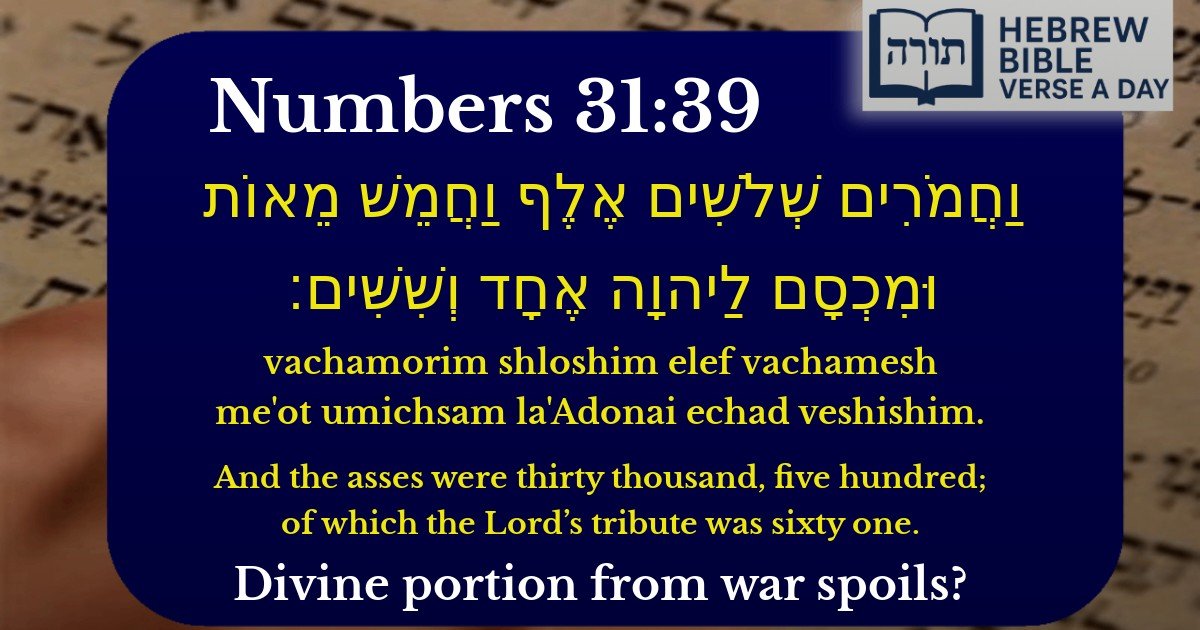
וַחֲמֹרִים שְׁלֹשִׁים אֶלֶף וַחֲמֵשׁ מֵאוֹת וּמִכְסָם לַיהוָה אֶחָד וְשִׁשִּׁים׃
English Translation
And the asses were thirty thousand, five hundred; of which the Lord’s tribute was sixty one.
Transliteration
Vachamorim shloshim elef vachamesh me'ot umichsam la'Adonai echad veshishim.
Hebrew Leining Text
וַחֲמֹרִ֕ים שְׁלֹשִׁ֥ים אֶ֖לֶף וַחֲמֵ֣שׁ מֵא֑וֹת וּמִכְסָ֥ם לַֽיהֹוָ֖ה אֶחָ֥ד וְשִׁשִּֽׁים׃
🎵 Listen to leining
Parasha Commentary
📚 Talmud Citations
This verse is not quoted in the Talmud.
Context of the Verse
This verse appears in Bamidbar (Numbers) 31:39, detailing the spoils of war taken by Bnei Yisrael from Midian. The Torah specifies the number of donkeys captured and the portion designated as a tribute to Hashem.
Explanation of the Numbers
Rashi (Bamidbar 31:39) explains that the Torah lists the spoils to emphasize the miracle of the battle—despite the small number of Israelite soldiers, they captured vast amounts of livestock. The 30,500 donkeys were part of the plunder, and the 61 donkeys were given as a terumah (tribute) to Hashem.
The Significance of the Tribute
The Mishnah (Bechorot 5:1) and Rambam (Hilchot Bekhorim 6:2) discuss the laws of terumat ma'aser (tithing). Here, the 61 donkeys represent a 1/500th portion given to the Kohanim, as derived from the verse. This parallels the tithe of animals in Vayikra (Leviticus) 27:32, where every tenth animal is holy.
Symbolism of Donkeys
The Midrash Tanchuma (Chukat 1) associates donkeys with material labor and burden-bearing. The large number captured signifies the wealth transferred from Midian to Israel, while the tribute acknowledges Hashem’s role in their victory. The Kli Yakar (Bamidbar 31:39) adds that donkeys, being impure animals, represent the kelipot (husks of impurity) subdued through sanctification when dedicated to Hashem.
Mathematical Precision