
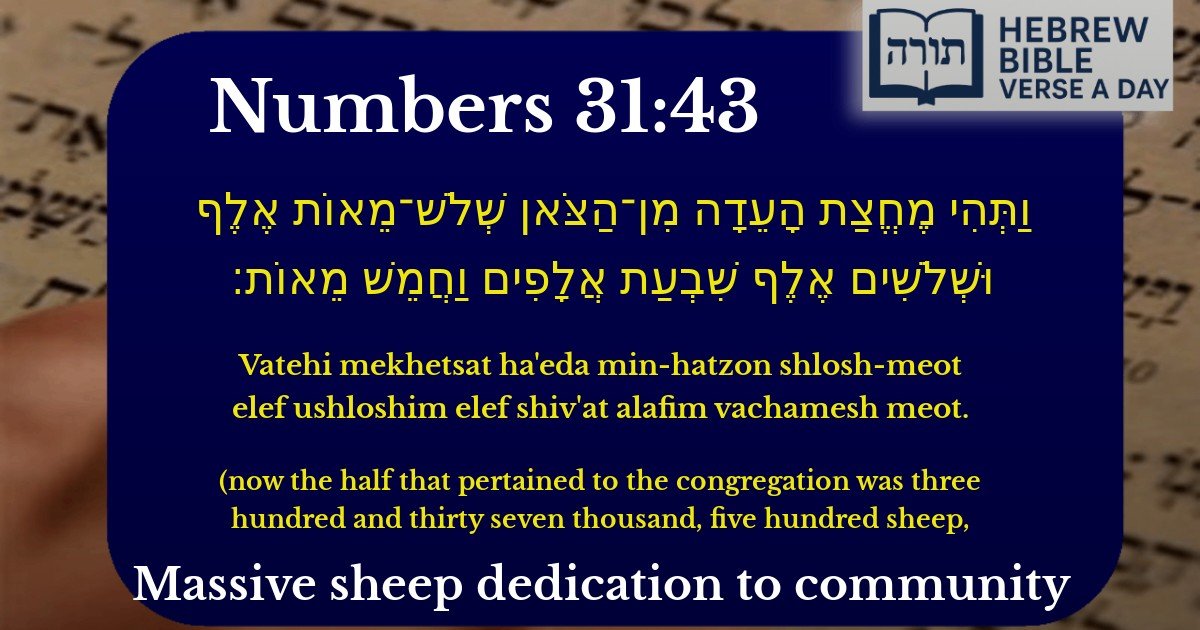

Numbers 31:43 - Massive sheep dedication to community

Numbers 31:43 - במדבר 31:43

Hebrew Text

וַתְּהִי מֶחֱצַת הָעֵדָה מִן־הַצֹּאן שְׁלֹשׁ־מֵאוֹת אֶלֶף וּשְׁלֹשִׁים אֶלֶף שִׁבְעַת אֲלָפִים וַחֲמֵשׁ מֵאוֹת׃

English Translation

(now the half that pertained to the congregation was three hundred and thirty seven thousand, five hundred sheep,

Transliteration

Vatehi mekhetsat ha'eda min-hatzon shlosh-meot elef ushloshim elef shiv'at alafim vachamesh meot.

Hebrew Leining Text

וַתְּהִ֛י מֶחֱצַ֥ת הָעֵדָ֖ה מִן־הַצֹּ֑אן שְׁלֹשׁ־מֵא֥וֹת אֶ֙לֶף֙ וּשְׁלֹשִׁ֣ים אֶ֔לֶף שִׁבְעַ֥ת אֲלָפִ֖ים וַחֲמֵ֥שׁ מֵאֽוֹת׃

🎵 Listen to leining

Parasha Commentary

Context in the Torah

The verse (Numbers 31:43) describes the division of spoils from the war against Midian, where half of the captured sheep were allocated to the congregation of Israel. This follows the commandment to take vengeance on Midian for leading Israel astray (Numbers 31:2). The precise counting of the sheep—337,500—reflects the Torah's emphasis on exactitude in matters of holiness and communal property.

Rashi's Commentary

Rashi (Rabbi Shlomo Yitzchaki) notes that the Torah specifies the exact number of sheep to teach that every detail of communal property must be accounted for with integrity. He cites the Talmud (Bava Metzia 42a), which states that blessings come only to that which is "hidden from the eye," meaning honest accounting avoids suspicion and invites divine favor.

Symbolism of the Number

  • 337,500 as a Multiple of 50: The Midrash (Bamidbar Rabbah 22:8) connects this number to the 50 levels of understanding (based on the 50 gates of Binah). The division of spoils required wisdom, reflecting the sanctity of the task.
  • Sheep as a Metaphor: The large number of sheep (צאן) may allude to Israel's role as a "flock" guided by Hashem (as in Ezekiel 34:31). Their abundance signifies divine providence after victory.

Halachic Implications

The Rambam (Maimonides, Hilchot Matnot Aniyim 1:1-2) derives from this verse that communal possessions must be distributed with transparency, as the spoils were meticulously counted before allocation. This principle extends to tzedakah and public funds in Jewish law.

Kli Yakar's Insight

Rabbi Shlomo Ephraim Luntschitz (Kli Yakar) emphasizes that the half given to the congregation (מחצת העדה) underscores collective responsibility. Even in material gains, the community shares equally, reinforcing unity—a lesson for all generations in handling communal wealth.

📚 Talmud Citations

This verse is not quoted in the Talmud.

Frequently Asked Questions

Q: What is the significance of the large number of sheep mentioned in Numbers 31:43?
A: The large number of sheep (337,500) highlights the great wealth and bounty that the Israelites acquired after their victory over Midian, as described in this chapter. According to Rashi, this emphasizes Hashem's kindness in providing for the Jewish people, even in the context of war. The division of spoils also teaches about fairness in distributing resources.
Q: Why does the Torah specify the exact count of sheep in Numbers 31:43?
A: The Torah often gives precise numbers to teach accuracy in accounting and honesty in handling communal property. Rambam (Hilchot Gezeilah 5:1) derives from such verses the importance of proper financial conduct, especially regarding public funds. The exact count also shows that every detail of the spoils was recorded and divided according to Hashem's command.
Q: How was the half of the sheep divided among the Israelites in Numbers 31:43?
A: As explained in the surrounding verses (Numbers 31:25-47), Moshe was commanded by Hashem to divide the spoils equally between the warriors and the rest of the congregation. The half mentioned in this verse (337,500 sheep) went to the general community, while the other half went to the soldiers. A portion was also separated as a tribute to Hashem and the Kohanim.
Q: What lesson can we learn from the division of spoils in Numbers 31:43?
A: The division teaches fairness, gratitude, and recognizing Hashem's role in success. The Midrash (Bamidbar Rabbah 22:8) explains that sharing the spoils equally between soldiers and the community reinforces unity. Additionally, setting aside a portion for the Mishkan (Tabernacle) reminds us to dedicate part of our material blessings to spiritual purposes.