Frequently Asked Questions
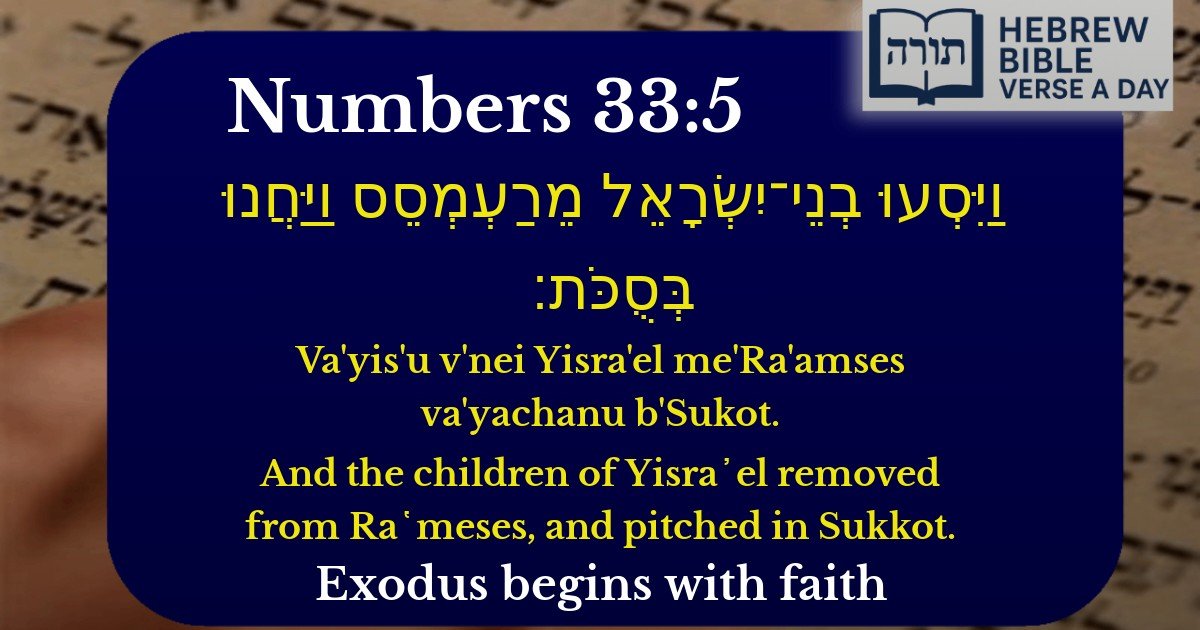
Q: What does the verse 'And the children of Yisra᾽el removed from Ra῾meses, and pitched in Sukkot' mean?
A: This verse describes the first stage of the Israelites' journey after leaving Egypt. 'Ra῾meses' was one of the cities where they had been enslaved (Exodus 1:11), and 'Sukkot' was their first stop in the wilderness. Rashi explains that Sukkot was a real place, not to be confused with the festival of Sukkot, though the name reminds us of how Hashem protected them with 'clouds of glory' during their travels.
Q: Why is the journey from Ra῾meses to Sukkot important?
A: This marks the beginning of the Israelites' physical and spiritual transition from slavery to freedom. The Rambam teaches that remembering the Exodus (including these details) helps strengthen our faith in Hashem. The Talmud (Pesachim 116b) also emphasizes recounting these details during the Passover Seder to fulfill the mitzvah of remembering the Exodus.
Q: What can we learn from the Israelites' first journey to Sukkot?
A: We learn that freedom is a process - the Israelites didn't immediately reach the Promised Land. The Midrash (Mechilta) notes that Sukkot represents temporary dwellings, teaching us to trust in Hashem's protection even during transitions. Just as they journeyed step by step, we too must grow spiritually through gradual steps.
Q: How does this verse connect to the holiday of Sukkot?
A: While this Sukkot was a physical location, our sages (Talmud, Sukkah 11b) connect it to the festival of Sukkot. Just as Hashem protected the Israelites with clouds of glory when they left Egypt, we sit in sukkahs to remember this divine protection. The verse thus reminds us of Hashem's constant care throughout our history.
Q: Why does the Torah specify these locations in the journey?
A: The Ramban explains that listing all the stops (as in Numbers 33) demonstrates Hashem's kindness - He led them carefully through the wilderness. Rashi adds that these details verify the miracle of the Exodus, as future generations could investigate these real locations. It teaches us that Judaism values historical truth and geographical accuracy.


Location and Significance of Ra'amses
According to Rashi (Shemot 12:37), Ra'amses was one of the storage cities built by the Israelites during their enslavement in Egypt (see Shemot 1:11). The name Ra'amses reflects its connection to Pharaoh, as it was named after him. The departure from Ra'amses marks the beginning of the Exodus, fulfilling Hashem's promise to take the Israelites out of Egypt.
The Journey to Sukkot
The Midrash (Mechilta d'Rabbi Yishmael, Bo 13) explains that Sukkot was the first stop in the Israelites' journey toward freedom. The name "Sukkot" (meaning "booths") is interpreted in multiple ways:
Symbolism of the Departure
Rambam (Moreh Nevuchim 3:24) notes that the Exodus was orchestrated in stages to strengthen the Israelites' faith and demonstrate Hashem's meticulous guidance. The journey from Ra'amses to Sukkot represents the transition from slavery to divine providence, as they moved from a place of oppression to one of protection.
Chronological Context
The Talmud (Pesachim 116b) connects this verse to the timeline of the Exodus, emphasizing that the departure occurred on the 15th of Nisan, the first day of Pesach. The journey to Sukkot was the initial step in fulfilling the geulah (redemption) promised to Avraham Avinu in the Covenant Between the Parts (Bereishit 15:13-14).