Frequently Asked Questions
Q: What does Numbers 35:22 mean?
A: Numbers 35:22 discusses accidental killing (manslaughter) where someone causes another's death without intent or premeditated hostility. The Torah distinguishes this from murder, as it describes scenarios like pushing someone suddenly or throwing an object without malice. This verse is part of the laws about cities of refuge (arei miklat) where accidental killers could seek safety.
Q: Why does the Torah differentiate between intentional and accidental killing?
A: The Torah emphasizes justice and fairness. Intentional murder (retzicha) carries severe consequences, while accidental killing (shegaga) requires a different response—exile to a city of refuge (Rambam, Hilchot Rotzeach 5-6). This distinction teaches the value of human life and the importance of accountability, even for unintended harm.
Q: What practical lesson can we learn from Numbers 35:22?
A: This verse reminds us to act carefully, as even unintended actions can have serious consequences. The Talmud (Makkot 10b) explains that accidental killers went to cities of refuge partly to reflect on their negligence. It teaches mindfulness in our behavior to avoid causing harm, whether physically or spiritually.
Q: How does the concept of 'without enmity' (בְּלֹא־אֵיבָה) apply today?
A: Rashi explains that 'without enmity' means no prior hatred existed between the individuals. Today, this teaches the importance of resolving conflicts peacefully and avoiding grudges, as unresolved tensions can lead to tragic outcomes—even unintentionally (Midrash Tanchuma, Masei 8).
Q: What is the significance of 'casting an object without lying in wait' in this verse?
A: The verse mentions causing death by throwing an object carelessly (e.g., a tool while working). The Talmud (Bava Kamma 32a) derives that one must ensure their actions won’t endanger others. This applies today to safety in workplaces, public spaces, and even speech—avoiding reckless behavior that could harm others.


Context in Torah
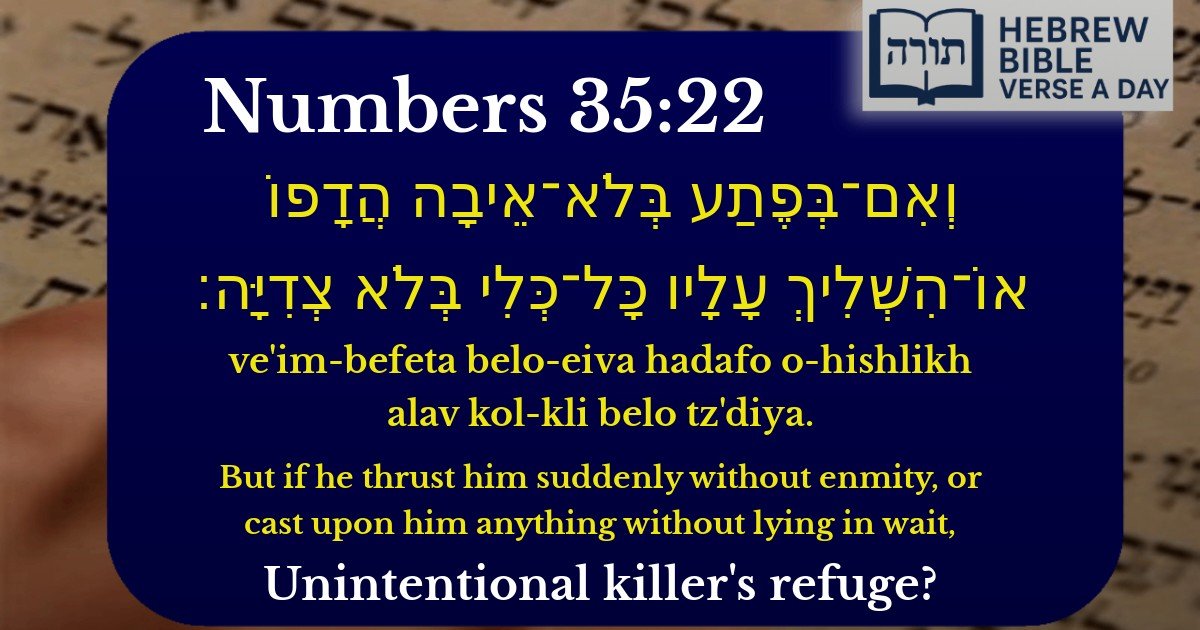
This verse (Numbers 35:22) appears in the context of the laws concerning accidental manslaughter (גּוֹרֵל שׁוֹגֵג) and the establishment of cities of refuge (עָרֵי מִקְלָט). It describes a scenario where one person causes the death of another unintentionally, without premeditation or enmity.
Rashi's Explanation
Rashi (Rabbi Shlomo Yitzchaki) comments that the phrase "בְּפֶתַע בְּלֹא־אֵיבָה" ("suddenly without enmity") teaches that the act must be entirely accidental, with no prior hostility between the parties. The term "הֲדָפוֹ" ("thrust him") refers to pushing someone without intent to kill, while "הִשְׁלִיךְ עָלָיו כָּל־כְּלִי" ("cast upon him any object") includes cases where an object is thrown without aiming at the victim.
Rambam's Legal Analysis
In Mishneh Torah (Hilchot Rotzeach 5:2), the Rambam (Maimonides) rules that this verse defines the parameters of unintentional killing. The absence of "צְדִיָּה" ("lying in wait") is crucial—it means the perpetrator did not plan the act, distinguishing it from murder (רְצִיחָה). Such cases require exile to a city of refuge.
Talmudic Discussion
Midrashic Insight
The Midrash Tanchuma (Masei 8) connects this law to Divine providence: even accidental deaths are not truly "random," but occur under Hashem's decree. The cities of refuge thus serve as both physical protection and spiritual rectification for the perpetrator.
Halachic Implications
As codified in Shulchan Aruch (Choshen Mishpat 425:1), these criteria determine whether a killer is eligible for exile. Key factors include: