Frequently Asked Questions
Q: What does 'the revenger of blood' mean in Numbers 35:27?
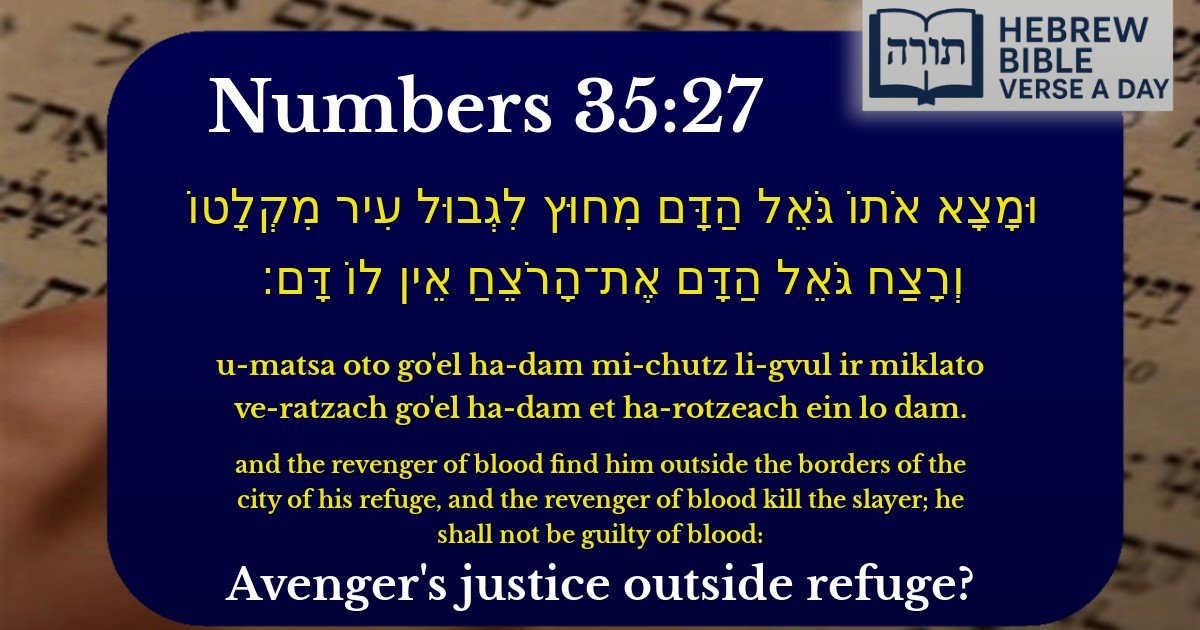
A: The 'revenger of blood' (גואל הדם) refers to a close relative of a murder victim who has the responsibility to pursue justice. According to Jewish law (based on the Torah and Talmud), this does not mean taking personal revenge, but rather ensuring justice is carried out through proper legal channels. The verse discusses the case where a murderer leaves a city of refuge, and the revenger is permitted to act.
Q: Why does the Torah allow the revenger of blood to kill the murderer outside the city of refuge?
A: The Torah permits this only under strict conditions: the murderer must have been convicted of intentional murder (not accidental killing) and then left the safety of the city of refuge (Rashi on Numbers 35:27). This law emphasizes the severity of murder and the importance of justice. The cities of refuge were meant to protect accidental killers, not intentional murderers.
Q: What is the significance of the phrase 'he shall not be guilty of blood' in this verse?
A: This means the revenger of blood will not be held accountable for killing the murderer in this specific case, as he is carrying out justice according to Torah law (Rambam, Hilchos Rotzeach 5:12). However, this only applies if all the legal conditions are met - the killing must have been intentional, properly judged, and the murderer left the city of refuge.
Q: How does this verse about cities of refuge apply today?
A: While we don't have cities of refuge or this exact system today, the principles remain important: 1) The gravity of murder in Jewish law, 2) The distinction between intentional and accidental acts, and 3) That justice must be carried out properly, not through vigilante action (Talmud Makkot 10a). Today, these matters would be handled by proper courts and legal systems.
Q: What lesson can we learn from Numbers 35:27 about justice?
A: This verse teaches us that while justice is crucial, it must follow proper procedures. The revenger could only act when the murderer left the designated safe area, showing that even justice has boundaries. The Talmud (Makkot 7a) discusses how careful courts must be with capital cases, teaching us the value of both justice and proper legal process.


Context of the Verse
This verse (Numbers 35:27) is part of the Torah's discussion of the laws concerning the cities of refuge (ערי מקלט). These cities were designated as safe havens for individuals who committed unintentional manslaughter, protecting them from the "go'el hadam" (גואל הדם), the blood avenger—typically a close relative of the victim who sought retribution.
Explanation of the Verse
The verse states that if the blood avenger finds the unintentional killer outside the boundaries of a city of refuge and kills him, the avenger is not guilty of murder. Rashi explains that this is because the killer had already been judged as deserving of death by the court, but was granted the protection of the city of refuge as an act of mercy. By leaving the city, the killer forfeits this protection.
Halachic Implications
Moral and Ethical Lessons
The Midrash (Tanchuma, Masei 8) teaches that this law underscores the sanctity of human life. Even an unintentional killer must face consequences, but the Torah provides a balanced approach—protection within the city of refuge, yet accountability if its boundaries are violated. This reflects the principle that justice must be tempered with compassion, but not at the expense of responsibility.
Additional Insights
The Sforno notes that the phrase "אין לו דם" ("he has no blood") means the blood avenger is not held accountable, as the killer's death is considered a form of divine justice. The Netziv adds that this law serves as a deterrent, encouraging unintentional killers to remain in the city of refuge until the death of the Kohen Gadol, as prescribed elsewhere in the Torah.