

Join Our Newsletter To Be Informed When New Videos Are Posted
Hebrew Text
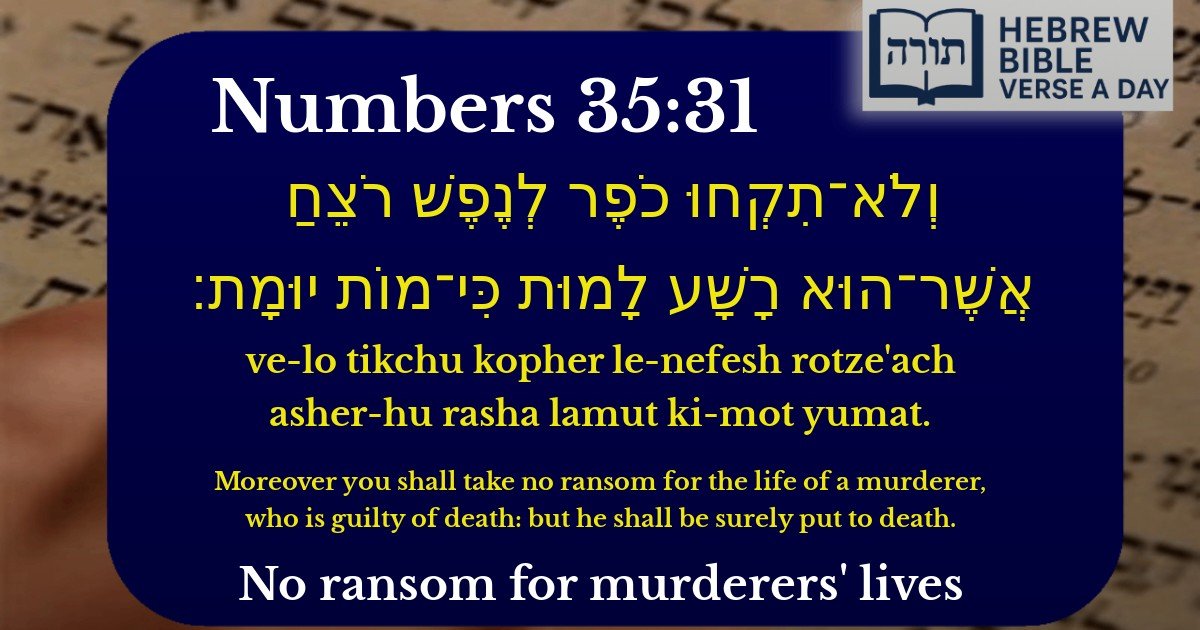
וְלֹא־תִקְחוּ כֹפֶר לְנֶפֶשׁ רֹצֵחַ אֲשֶׁר־הוּא רָשָׁע לָמוּת כִּי־מוֹת יוּמָת׃
English Translation
Moreover you shall take no ransom for the life of a murderer, who is guilty of death: but he shall be surely put to death.
Transliteration
Ve-lo tikchu kopher le-nefesh rotze'ach asher-hu rasha lamut ki-mot yumat.
Hebrew Leining Text
וְלֹֽא־תִקְח֥וּ כֹ֙פֶר֙ לְנֶ֣פֶשׁ רֹצֵ֔חַ אֲשֶׁר־ה֥וּא רָשָׁ֖ע לָמ֑וּת כִּי־מ֖וֹת יוּמָֽת׃
🎵 Listen to leining
Parasha Commentary
📚 Talmud Citations
This verse is quoted in the Talmud.
📖 Sanhedrin 52b
The verse is cited in a discussion about the prohibition of accepting ransom for a murderer, emphasizing that a murderer must be put to death and no monetary compensation can be accepted in lieu of execution.
📖 Makkot 5b
Referenced in the context of discussing the laws of murder and the inapplicability of ransom, reinforcing the principle that a murderer cannot escape capital punishment through payment.
Prohibition Against Accepting Ransom for a Murderer
The verse (Bamidbar 35:31) states unequivocally that one may not accept a ransom (kofer) for the life of a murderer who is guilty of death. This law emphasizes the severity of murder and the absolute requirement for justice in such cases.
Rashi's Explanation
Rashi comments that this verse teaches that even if the murderer offers all the money in the world, and even if the victim's family is willing to accept compensation, the court is forbidden to accept it. The Torah insists that the murderer must be put to death (ki-mos yumas), as there is no atonement for his crime other than his own life.
Rambam's Legal Perspective
In Hilchos Rotzeach U’Shemiras Nefesh (1:4), the Rambam codifies this law, stating that a murderer may not be pardoned or have his sentence commuted under any circumstances. He explains that accepting a ransom would undermine the deterrent effect of the death penalty and devalue human life, as it would imply that a life can be compensated monetarily.
Talmudic Discussion
The Gemara in Sanhedrin (45b) derives from this verse that the prohibition applies even if the murderer is a Torah scholar or a person of high stature. No exceptions are made, reinforcing the principle that justice must be impartial and absolute.
Moral and Theological Implications
Midrashic Insight
The Sifrei (Bamidbar 161) elaborates that this law reflects the principle of "middah k'neged middah" (measure for measure): just as the murderer showed no mercy in taking a life, the court must show no mercy in carrying out justice.