
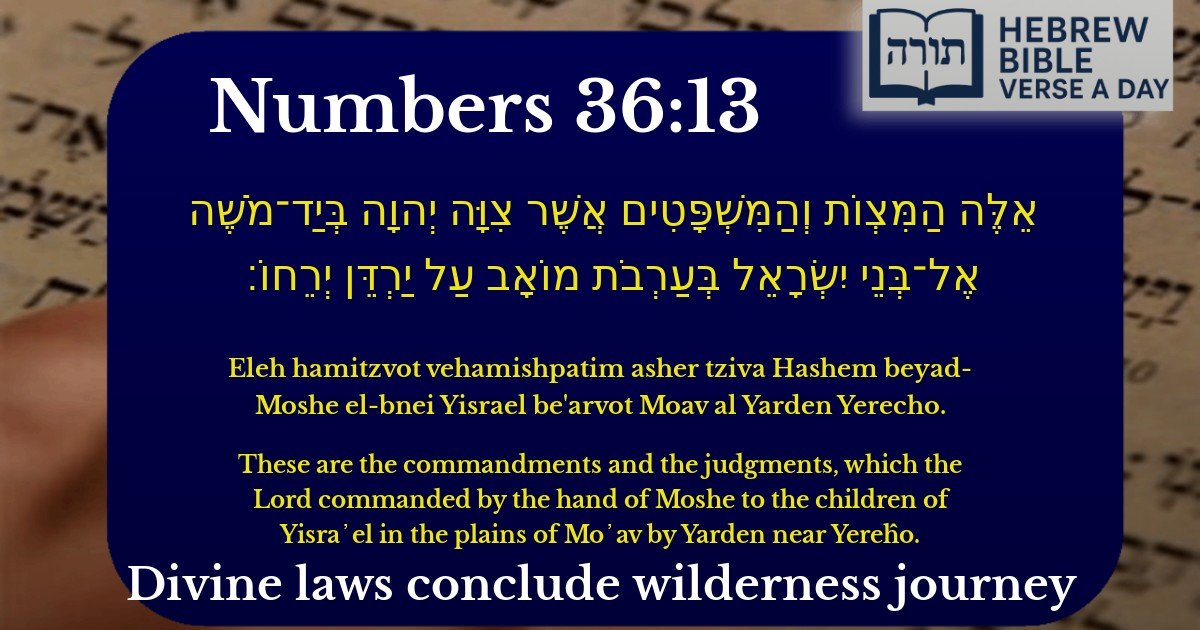

Numbers 36:13 - Divine laws conclude wilderness journey

Numbers 36:13 - במדבר 36:13

Hebrew Text

אֵלֶּה הַמִּצְוֺת וְהַמִּשְׁפָּטִים אֲשֶׁר צִוָּה יְהוָה בְּיַד־מֹשֶׁה אֶל־בְּנֵי יִשְׂרָאֵל בְּעַרְבֹת מוֹאָב עַל יַרְדֵּן יְרֵחוֹ׃

English Translation

These are the commandments and the judgments, which the Lord commanded by the hand of Moshe to the children of Yisra᾽el in the plains of Mo᾽av by Yarden near Yereĥo.

Transliteration

Eleh hamitzvot vehamishpatim asher tziva Hashem beyad-Moshe el-bnei Yisrael be'arvot Moav al Yarden Yerecho.

Hebrew Leining Text

אֵ֣לֶּה הַמִּצְוֺ֞ת וְהַמִּשְׁפָּטִ֗ים אֲשֶׁ֨ר צִוָּ֧ה יְהֹוָ֛ה בְּיַד־מֹשֶׁ֖ה אֶל־בְּנֵ֣י יִשְׂרָאֵ֑ל בְּעַֽרְבֹ֣ת מוֹאָ֔ב עַ֖ל יַרְדֵּ֥ן יְרֵחֽוֹ׃

🎵 Listen to leining

Parasha Commentary

Context of the Verse

The verse (Bamidbar 36:13) serves as the concluding statement of Sefer Bamidbar (the Book of Numbers), summarizing the transmission of the mitzvot (commandments) and mishpatim (judgments) to Bnei Yisrael. Rashi explains that this verse emphasizes that Moshe did not withhold any mitzvah from the people—everything was faithfully transmitted "by the hand of Moshe" as instructed by Hashem.

The Significance of "Commandments and Judgments"

The terms "mitzvot" and "mishpatim" are distinct in Jewish thought:

  • Mitzvot (Commandments): These include both chukim (statutes with no apparent rationale, such as kashrut) and eidot (testimonial laws, like Shabbat). Rambam (Hilchot Yesodei HaTorah 9:1) teaches that all mitzvot, regardless of human understanding, are divine decrees.
  • Mishpatim (Judgments): These are laws with evident ethical or logical basis, such as civil and criminal statutes. The Sforno notes that mishpatim reflect the inherent justice embedded in Torah, accessible even to human reasoning.

The Location: Plains of Moav

The verse specifies that these laws were given "in the plains of Moav," near the Jordan River opposite Yericho. The Kli Yakar highlights the significance of this location:

  • It marks the transition from wilderness wandering to entering Eretz Yisrael, symbolizing the need for these laws to guide the nation in their new homeland.
  • The proximity to Yericho—the first city to be conquered—underscores the practical application of these commandments in establishing a just society.

Transmission "by the Hand of Moshe"

The phrase "בְּיַד־מֹשֶׁה" (by the hand of Moshe) is interpreted by the Midrash (Sifrei Bamidbar 157) as affirming Moshe's unique role as the faithful conduit of Torah. The Ramban adds that this wording reinforces the belief in Torah MiSinai—that every law, whether explicitly stated or derived through halachic process, originates from divine revelation through Moshe.

📚 Talmud Citations

This verse is not quoted in the Talmud.

Frequently Asked Questions

Q: What does Numbers 36:13 mean?
A: Numbers 36:13 concludes the book of Bamidbar (Numbers) by summarizing that these are the commandments and laws that Hashem gave to the Jewish people through Moshe in the plains of Moav, near the Jordan River by Jericho. Rashi explains that this verse serves as a reminder that all the mitzvot were given by Hashem to Moshe to transmit to Bnei Yisrael.
Q: Why is Numbers 36:13 important?
A: This verse is important because it emphasizes the divine origin of the Torah's commandments. The Rambam (Maimonides) teaches in his introduction to Mishneh Torah that every mitzvah comes directly from Hashem through Moshe, reinforcing the authenticity and authority of Jewish law.
Q: What can we learn from Numbers 36:13?
A: We learn that the Torah's commandments are not human inventions but were given by Hashem. The Talmud (Sanhedrin 56a) notes that even laws given in specific locations (like the plains of Moav) apply to all Jews everywhere, teaching us the eternal and universal nature of Torah.
Q: How does Numbers 36:13 apply today?
A: This verse reminds us that the mitzvot are binding for all generations. The Midrash (Sifrei) explains that just as Bnei Yisrael accepted the commandments in Moshe's time, we too must uphold them with the same commitment, recognizing their divine origin and eternal relevance.
Q: Why does the verse mention the location where the commandments were given?
A: The mention of the plains of Moav teaches us that Torah was given in different places to show that it applies everywhere. Rashi notes that just as these laws were given in the wilderness and in Moav, they are equally binding whether one lives in Israel or outside of it.