Frequently Asked Questions
Q: What does 'Shema Yisrael' mean?
A: 'Shema Yisrael' means 'Hear, O Israel' and is the beginning of the most important prayer in Judaism. It declares the oneness of Hashem (G-d) and is a fundamental statement of Jewish faith. The verse (Devarim 6:4) affirms that Hashem is our G-d and that He is One, with no divisions or partners.
Q: Why is the Shema so important in Judaism?
A: The Shema is central to Jewish belief because it proclaims the absolute unity of Hashem. The Rambam (Maimonides) lists belief in Hashem's oneness as the first of the 13 Principles of Faith. Jews recite it twice daily (morning and evening) as a mitzvah from the Torah, fulfilling the commandment to 'speak of them... when you lie down and when you rise up' (Devarim 6:7).
Q: What does it mean that 'Hashem is One'?
A: When we say 'Hashem is One,' we mean that G-d is absolutely unique, indivisible, and the only true existence. Rashi explains that Hashem is the only G-d now and will always be—no other force has true power. The Ibn Ezra adds that this oneness means Hashem is singular in every way—not composed of parts, not limited by time or space, and unlike anything in creation.
Q: Why do we cover our eyes when saying the Shema?
A: Covering our eyes (with the right hand) while reciting the first verse of Shema helps us focus completely on the words without distraction, as if declaring this truth with our entire being. The Mishnah Berurah (Orach Chaim 61:5) explains that this gesture demonstrates our complete acceptance of Hashem's kingship, blocking out the physical world to concentrate on spiritual connection.
Q: How can we apply the message of Shema in daily life?
A: The Shema teaches us to recognize Hashem's presence in every aspect of life. The Talmud (Berachot 13b) says reciting it with proper intention accepts the 'yoke of Heaven.' Practically, this means: 1) Living with awareness that Hashem is One and involved in the world, 2) Aligning our actions with Torah values, and 3) Using every moment—whether mundane or holy—to serve G-d with complete devotion.

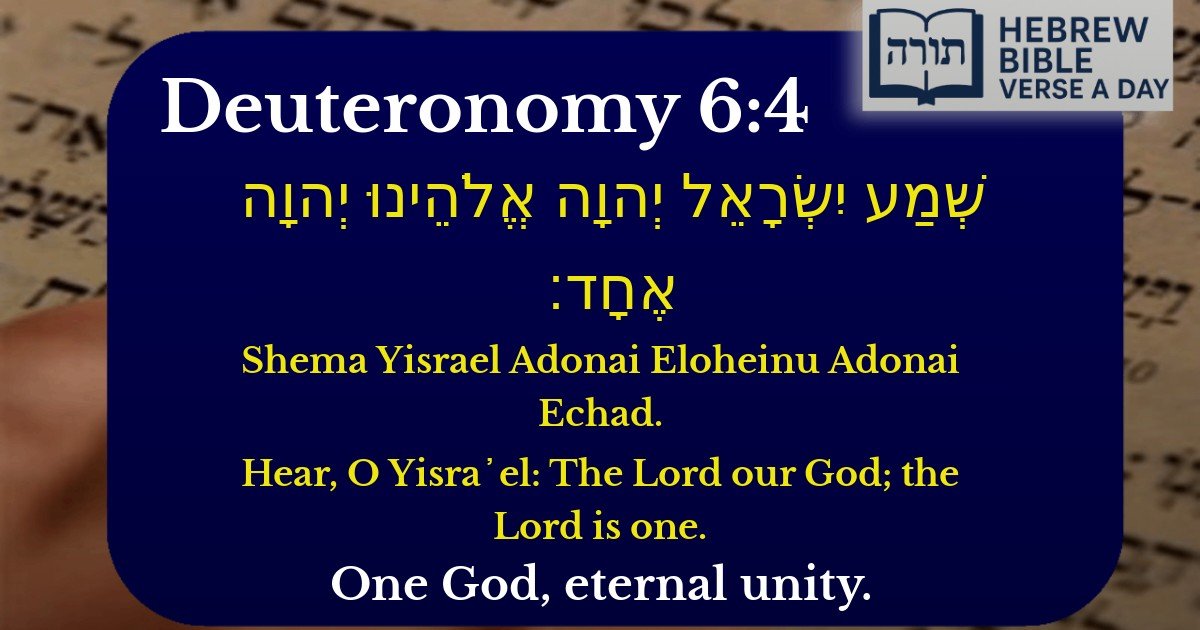

The Shema: Foundation of Jewish Faith
The verse "שְׁמַע יִשְׂרָאֵל יְהוָה אֱלֹהֵינוּ יְהוָה אֶחָד" (Devarim 6:4) is the foundational declaration of Jewish monotheism, known as the Shema Yisrael. It affirms the absolute oneness of Hashem and serves as a daily proclamation of faith for the Jewish people.
Rashi's Explanation
Rashi (Devarim 6:4) interprets the phrase "ה' אֶחָד" ("Hashem is one") to mean that Hashem is the only God now and will be recognized as the only God in the future, even by all nations. This reflects the prophetic vision of universal recognition of Hashem's sovereignty (Zechariah 14:9).
Rambam's Philosophical Perspective
In Hilchot Yesodei HaTorah (1:7), the Rambam (Maimonides) explains that this verse teaches not merely that Hashem is numerically one, but that He is unique in His essence—utterly unlike any created being, without division or multiplicity. This forms the basis of the 13 Principles of Faith.
Talmudic Insights
Kabbalistic Dimensions
The Zohar (Devarim 267b) explains that the three names of Hashem in this verse (יְהוָה אֱלֹהֵינוּ יְהוָה) correspond to different levels of divine manifestation, yet they are ultimately unified in absolute oneness. This reflects the mystical understanding of Hashem's unity permeating all levels of existence.
Practical Halachic Implications