
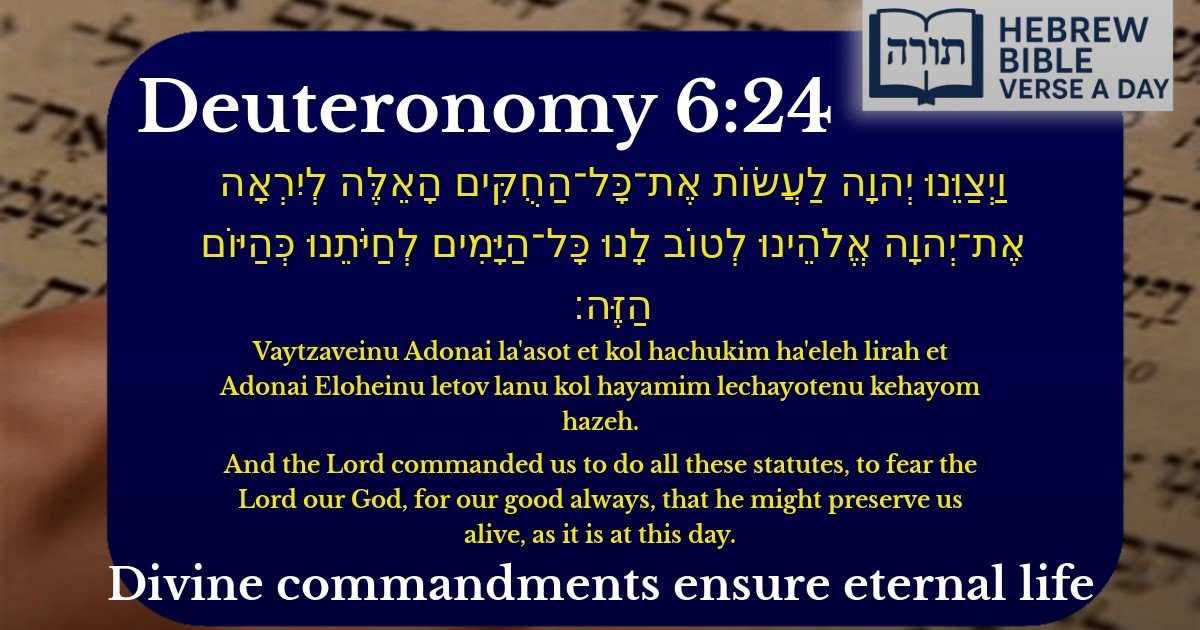

Deuteronomy 6:24 - Divine commandments ensure eternal life

Deuteronomy 6:24 - דברים 6:24

Hebrew Text

וַיְצַוֵּנוּ יְהוָה לַעֲשׂוֹת אֶת־כָּל־הַחֻקִּים הָאֵלֶּה לְיִרְאָה אֶת־יְהוָה אֱלֹהֵינוּ לְטוֹב לָנוּ כָּל־הַיָּמִים לְחַיֹּתֵנוּ כְּהַיּוֹם הַזֶּה׃

English Translation

And the Lord commanded us to do all these statutes, to fear the Lord our God, for our good always, that he might preserve us alive, as it is at this day.

Transliteration

Vaytzaveinu Adonai la'asot et kol hachukim ha'eleh lirah et Adonai Eloheinu letov lanu kol hayamim lechayotenu kehayom hazeh.

Hebrew Leining Text

וַיְצַוֵּ֣נוּ יְהֹוָ֗ה לַעֲשׂוֹת֙ אֶת־כׇּל־הַחֻקִּ֣ים הָאֵ֔לֶּה לְיִרְאָ֖ה אֶת־יְהֹוָ֣ה אֱלֹהֵ֑ינוּ לְט֥וֹב לָ֙נוּ֙ כׇּל־הַיָּמִ֔ים לְחַיֹּתֵ֖נוּ כְּהַיּ֥וֹם הַזֶּֽה׃

🎵 Listen to leining

Parasha Commentary

The Commandment to Observe the Statutes

The verse states, "And the Lord commanded us to do all these statutes", emphasizing the divine origin of the mitzvot. Rashi (Devarim 6:24) explains that the term "חֻקִּים" (chukim) refers to decrees—commandments whose reasons are not immediately apparent to human understanding, yet we fulfill them solely because they are the will of the Creator. The Rambam (Hilchot Meilah 8:8) teaches that even mitzvot whose rationale is unclear must be observed with the same reverence as those whose purpose is evident.

The Purpose: Fear of Heaven (Yirat Shamayim)

The verse continues, "to fear the Lord our God", indicating that the ultimate goal of mitzvah observance is to cultivate yirat Shamayim (fear of Heaven). The Sifri (Devarim 41) elaborates that performing mitzvot with proper intent leads one to a deeper awareness of Hashem’s presence. The Ramban (Devarim 6:24) adds that yirah is not merely fear of punishment but awe of the Divine Majesty, inspiring a person to align their actions with the will of Hashem.

For Our Eternal Benefit

The verse concludes, "for our good always, that He might preserve us alive, as it is at this day". The Talmud (Berachot 5a) teaches that even when mitzvot seem difficult, they are ultimately for our benefit—both spiritually and physically. The Midrash (Devarim Rabbah 3:5) explains that "for our good" refers to the World to Come (Olam Haba), while "to preserve us alive" alludes to blessings in this world. The Netziv (Ha'amek Davar) notes that the phrase "as it is at this day" serves as a reminder of Hashem’s continuous providence, sustaining us just as He did in the wilderness.

Key Lessons from the Verse

  • Divine Authority: Mitzvot are binding because they originate from Hashem, not human reasoning.
  • Spiritual Growth: Observance leads to yirat Shamayim, the foundation of a meaningful relationship with Hashem.
  • Ultimate Good: Mitzvot bring benefit in both this world and the next, even if their purpose is not always apparent.

📚 Talmud Citations

This verse is not quoted in the Talmud.

Frequently Asked Questions

Q: What does it mean to 'fear the Lord our God' in Deuteronomy 6:24?
A: In Orthodox Jewish tradition, 'fearing the Lord' (יראת ה׳) means having awe and reverence for Hashem, recognizing His greatness and authority. Rashi explains that this fear motivates us to observe the mitzvot properly. The Rambam (Hilchot Yesodei HaTorah 2:1-2) teaches that this fear is the foundation of serving Hashem and leads to spiritual growth.
Q: Why does the verse say keeping mitzvot is 'for our good always'?
A: The Torah teaches that mitzvot are ultimately for our benefit, both spiritually and physically. The Sforno explains that following Hashem's commandments brings lasting goodness—sometimes in this world (like societal harmony) and always in the World to Come. The Talmud (Eruvin 13b) states that even when we don't understand a mitzvah's reason, we trust in Hashem's wisdom that it's for our eternal good.
Q: How does this verse apply to Jewish life today?
A: This verse reminds us that Torah observance is timeless. The Chofetz Chaim taught that every generation must see itself as receiving the Torah anew. By keeping mitzvot with proper intention (like the 'fear of Heaven' mentioned here), we merit divine protection and blessing, just as our ancestors did. The phrase 'as it is this day' implies the mitzvot sustain Jewish continuity in every era.
Q: What is the connection between mitzvot and being 'preserved alive'?
A: The Midrash (Sifrei Devarim) explains that Torah observance brings both physical and spiritual vitality. On a national level, it ensures Jewish survival (as seen throughout history). On a personal level, the Vilna Gaon teaches that each mitzvah elevates the soul. The Talmud (Makot 23b) also notes that mitzvot are 'life-giving' by protecting us from negative influences.
Q: Why does the verse emphasize doing 'all these statutes'?
A: The Torah stresses completeness in mitzvah observance. Ramban explains that we shouldn't selectively choose which commandments to follow—every mitzvah has divine wisdom. The Talmud (Avodah Zarah 3a) compares this to a king's decree where ignoring any part is rebellion. 'All' also implies doing mitzvot both in action and intention, as the Mishnah (Avot 1:3) teaches about serving Hashem wholeheartedly.