Frequently Asked Questions
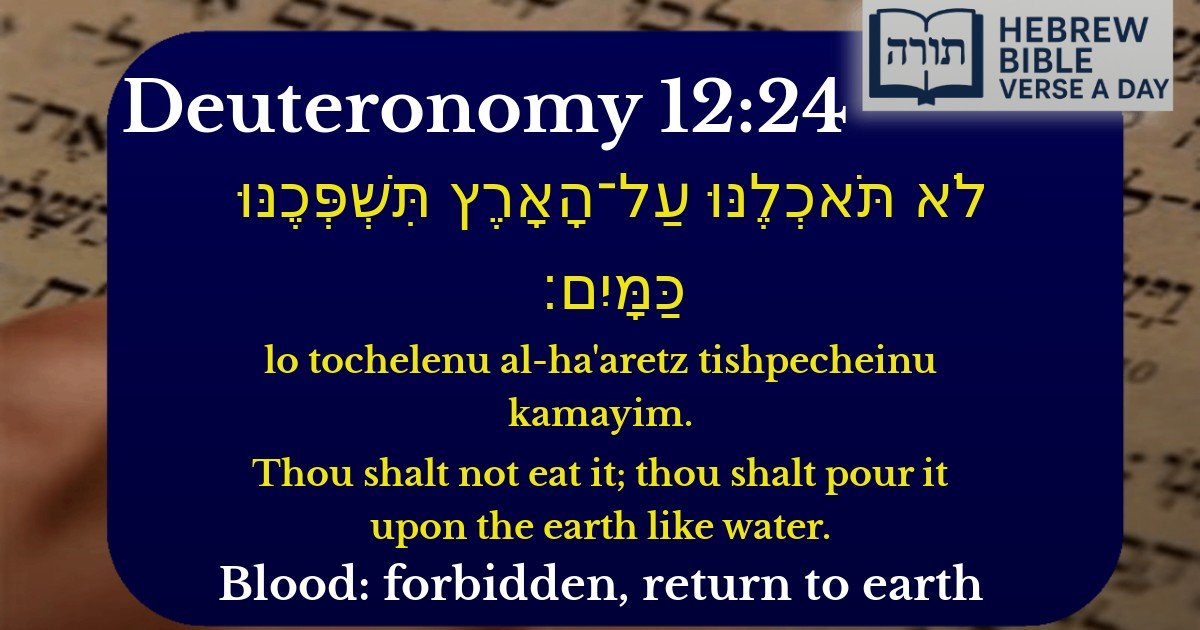
Q: What does Deuteronomy 12:24 mean when it says 'Thou shalt not eat it; thou shalt pour it upon the earth like water'?
A: This verse refers to the prohibition against consuming blood, which is a fundamental law in the Torah (Vayikra 17:10-14). The Torah commands that when slaughtering an animal for food, the blood must be drained and poured out on the ground like water, rather than consumed. Rashi explains that this teaches us to treat blood with respect, as it represents the life-force (nefesh) of the animal.
Q: Why is it important not to eat blood according to the Torah?
A: The Torah (Vayikra 17:11) states that 'the life of the flesh is in the blood,' and therefore it is sacred. The Rambam (Hilchos Ma'achalos Asuros 6:1) explains that consuming blood would dull a person's spiritual sensitivity. By refraining from eating blood, we acknowledge Hashem's dominion over life and show respect for the sanctity of life.
Q: How does the commandment to pour out blood 'like water' apply today?
A: Today, this commandment is observed through the laws of kosher slaughter (shechita) and proper meat preparation. After slaughtering an animal, the blood must be drained and the meat undergoes salting (melicha) or roasting to remove residual blood. The Shulchan Aruch (Yoreh De'ah 69) details these procedures to ensure we fulfill the Torah's commandment properly.
Q: What can we learn from the comparison of blood to water in this verse?
A: The comparison teaches that just as water has no intrinsic value when poured on the ground (as it returns to the earth), so too we must treat blood as something not for our consumption. The Sforno explains that this emphasizes how blood belongs to Hashem alone, just as all life ultimately returns to its Source.
Q: Are there any exceptions to the prohibition against eating blood?
A: The Talmud (Chullin 117a) discusses that only the blood of fish and locusts is permitted, as the Torah specifically prohibits the blood of animals and birds. The Rambam (Hilchos Ma'achalos Asuros 6:2) rules accordingly, noting that fish blood is permitted because it doesn't require the same draining process as animal blood.


Context and Source
The verse "לֹא תֹּאכְלנּוּ עַל־הָאָרֶץ תִּשְׁפְּכֶנּוּ כַּמָּיִם" (Devarim 12:16) appears in the context of the Torah's laws regarding the consumption of blood. This prohibition is part of a broader discussion about the proper treatment of sacrificial and non-sacrificial meat, emphasizing the sanctity of blood as the "life force" (נפש) of an animal.
Prohibition Against Consuming Blood
Rashi (Devarim 12:16) explains that the phrase "לֹא תֹּאכְלנּוּ" ("Thou shalt not eat it") refers to the blood of animals, which is strictly forbidden according to the Torah (Vayikra 17:10-14). The Rambam (Hilchot Ma'achalot Asurot 6:1) elaborates that this prohibition applies to all blood, whether from a kosher or non-kosher animal, and is one of the 613 mitzvot.
Pouring Blood Like Water
The second half of the verse, "עַל־הָאָרֶץ תִּשְׁפְּכֶנּוּ כַּמָּיִם" ("thou shalt pour it upon the earth like water"), instructs how to dispose of the blood properly. The Talmud (Chullin 84a) derives from this that the blood must be covered with earth, similar to the mitzvah of covering the blood of a slaughtered wild animal or bird (Vayikra 17:13). Rashi notes that the comparison to water teaches that the blood should be poured out completely, leaving no residue.
Spiritual and Ethical Lessons
Halachic Application
The Shulchan Aruch (Yoreh De'ah 66-67) codifies the detailed laws of kashrut regarding blood, including: