

Join Our Newsletter To Be Informed When New Videos Are Posted
Hebrew Text
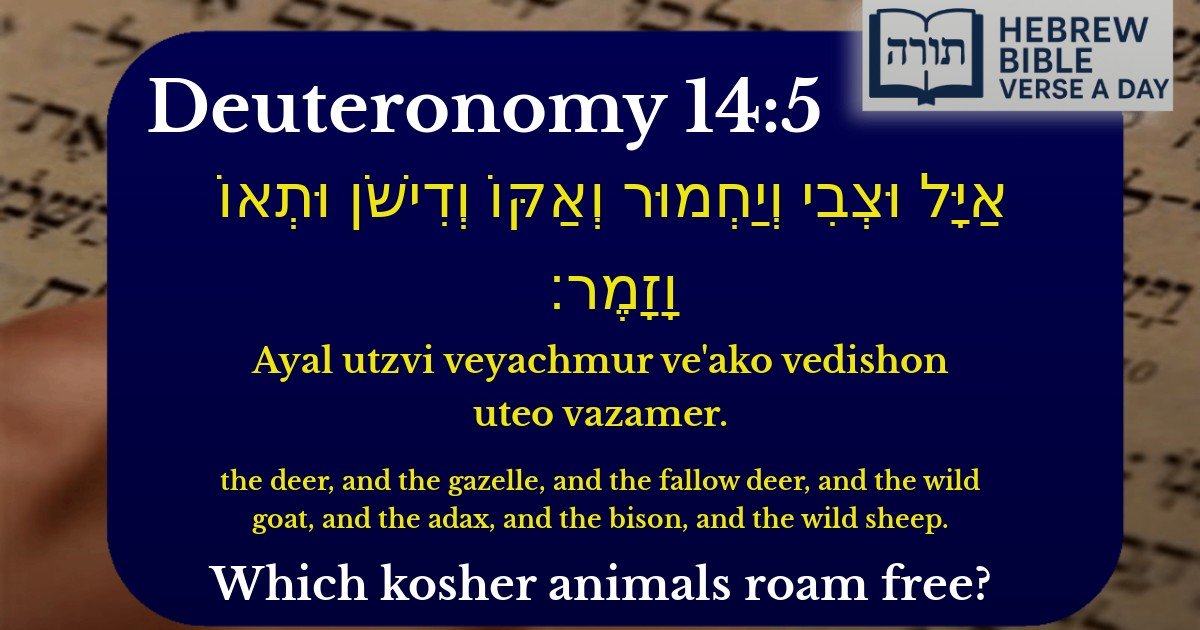
אַיָּל וּצְבִי וְיַחְמוּר וְאַקּוֹ וְדִישֹׁן וּתְאוֹ וָזָמֶר׃
English Translation
the deer, and the gazelle, and the fallow deer, and the wild goat, and the adax, and the bison, and the wild sheep.
Transliteration
Ayal utzvi veyachmur ve'ako vedishon uteo vazamer.
Hebrew Leining Text
אַיָּ֥ל וּצְבִ֖י וְיַחְמ֑וּר וְאַקּ֥וֹ וְדִישֹׁ֖ן וּתְא֥וֹ וָזָֽמֶר׃
🎵 Listen to leining
Parasha Commentary
📚 Talmud Citations
This verse is quoted in the Talmud.
📖 Chullin 59b
The verse is referenced in a discussion about the characteristics of kosher animals, specifically regarding the identification of the 'wild goat' (yaḥmur) and other animals listed in the verse.
Interpretation of the Verse from Deuteronomy 14:5
The verse lists seven species of kosher animals that are permitted for consumption according to Jewish law. The Torah specifies these animals to distinguish between what is permitted (kosher) and what is forbidden (non-kosher). Below is an analysis based on traditional Orthodox Jewish sources:
Identification of the Animals
Halachic Significance
The Torah enumerates these species to emphasize that only animals with split hooves and that chew their cud (as per Vayikra 11:3) are permitted. The Talmud (Chullin 59a) derives from this list that any animal possessing these two signs is kosher, even if not explicitly named. The Rambam (Hilchot Ma'achalot Asurot 1:2) codifies this principle, ensuring clarity in halachic practice.
Symbolic Meaning
Midrash Tanchuma (Shemini 6) teaches that kosher animals represent moral lessons. For example, the deer’s swiftness symbolizes the urgency of repentance, while the gazelle’s purity reflects ethical behavior. The Sforno (Devarim 14:5) adds that permitted animals are naturally gentle, reinforcing the Torah’s emphasis on compassion.