

Join Our Newsletter To Be Informed When New Videos Are Posted
Hebrew Text
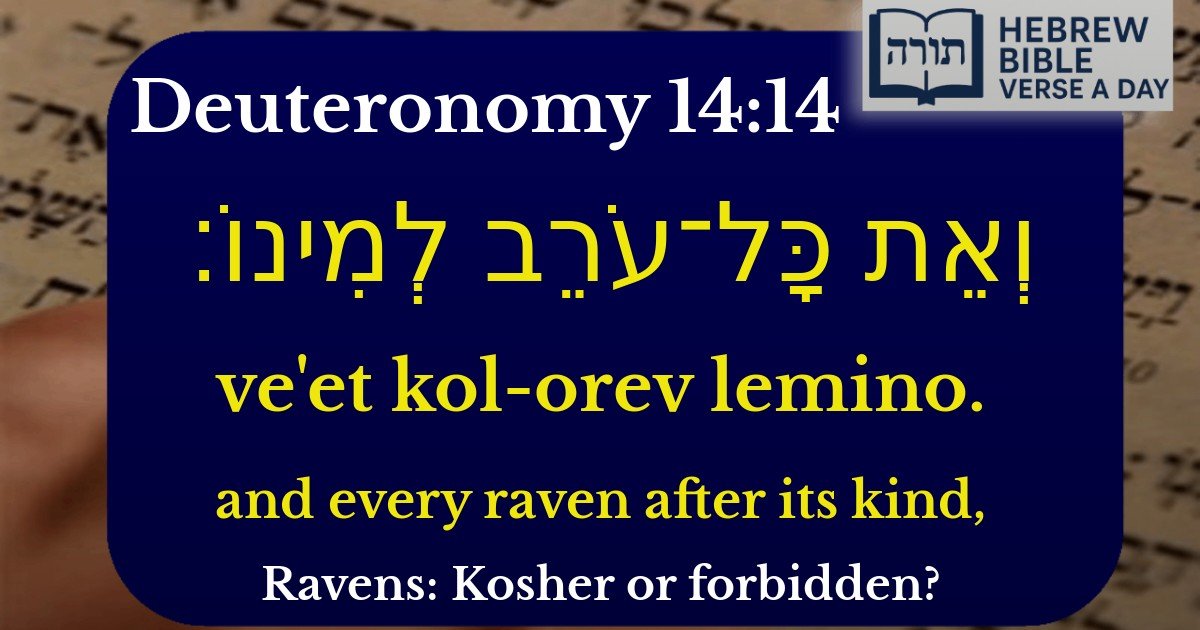
וְאֵת כָּל־עֹרֵב לְמִינוֹ׃
English Translation
and every raven after its kind,
Transliteration
Ve'et kol-orev lemino.
Hebrew Leining Text
וְאֵ֥ת כׇּל־עֹרֵ֖ב לְמִינֽוֹ׃
🎵 Listen to leining
Parasha Commentary
📚 Talmud Citations
This verse is not quoted in the Talmud.
Understanding the Phrase "וְאֵת כָּל־עֹרֵב לְמִינוֹ"
The verse "וְאֵת כָּל־עֹרֵב לְמִינוֹ" ("and every raven after its kind") appears in Vayikra (Leviticus) 11:15, within the context of the Torah's listing of non-kosher birds. The raven (orev) is singled out as forbidden for consumption, along with other birds of prey or scavengers.
Rashi's Commentary on the Raven
Rashi (Vayikra 11:15) explains that the raven is included among the non-kosher birds due to its predatory and cruel nature. He notes that the raven does not show mercy even to its own offspring, a trait that renders it spiritually unfit for consumption. This aligns with the broader Torah principle that kosher animals and birds must exhibit traits of compassion and docility.
Midrashic Insights
The Midrash (Bereishit Rabbah 33:5) elaborates on the raven’s behavior during the time of Noach. When Noach sent the raven from the Ark, it refused to fulfill its mission of scouting for dry land, demonstrating its untrustworthy nature. This Midrash reinforces the idea that the raven’s character traits make it unsuitable for consumption.
Halachic Implications
Rambam (Hilchot Ma’achalot Asurot 1:15) categorizes the raven as one of the birds explicitly prohibited by the Torah. The phrase "לְמִינוֹ" ("after its kind") indicates that all species resembling the raven in behavior or physical characteristics are likewise forbidden, unless tradition explicitly identifies them as kosher.
Symbolic Meaning