Frequently Asked Questions
Q: Why are the stork, heron, hoopoe, and bat listed as non-kosher birds in Deuteronomy 14:18?
A: These birds are listed as non-kosher because they possess traits that make them unfit for consumption according to Torah law. The Talmud (Chullin 63a) explains that non-kosher birds are typically predators or exhibit cruel behavior. The stork, for example, is called 'chasida' (kind one) in Hebrew because it shows kindness to its own kind, but it is still non-kosher because it preys on other creatures.
Q: What is the significance of the phrase 'after its kind' in Deuteronomy 14:18?
A: The phrase 'after its kind' teaches that all varieties within these bird species are non-kosher. Rashi explains that this includes all similar species that share the same characteristics. The Torah specifies this to prevent confusion - if one sees a bird similar to a heron, they should know it's also forbidden.
Q: Why is the bat listed with birds when it's actually a mammal?
A: Although scientifically classified as a mammal, the Torah lists the bat with birds because in biblical taxonomy, flying creatures are categorized together. The Rambam (Hilchot Ma'achalot Asurot 1:15) explains that the Torah's classification is based on observable characteristics - since bats fly like birds, they are grouped accordingly for dietary laws.
Q: What lesson can we learn from the non-kosher birds listed in Deuteronomy 14:18?
A: The Midrash teaches that the dietary laws come to refine our character. Non-kosher birds often represent negative traits we should avoid. For example, the stork (chasida) shows selective kindness only to its own kind, teaching us that true kindness must be universal. The bat, which is neither fully bird nor mammal, warns against inconsistent behavior in serving Hashem.
Q: How do we identify non-kosher birds today based on this verse?
A: The Talmud (Chullin 59a, 63b) establishes signs to identify non-kosher birds: those that prey on other animals, have an extra toe, or can't perch properly. Since we've lost the tradition for many species, Orthodox practice only permits eating birds with a clear mesorah (tradition) of being kosher. The birds listed in our verse serve as examples of forbidden species.


Overview of the Verse
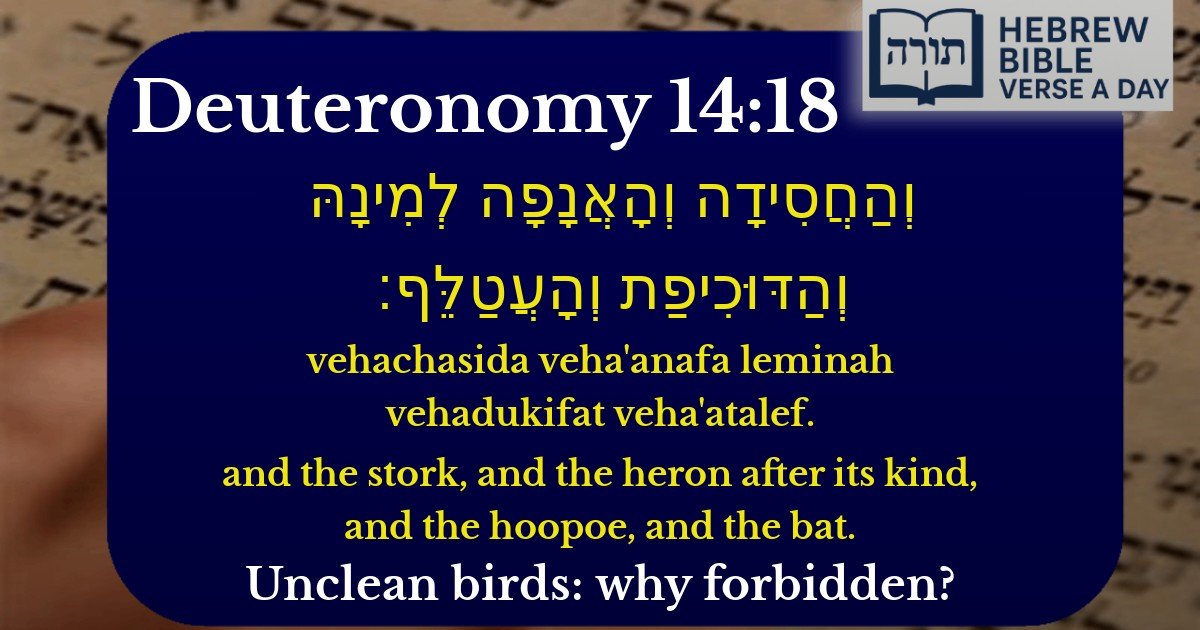
The verse lists certain non-kosher birds, including the chasidah (stork), anafah (heron), duchifat (hoopoe), and atalef (bat). These are among the species prohibited for consumption according to the Torah's dietary laws (Vayikra 11:19, Devarim 14:18). The inclusion of these birds highlights the Torah's detailed categorization of permitted and forbidden creatures.
The Chasidah (Stork)
Rashi (Vayikra 11:19) explains that the chasidah is named for its trait of chesed (kindness), as it shares food with its fellow birds. However, despite this positive trait, it remains non-kosher. The Talmud (Chullin 63a) notes that the stork's kindness is limited to its own kind, implying a lack of universal compassion, which may be why it is unfit for consumption.
The Anafah (Heron)
The anafah is identified as a heron-like bird. The Talmud (Chullin 63a) associates it with being quarrelsome (anaf meaning "anger"), suggesting its aggressive nature. Rambam (Hilchot Ma'achalot Asurot 1:15) lists it among the forbidden birds due to its predatory habits.
The Duchifat (Hoopoe)
The duchifat (hoopoe) is known for its distinctive crown-like crest. The Midrash (Bereishit Rabbah 19:5) connects it to King Solomon’s wisdom, as it was one of the creatures he studied. Despite this, it is non-kosher. The Talmud (Chullin 65a) discusses its identifying features, such as its split toes, which are signs of a non-kosher bird.
The Atalef (Bat)
The atalef (bat) is unique as it is the only flying mammal listed among birds. The Talmud (Bava Batra 73b) describes its unusual nature, and Rambam (Hilchot Ma'achalot Asurot 1:16) confirms its prohibition. Though it resembles a bird in flight, its mammalian traits (e.g., live birth) disqualify it from being kosher.
Halachic Significance