Frequently Asked Questions
Q: What does the verse 'Only thou shalt not eat its blood; thou shalt pour it upon the ground like water' mean?
A: This verse from Deuteronomy 12:16 (not 15:23) prohibits consuming the blood of an animal, which is considered sacred to Hashem (Leviticus 17:11). Instead, the blood must be poured out on the ground like water, showing respect for life. Rashi explains that this teaches us to treat blood with reverence, as it represents the soul (nefesh) of the creature.
Q: Why is the prohibition against eating blood important in Judaism?
A: The Torah repeatedly forbids eating blood (e.g., Leviticus 7:26-27) because it symbolizes life, which belongs solely to Hashem. The Rambam (Hilchot Ma'achalot Asurot 6:1) states that this mitzvah reinforces the sanctity of life and reminds us that only Hashem has ultimate dominion over it. The Talmud (Chullin 117a) also discusses the severity of this prohibition.
Q: How do we apply the commandment to pour out blood 'like water' today?
A: In practical halacha (Jewish law), this verse teaches the proper method of kosher slaughter (shechita) and meat preparation. The Shulchan Aruch (Yoreh De'ah 65-66) details how blood must be drained and removed through salting or roasting. This ensures we fulfill the Torah's command to treat blood with respect and avoid consuming it.
Q: What spiritual lesson can we learn from not eating blood?
A: The Midrash (Sifrei Devarim 12:23) teaches that abstaining from blood elevates us above animal instincts, reminding us that human life has a divine purpose. By controlling our physical desires (like avoiding blood), we grow spiritually. The Sefer HaChinuch (Mitzvah 148) adds that this mitzvah cultivates compassion by making us conscious of the sacredness of all life.
Q: Does this verse apply to all types of blood?
A: The prohibition specifically applies to the blood of kosher animals and birds (Rambam, Hilchot Ma'achalot Asurot 6:1). Fish blood is permitted (Talmud Chullin 111b), and human blood is addressed under separate halachic guidelines. The verse emphasizes that even permitted meat must be prepared in a way that honors the Torah's restrictions on blood.

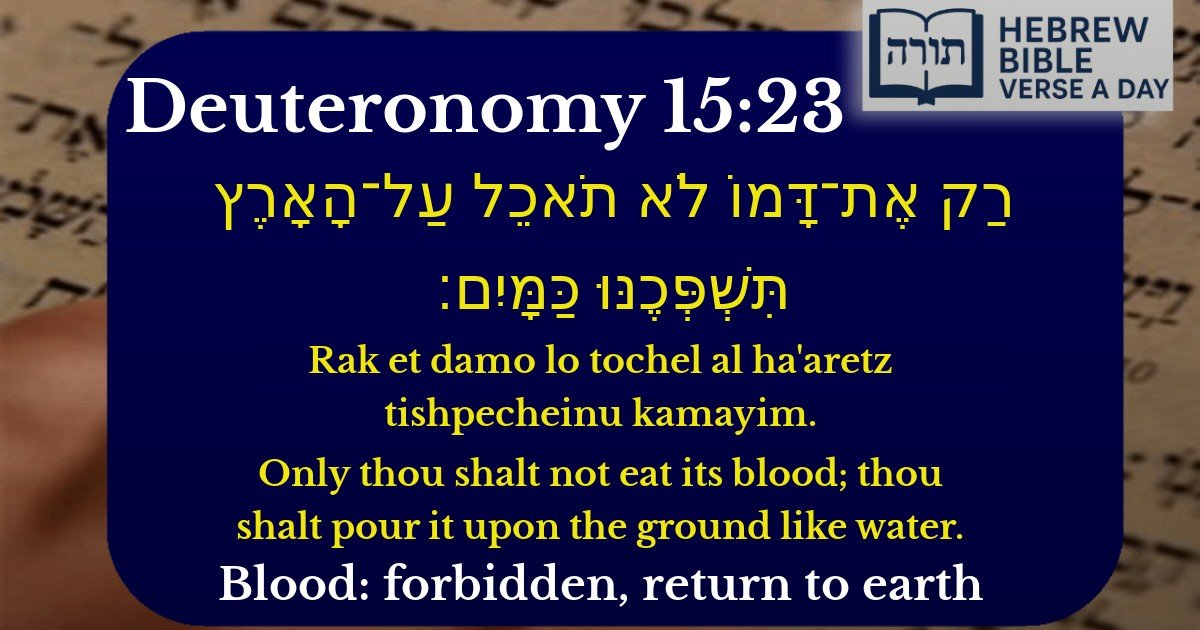

Prohibition of Consuming Blood
The verse (Devarim 12:16) prohibits the consumption of blood, commanding that it be poured on the ground like water. This prohibition is rooted in the sanctity of blood as the nefesh (life force) of the animal, as stated in Vayikra 17:11: "For the life of the flesh is in the blood." Rashi explains that the Torah emphasizes this prohibition with the word רק ("only") to teach that while certain parts of the animal may be permitted, the blood is strictly forbidden.
Symbolic Act of Pouring Blood
The instruction to pour the blood on the ground like water is interpreted by the Rambam (Hilchot Ma'achalot Asurot 6:1) as a means of demonstrating reverence for life. By treating the blood as something to be discarded rather than consumed, we acknowledge that the life force belongs to Hashem alone. The Talmud (Chullin 84a) further elaborates that this act ensures the blood is not misused for idolatrous practices, which were common among ancient nations.
Halachic Implications
Midrashic Insight
The Midrash (Sifrei Devarim 75) compares pouring out blood to water to teach that just as water sustains all life, blood—representing the life given by Hashem—must be returned to the earth in a respectful manner. This reflects the broader Torah principle of bal tashchit (avoiding wastefulness) and gratitude for Divine creation.