Frequently Asked Questions
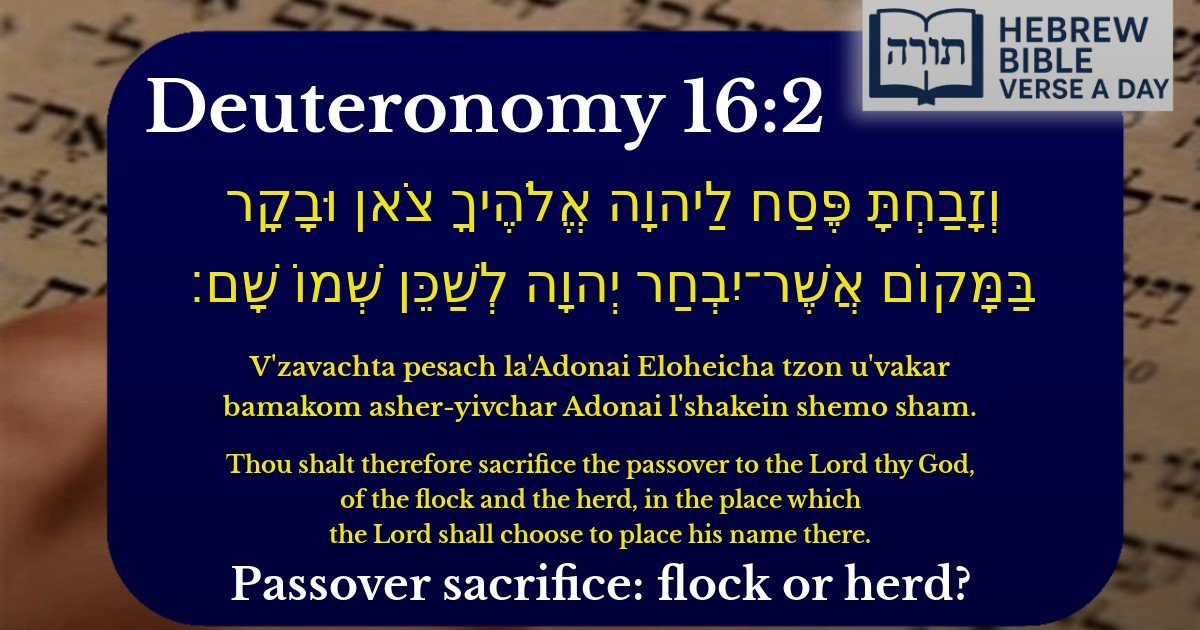
Q: What does Deuteronomy 16:2 mean?
A: Deuteronomy 16:2 commands the Jewish people to bring the Passover sacrifice (Korban Pesach) to Hashem in the place He designates—later understood as the Temple in Jerusalem. The verse specifies that the sacrifice can be from either sheep or cattle (though historically, it was primarily from sheep). Rashi explains that 'the place which Hashem shall choose' refers to the future site of the Beit HaMikdash (Holy Temple).
Q: Why is the Passover sacrifice important in Judaism?
A: The Passover sacrifice commemorates the Exodus from Egypt, when Hashem 'passed over' Jewish homes during the final plague. The Rambam (Hilchot Korban Pesach) teaches that this mitzvah reinforces our gratitude for redemption and our connection to Hashem. It was a central ritual performed in the Temple era, and today, we remember it during the Seder through the roasted shankbone (zeroa).
Q: Why does the verse mention both sheep and cattle for the Passover sacrifice?
A: While the original Passover in Egypt used only sheep (Exodus 12:5), this verse expands the option to cattle to accommodate larger crowds in the Temple era (Chizkuni). However, the Talmud (Pesachim 70b) notes that sheep remained the preferred choice, as cattle were more expensive and less practical for family groups.
Q: What can we learn from 'the place Hashem shall choose' in this verse?
A: This phrase teaches the importance of centralized worship in Judaism. Unlike idolatrous practices done anywhere, serving Hashem requires following His designated place—first the Mishkan (Tabernacle) and later the Beit HaMikdash (Temple) in Jerusalem (Ramban). Today, while we pray everywhere, we still face Jerusalem, remembering this ideal.
Q: How do Jews observe this verse today without the Temple?
A: Since we cannot currently bring the Passover sacrifice without the Temple, we fulfill this mitzvah symbolically at the Seder. The zeroa (roasted bone) on the Seder plate represents the Korban Pesach, and we recite prayers about its restoration. The Rambam (Melachim 11:1) teaches that when the Temple is rebuilt, this commandment will be observed again as written.


Understanding the Verse in Context
The verse (Devarim 16:2) commands the offering of the Korban Pesach (Passover sacrifice) to Hashem, specifying that it must be brought from the flock or the herd in the place where Hashem chooses to establish His name—referring to the Beit HaMikdash (Holy Temple) in Yerushalayim. This mitzvah is central to the observance of Pesach and is rooted in the Exodus narrative, commemorating our redemption from Mitzrayim (Egypt).
Rashi's Commentary
Rashi (Devarim 16:2) clarifies that the phrase "צֹאן וּבָקָר" (flock and herd) initially seems contradictory, since the Korban Pesach must be a lamb or goat (from the flock). He resolves this by explaining that the verse refers to two separate offerings:
Rambam's Halachic Perspective
In Hilchot Korban Pesach (1:1), the Rambam emphasizes that the Korban Pesach is a unique obligation incumbent upon every Jewish male. He notes that it must be slaughtered "in the place which Hashem shall choose"—meaning exclusively in the Beit HaMikdash—and cannot be offered elsewhere, unlike some other korbanot which had provisional allowances before the Temple was built.
The Significance of the Location
The phrase "לְשַׁכֵּן שְׁמוֹ שָׁם" (to place His name there) is a recurring theme in Devarim, referring to the Divine Presence resting in the Beit HaMikdash. The Talmud (Zevachim 119a) derives from this that the Korban Pesach may only be slaughtered in the Azarah (Temple courtyard) and must be eaten within the walls of Yerushalayim, underscoring the sanctity of the place.
Midrashic Insights
The Midrash (Sifrei Devarim 130) connects this verse to the broader theme of aliyah l'regel (pilgrimage to Yerushalayim for the festivals). It teaches that bringing the Korban Pesach in the designated place fosters unity among Klal Yisrael, as all gather in obedience to Hashem’s command, reenacting the communal sacrifice of the first Pesach in Mitzrayim.
Practical Halachic Implications