Frequently Asked Questions
Q: What does Deuteronomy 24:16 mean?
A: Deuteronomy 24:16 teaches that in Jewish law, a person cannot be punished for someone else's sins. Fathers cannot be executed for the sins of their children, and children cannot be executed for the sins of their fathers. Each person is responsible only for their own actions. This principle is fundamental to Torah justice, as explained by Rashi and other commentators.
Q: Why is this verse important in Judaism?
A: This verse is important because it establishes the Torah's principle of individual accountability. The Rambam (Maimonides) cites this law in his legal works, showing that justice must be fair and personal. It prevents collective punishment and ensures that only the guilty party bears responsibility for their actions, a cornerstone of Jewish ethics and halacha (Jewish law).
Q: How does this verse apply today?
A: Today, this verse reminds us that we cannot blame others for our mistakes, nor can we be held responsible for the actions of our family members. In Jewish thought, each person must take ownership of their deeds. The Talmud (Sanhedrin 27b) discusses this concept extensively, emphasizing personal repentance and accountability in spiritual growth.
Q: Does this mean children are never punished for parents' sins?
A: While Deuteronomy 24:16 prohibits human courts from punishing children for parents' sins, the Torah does mention (Exodus 20:5) that God may allow consequences to affect future generations for idolatry. However, as Rashi explains, this only applies when descendants continue the sinful ways of their ancestors. Ultimately, repentance can break this cycle, as taught in Ezekiel 18:20.
Q: What can we learn from this verse about justice?
A: We learn that true justice must be individual and precise. The Sages derive from this verse that courts must carefully examine each case on its own merits. The Midrash (Sifrei Devarim) connects this to the idea that judges must be extremely careful when administering capital punishment, ensuring no innocent person is ever punished for another's crime.

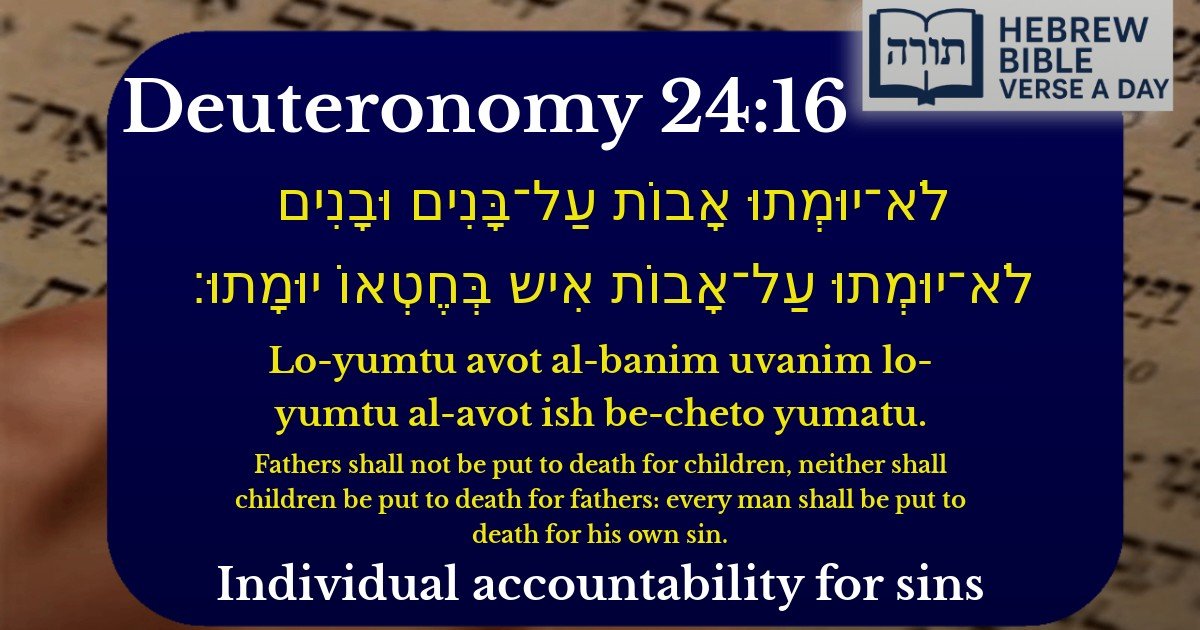

Interpretation of the Verse (Devarim 24:16)
The verse states: "Fathers shall not be put to death for children, neither shall children be put to death for fathers: every man shall be put to death for his own sin." This principle is foundational in Jewish law, emphasizing individual accountability in divine justice.
Rashi's Explanation
Rashi (Devarim 24:16) explains that this verse teaches that a father cannot be punished for the sins of his son, nor a son for the sins of his father. This is in contrast to the way human courts might operate, where family members could sometimes be held accountable for one another. However, divine justice operates differently, as each person is judged solely for their own actions.
Rambam's Legal Perspective
Rambam (Hilchos Sanhedrin 12:4) codifies this principle in halachah, stating that a court may not execute or punish a person for the sins of their relatives. This applies even in cases where a parent or child is guilty of a capital crime—each individual is judged independently.
Talmudic Discussion (Sanhedrin 27b)
The Talmud discusses this verse extensively, emphasizing that only the sinner themselves may be punished. The Gemara raises a question regarding cases where a father and son are both witnesses to a crime—can they testify together? The conclusion is that they may not serve as witnesses in a capital case, as their familial relationship could bias their testimony, but this is unrelated to the principle of individual punishment.
Midrashic Insights
The Midrash (Sifrei Devarim 280) connects this verse to the broader theme of divine justice and fairness. It contrasts human courts, which may lack complete knowledge, with Hashem’s perfect judgment, where no innocent person is held accountable for another’s wrongdoing. The Midrash also notes that this principle reinforces the idea of teshuvah (repentance), as each person has the opportunity to rectify their own actions without being burdened by the sins of others.
Exceptions and Nuances