Frequently Asked Questions
Q: What does Deuteronomy 26:1 mean?
A: Deuteronomy 26:1 is part of Moshe's instructions to the Jewish people before entering the Land of Israel. It explains that once they inherit and settle in the land, they must bring the first fruits (Bikkurim) to the Temple as an expression of gratitude to Hashem. Rashi explains that this mitzvah applies only after the land is fully conquered and divided among the tribes.
Q: Why is this verse important?
A: This verse introduces the mitzvah of Bikkurim (first fruits), which teaches us the importance of recognizing Hashem as the true source of our blessings. The Rambam (Hilchot Bikkurim 1:1) explains that this mitzvah instills humility and gratitude, as one acknowledges that everything comes from Hashem.
Q: What can we learn from Deuteronomy 26:1 today?
A: Even though we currently lack the Temple and cannot bring Bikkurim, the lesson remains relevant. The Sages teach that we should always express gratitude to Hashem for our sustenance. Today, this can be done through blessings (brachot) over food, giving tzedakah, or simply recognizing Hashem's kindness in our lives.
Q: Why does the verse say 'when you come into the land' and not 'if'?
A: The Torah uses the term 'when' (וְהָיָה כִּי) to emphasize that entering the Land of Israel was a certainty, as Hashem had promised this to Avraham, Yitzchak, and Yaakov. The Talmud (Sotah 14a) explains that dwelling in Eretz Yisrael is a fundamental part of Jewish identity and destiny.
Q: How does this verse connect to the Jewish people's relationship with the Land of Israel?
A: This verse highlights that the Land of Israel is a divine gift (נַחֲלָה - inheritance) to the Jewish people. The Midrash (Sifrei Devarim) explains that our right to the land is conditional upon fulfilling the Torah's commandments. The mitzvah of Bikkurim demonstrates our acknowledgment that the land and its produce ultimately belong to Hashem.

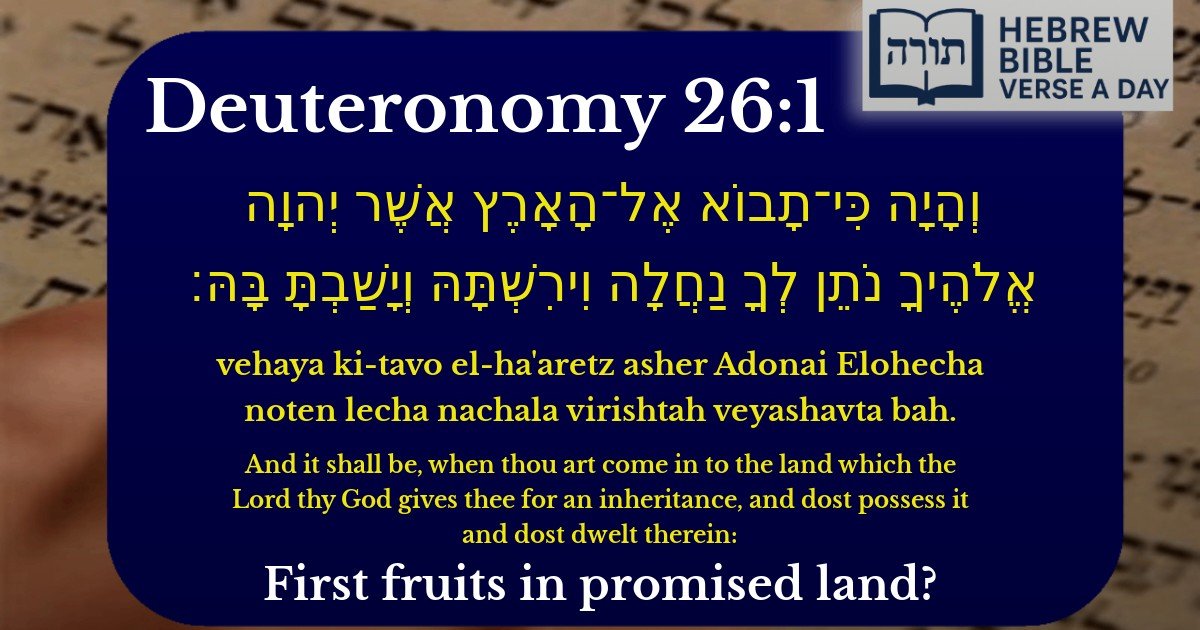

Context in Sefer Devarim
This verse (Devarim 26:1) opens the section discussing the mitzvah of Bikkurim (first fruits) and the declaration made when bringing them to the Beit HaMikdash. It follows the broader themes of Sefer Devarim, where Moshe prepares Bnei Yisrael for entering Eretz Yisrael and establishing a society based on Torah values.
Rashi's Explanation
Rashi notes that the phrase "וְהָיָה כִּי־תָבוֹא" ("And it shall be, when you come") uses the term "והיה" (which implies joy) rather than "והי" (which could imply suffering). This teaches that entering Eretz Yisrael is inherently a joyous occasion, as it fulfills the divine promise to the Avot. The double language of "וִירִשְׁתָּהּ וְיָשַׁבְתָּ בָּהּ" ("and dost possess it and dost dwell therein") indicates that the mitzvah of Bikkurim applies only after both conquest (kibbush) and settlement (chazakah) are complete.
Rambam's Perspective
In Hilchot Bikkurim (1:1-2), Rambam derives from this verse that the obligation of Bikkurim begins only after the complete conquest and division of the land during the time of Yehoshua. This demonstrates how physical possession of the land is intrinsically connected to the spiritual mitzvot tied to it.
Midrashic Insights
Halachic Implications
The Kessef Mishneh notes that the sequence in this verse establishes important halachic principles: First comes the divine gift ("נֹתֵן לְךָ נַחֲלָה"), then human effort ("וִירִשְׁתָּהּ"), followed by settled dwelling ("וְיָשַׁבְתָּ בָּהּ") - showing the partnership between heavenly assistance and human responsibility in acquiring Eretz Yisrael.
Chassidic Interpretation
The Sfat Emet reads this verse as addressing every Jew's spiritual journey: The "land" represents one's potential in avodat Hashem, which must first be recognized as a divine gift ("נֹתֵן לְךָ"), then actively acquired through personal effort ("וִירִשְׁתָּהּ"), until one can fully "dwell" in their spiritual achievements.